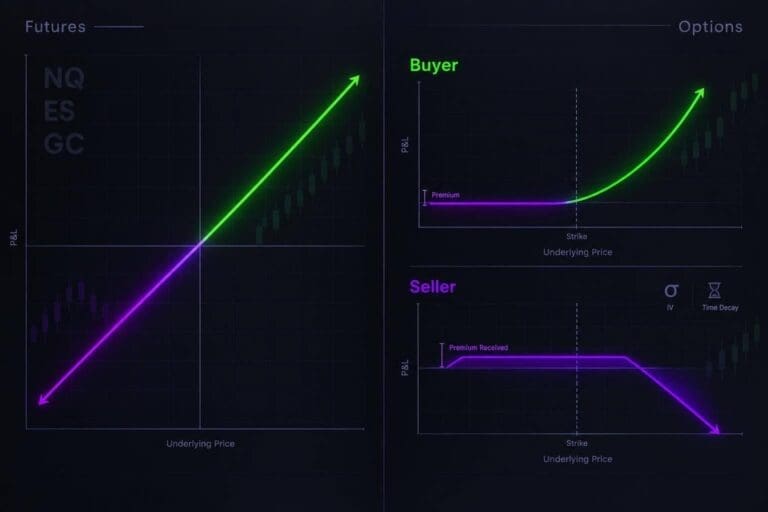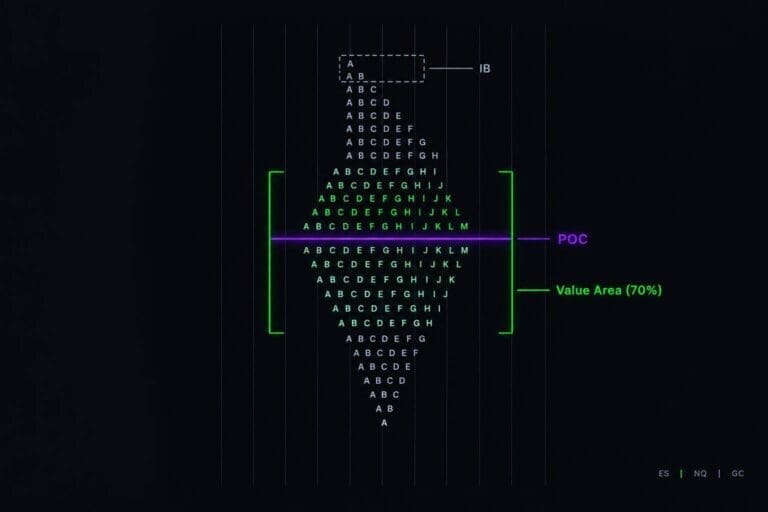
My take: if you trade index moves, futures are the better day-trading tool. If you trade earnings pops, sector runners, or single-name news, stocks still make more sense.
I’m going to keep this tight. You’ll get the plain-English split on hours, leverage, sizing, shorting, and cost drag, including how futures drawdown works plus where each market fits better for risk management for funded accounts. The big point is simple: more leverage doesn’t mean a better market. The right pick is the one that matches your setup and doesn’t screw up your execution.
Why Day Traders Compare Futures and Stocks
For day traders, futures vs. stocks changes trading hours, capital needs, leverage, and execution. Those aren’t small details. They decide whether your setup is easy to run or a pain in the ass before you even click buy or sell.
Pick the wrong market, and the structure works against you from the start. So the next question is simple: what are you actually trading, and how does that affect size and execution?
What You Are Actually Trading
The biggest structural difference is position unit size.
When you trade stocks or ETFs like AAPL or SPY, you’re buying and selling shares. You can buy 1 share, 47 shares, or 500 shares. That makes sizing simple. You can dial it in pretty tightly.
Futures work differently. Each contract is a fixed, standardized unit. One E-mini S&P 500 (ES) contract is worth $50 per point and $12.50 per tick [6][7]. The Micro E-mini S&P 500 (MES) is one-tenth the size, worth $5 per point and $1.25 per tick [6].
You can’t trade half a contract. That’s the catch. So futures sizing gives you less room to fine-tune than stocks do. Micro contracts like MES and MNQ help a lot, especially for smaller accounts, but they still don’t match the share-by-share control you get with stocks.
This matters most when you need tight sizing and fast entries without messing around.
Who This Comparison Is For
This gap matters most for active traders who need repeatable intraday setups.
This guide is for active U.S. day traders who place multiple trades per week and need to know what each market costs in time, capital, and execution friction. That includes traders looking at top futures prop firms and smaller-account traders who spent years getting boxed out by FINRA’s Pattern Day Trader (PDT) rule. Quick reality check: that rule is gone. FINRA eliminated the $25,000 PDT minimum and the day-trade count effective June 4, 2026, replacing them with intraday margin standards [8]. Futures never had a PDT rule to begin with [1][6].
If you trade single names, stocks usually make more sense. If you trade index moves or macro data, futures are usually the better tool.
sbb-itb-46ae61d
Trading Hours and Liquidity: How Each Market Affects Your Day
Futures trade almost 23 hours a day. Stocks mostly trade from 9:30 AM to 4:00 PM ET [1][3]. For day traders, that matters because trading hours shape when you get clean liquidity and when your fills start getting sloppy.
Still, more hours doesn’t automatically mean better execution.
Futures Trading Hours vs. Stock Market Hours
CME Globex runs from Sunday 6:00 PM ET through Friday 5:00 PM ET, with a short daily maintenance break from 5:00 PM to 6:00 PM ET [1][3]. That gives futures traders access when overseas markets move or when news hits after the stock market shuts down.
The U.S. stock market’s main session runs from 9:30 AM to 4:00 PM ET. Yes, extended-hours trading exists. No, it doesn’t trade like the regular session. Liquidity is thinner, and spreads are wider outside normal market hours [1][2].
Futures aren’t evenly liquid all day either. Outside the U.S. session, volume drops off. The weakest stretch is usually during the Asian session and early Europe, about 8:00 PM to 3:00 AM ET. That’s when spreads tend to widen and fills can get worse [3][7].
The better windows are pretty clear:
- 9:30 AM ET, when the U.S. cash session opens
- Major data times at 8:30 AM, 10:00 AM, and 10:30 AM ET
- The Europe/U.S. overlap from 8:00 AM to 11:00 AM ET [3]
That’s when the market usually has more depth, tighter spreads, and cleaner movement.
Liquidity, Spreads, and Order Book Structure
Futures like ES and MNQ trade on one centralized CME Globex order book [1][4]. Stocks and ETFs like AAPL and SPY trade across multiple exchanges and ECNs, so the liquidity is split up [1][4]. That difference matters.
With futures, you’re looking at one book and one tape. It’s cleaner. In stock names, the picture is more scattered. That’s part of why ES plays such a big role in S&P 500 price discovery. High-volume index futures also tend to keep spreads tight, with ES and MES often sitting at a one-tick spread [3].
Micro contracts also changed the game for smaller accounts. As of late 2025, Micro E-mini volume made up over 45% of all Equity Index futures volume. MNQ averaged about 2.2 million contracts per day, and MES averaged about 1.6 million [3].
That isn’t niche volume. That’s enough flow to matter.
Here’s what that looks like in ES/MNQ versus SPY/AAPL.
Hours and Liquidity Comparison: ES/MNQ vs. SPY/AAPL
| Feature | Futures (ES/MNQ) | Stocks/ETFs (SPY/AAPL) |
|---|---|---|
| Trading Hours | ~23 hrs/day, Sun 6:00 PM – Fri 5:00 PM ET | 6.5 hrs core, 9:30 AM – 4:00 PM ET |
| Liquidity Structure | Centralized (CME Globex) | Fragmented (multiple exchanges/ECNs) |
| Typical Spread | Often 1 tick on ES/MES | Tightest during core hours; wider in extended hours |
| Overnight Access | High; can react to global news | Limited; extended hours are thinner |
| Best Liquidity Window | U.S. open and major data releases | Regular trading hours, especially the open |
| Tape Clarity | Unified tape; cleaner order flow | Fragmented depth; less uniform view |
If you care about trading around news, overnight moves, or the open, futures give you more access and a cleaner book. Stocks still do fine during regular hours, but outside that window the experience drops off fast.
Hours and liquidity matter, but margin and capital efficiency usually decide which market is easier to trade with your account size.
Leverage, Margin, and Capital Efficiency: Futures vs. Stocks
Once trading hours and liquidity are sorted, margin is what tells you how much market you can actually control. It sets your size. It also decides how much pain your account can take before you’re forced out.
Futures Margin vs. Stock Margin
Stock day traders can get up to roughly 4:1 intraday leverage under standard broker margin rules [1]. Since June 4, 2026, that intraday buying power is based on your real-time margin excess instead of the old PDT day-trading formula, and your broker’s house margin rules set the actual ceiling [8]. So if you’ve got a $10,000 margin account, you can control up to about $40,000 in stock positions. Futures don’t work like that. Futures margin is a performance bond, not a loan [3].
That difference matters.
One E-mini S&P 500 (ES) contract at an index level of 5,500 gives you $275,000 in notional exposure, and a one-point move is worth $50 per contract [7]. That’s a lot of size from one contract. In practice, futures often give traders 20:1 to 50:1 leverage, based on the contract and broker [1].
Stocks used to come with the $25,000 PDT minimum if you wanted to day trade often. Not anymore. FINRA killed the PDT rule and the day-trade count effective June 4, 2026 [8], so a stock margin account now just needs the standard $2,000 minimum equity plus enough equity to cover whatever you’re holding intraday. One catch: brokers have until October 20, 2027 to fully phase in the new framework, so confirm where yours stands. Futures never had a PDT rule, so you’ve always been able to stay active with a small account there as long as you meet the margin requirement [1] [6].
Intraday Margin vs. Overnight Requirements
This is where a lot of traders get clipped. Low intraday futures margin usually expires at the broker cutoff, around 5:00 PM ET [1] [7]. Hold past that, and you’ll usually need the full exchange initial margin, which is often around $12,000 to $16,000 for one ES contract [7]. That’s a big jump.
Stock margin is more straightforward. Under Regulation T, overnight positions usually need 50% of the position value [1] [6].
The upside in futures is obvious: less cash tied up during the day. The downside is just as obvious. A small move against you can wipe out that intraday margin deposit fast [7]. So no, maxing out the contracts your broker allows is not a trading plan. Position sizing matters more.
Leverage and Capital Requirements Comparison Table
Here’s the clean side-by-side view.
| Feature | Stock Day Trading | Futures Day Trading |
|---|---|---|
| PDT Rule | Eliminated June 4, 2026; replaced by intraday margin standards [8] | Never applied [1] [6] |
| Typical Intraday Leverage | Up to 4:1 [1] | 20:1 to 50:1 [1] |
| Margin Type | Loan (Reg T) [1] [6] | Performance Bond [3] |
| Typical Starting Capital | No PDT minimum since June 4, 2026 [8]; $2,000 standard margin-account floor, broker house minimums may be higher | $500–$2,500 for Micro contracts [1] [3] |
| Intraday Margin (example) | 25% of share value [1] | $50–$100 (MES), $500–$1,500 (ES) [3] |
| Overnight Margin | 50% of position value (Reg T) [1] [6] | Exchange initial margin (~$12,000–$16,000 for ES) [7] |
| Auto-Liquidation Risk | Moderate | High; small moves can trigger auto-liquidation [7] |
Futures are more capital-efficient. That’s the good part. The bad part is simple: that same leverage makes oversizing a fast way to blow yourself up. Next: how tick size, short selling, and execution change the tradeoff.
Execution, Tick Size, and Short Selling: Key Differences
Tick size, short-selling rules, and execution quality decide how clean your entries and exits are. After you figure out size, the next thing that matters is precision. How tight can you get in? How clean can you get out? And can you flip short without extra nonsense?
Tick Size and Position Sizing
Futures move in fixed increments called ticks, and each tick has a set dollar value. For the E-mini S&P 500 (ES), one tick is 0.25 index points, worth $12.50 per contract [3][7]. The Micro E-mini S&P 500 (MES) uses the same tick size, but the tick value drops to $1.25, which makes it easier to handle in a smaller account [3][7]. The Micro Nasdaq-100 (MNQ) moves $0.50 per tick, while the full-size NQ moves at $5.00 per tick [3][5].
| Contract | Tick Size | Tick Value | Point Value |
|---|---|---|---|
| E-mini S&P 500 (ES) | 0.25 | $12.50 | $50.00 |
| Micro E-mini S&P 500 (MES) | 0.25 | $1.25 | $5.00 |
| E-mini Nasdaq-100 (NQ) | 0.25 | $5.00 | $20.00 |
| Micro Nasdaq-100 (MNQ) | 0.25 | $0.50 | $2.00 |
Stocks let you size share by share, so you can fine-tune risk in smaller steps. Futures don’t. You’re dealing with whole contracts.
That matters fast. If your stop is 10 points on one ES contract, your risk is $500 ($50 per point × 10 points). On a $50,000 account, that’s 1% of equity [7]. Clean math. No guesswork.
Sizing is one part of the job. The next split between stocks and futures shows up when you want to get short.
Short Selling in Futures vs. Stocks
Futures are simple here. Shorting works the same both ways: no stock borrow, no locate, no uptick-rule friction [1]. You hit sell, you’re short. That’s it.
Stocks are more annoying. Your broker has to locate shares to borrow before you can short. Easy-to-borrow names are often available with low fees, but hard-to-borrow stocks can come with added costs or not be shortable at all [1]. On top of that, stock traders can run into the Short Sale Rule (SSR) and other uptick-related limits, which can block shorting on the bid during a drop [1].
For intraday traders, that difference is a big deal. If you need to move both ways without extra steps, futures cut out that whole mess. And when price starts moving hard, that cleaner process matters even more.
Slippage and Execution During Fast Markets
Fast markets are where this stuff stops being theory. Futures fill against one centralized book, while stocks are split across venues and can get messier during news [4][1]. For active intraday traders, this is where market choice shows up in actual fills.
During high-impact events like FOMC decisions or CPI releases, futures liquidity can thin out and stops can gap through [6][7]. A lot of day traders flatten before CPI or FOMC because they don’t want the gap risk. That makes sense.
On ES, one tick is $12.50 per contract [3][7]. So a little slippage isn’t always little once you’re trading size. Two or three bad ticks on entry or exit can change the whole trade.
Volatility, Strategy Fit, and Trading Costs
After-hours access, liquidity, and leverage matter. But strategy fit is the last filter that decides whether a market actually works for you. More leverage doesn’t make a market better by default. What matters is simple: does the instrument move in a way your setup can use, and do the trading costs leave enough room for the trade to make sense?
Where Futures Tend to Work Better
Futures usually make more sense when you trade the same setup again and again. You’ve got one central order book, fixed tick sizes, and cleaner index or macro-driven movement. That setup is a good match for traders who want to specialize instead of bouncing between symbols.
ES and NQ are solid for scalping, order flow, and trend continuation. If your style needs bigger intraday movement and harder momentum, NQ or MNQ is usually the better lane. If you’re trading mean reversion and want something a bit steadier, ES or MES tends to fit better [3].
For order-flow scalpers, ZN often gets the nod when you want a slower market with a deeper book. It tends to react in a more repeatable way around macro data, which is exactly what some traders want [3].
This is where futures can shine: the open, scheduled data releases, and repeat reactions around key levels. If your edge comes from seeing the same patterns show up over and over, futures usually beat scattered stock-picking.
Where Stocks Can Still Be the Better Choice
Stocks still have the edge when the trade is about one company, one sector, or one catalyst. If the move is tied to earnings, a news headline, guidance, FDA chatter, or a hot sector rotation, stocks are often the cleaner vehicle.
Gap-and-go setups, earnings trades, and news-driven momentum tend to work best in liquid names like AAPL or in ETFs like SPY, where the catalyst is doing the heavy lifting [2][7].
Put it bluntly: if the move comes from the company or sector itself, stocks still win.
Costs and Volatility Comparison Table
If both markets line up with your style, cost structure becomes the practical tie-breaker. That’s where a lot of traders screw this up. They focus on the setup and ignore the friction.
| Cost or Feature | Stocks (e.g., AAPL, SPY) | Futures (e.g., ES, MNQ) |
|---|---|---|
| Costs | Often $0 commissions; spreads and slippage still matter | Exchange fees plus data costs; tighter execution in liquid contracts |
| Short Selling | Requires borrowing shares; uptick rules can apply [1] | Seamless; no locate or borrowing costs [1] |
| Volatility Fit | Better for catalyst-driven momentum and single-name moves [2][7] | Better for index scalping, order flow, and trend continuation [1][3] |
| Best Intraday Match | Catalyst-driven names | Index/macro setups |
Futures vs. Stocks for Prop-Firm Traders
For prop traders, this comes down to one thing: how tightly you can control risk on each trade. That’s the whole game. Not theory. Not market lore. Just drawdown control, position sizing, and how much rule friction you have to deal with.
Why Futures Fit Prop Trading Best
Futures usually fit prop trading better because smaller contract sizing and simple shorting make drawdown control cleaner. Micro contracts give you more precise risk sizing when you’re trading under tight limits. That’s a big deal when you’re trying to stay steady in both directions during fast sessions.
This hits harder when your firm has rules around:
- daily loss limits
- trailing drawdown
- contract caps
| Symbol | Tick Value |
|---|---|
| ES | $12.50 |
| NQ | $5.00 |
| MES | $1.25 |
| MNQ | $0.50 |
That table tells the story fast. Trading MES instead of ES gives you much finer control. Same idea with MNQ versus NQ. If your account has a tight buffer, that smaller tick value can keep a normal pullback from turning into a rule breach.
When Stocks May Be the Simpler Starting Point
Stocks can still be the simpler starting point if your edge is built around single-name catalysts. In that case, share-based sizing may feel more natural and easier to read on the fly. If you already trade equity setups, stocks can be more straightforward than switching your brain over to fixed contracts.
Tools to Match Size to Risk
Once you know which market fits your style, the next move is simple: match your contract size to your drawdown limit. Use the futures risk management planner and the futures prop firm hub to line up your size with the room you actually have in the account.
Bottom Line: Futures or Stocks for Day Trading?
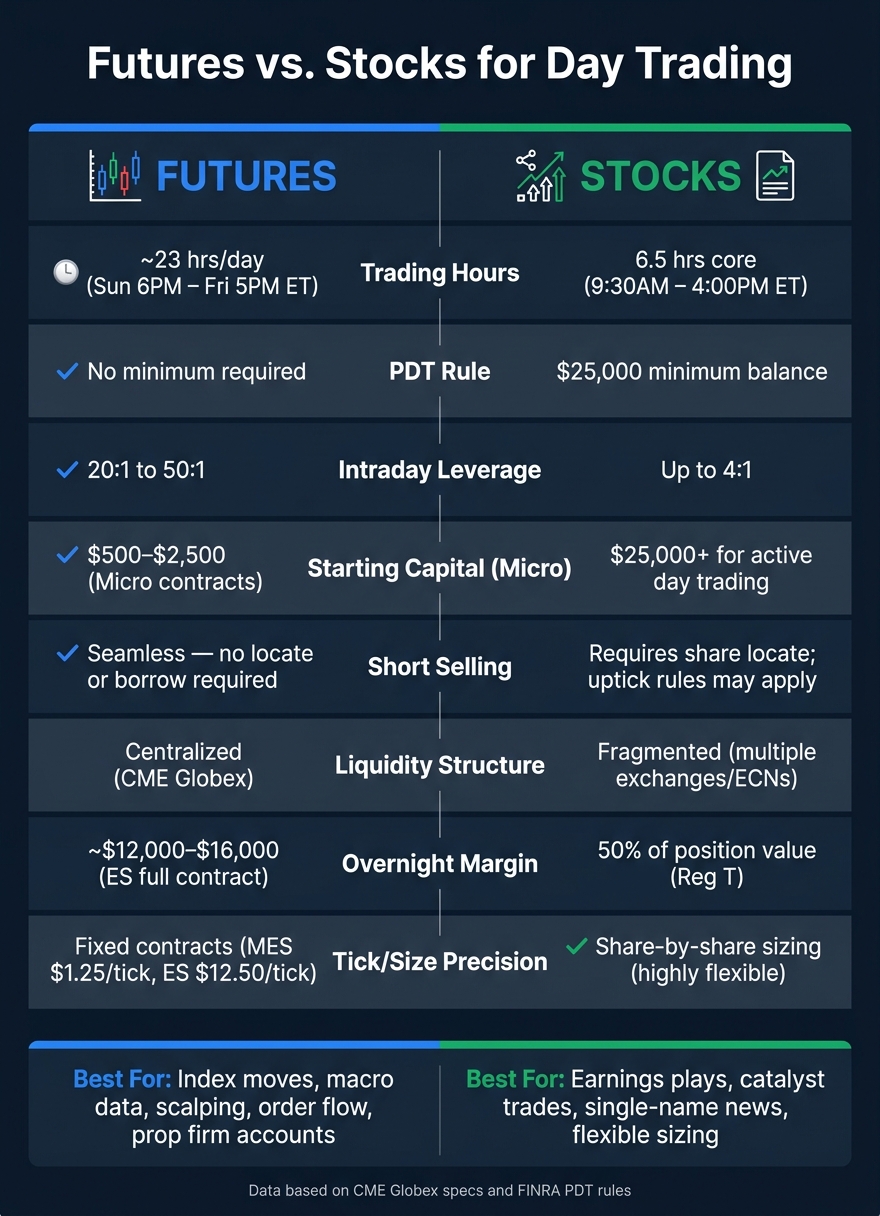
Futures vs Stocks for Day Trading: Side-by-Side Comparison
After stacking up trading hours, liquidity, leverage, and execution, this comes down to the kind of setup you trade.
For most active day traders, futures are the better tool. You get near-24-hour access, easier shorting, and more intraday leverage [1]. That matters. “No PDT rule” used to sit on this list too, but FINRA scrapped the $25,000 minimum for stock margin accounts in June 2026, so that gap has mostly closed [8]. If you trade index moves, futures also tend to show their hand first. In practice, ES often leads broad index action, and SPY will often react to overnight futures moves once the cash open hits [7].
Stocks still make sense if your edge is tied to single-name action. Earnings, news pops, analyst upgrades, weird company-specific moves – that’s stock territory. Stocks also give you more flexibility with share sizing, which can help if you want tighter scaling.
The simple version: use the market that fits your edge, not the one with the biggest leverage pitch.
| If you want… | Choose |
|---|---|
| Near-24-hour access | Futures |
| More intraday leverage | Futures |
| Easy shorting | Futures |
| Earnings and catalyst trades | Stocks |
| Flexible share sizing | Stocks |
FAQs
Which is better for a small account?
For a small account, futures usually make more sense than stocks. The big reason is simple: micro E-mini contracts let you trade with less capital and give you fixed, predictable risk per tick. The old U.S. Pattern Day Trader (PDT) rule used to be the other big reason, but FINRA eliminated the $25,000 minimum for stock margin accounts effective June 4, 2026, so that is no longer a deciding factor.
A practical starting range for MES is often around $500 to $1,500, though $5,000 to $25,000 is a lot more realistic if you want some room to breathe. ES/MNQ micros can also make risk per trade easier to control when you size them right. That said, leverage cuts both ways. It can help, but it can also make losses pile up fast.
Are Micro futures safer than stocks?
Micro futures aren’t automatically safer than stocks. They’re highly leveraged, which means wins and losses can stack up fast. Yes, that includes the risk of losing more than your initial deposit.
What makes them feel easier to handle is the smaller size. You can trade smaller positions and start with less capital. The pattern day trader rule used to be another plus for futures, but FINRA eliminated it for stock margin accounts in June 2026, so that one is off the list. That said, none of that changes the core risk. You still need tight risk management, because volatility can hit hard and you’re trading in a market packed with pros.
How do I choose between index futures and single stocks?
Choose index futures if you want broad market exposure, deep liquidity, and near-24/6 trading. The old U.S. $25,000 Pattern Day Trader rule used to be a reason too, but FINRA eliminated it for stock margin accounts effective June 4, 2026, so it no longer tips the scales.
Choose single stocks if your edge is tied to one company’s price action, especially around earnings or news. If your account is small, micros like MES or MNQ are usually the cleanest place to start.