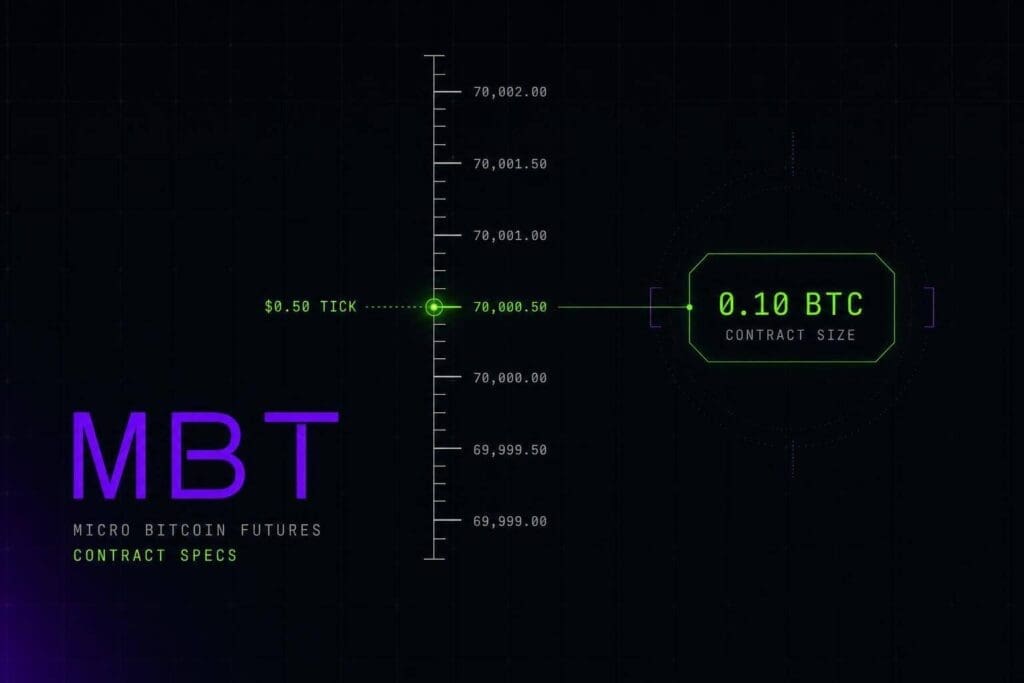
MBT pays $0.50 per tick, per contract. That’s the number you need first. From there, the rest is just position sizing math: $0.10 per 1-point move, 0.10 BTC per contract, and $100 per contract for a $1,000 Bitcoin move.
If you’re trading MBT, this is the part that keeps you out of dumb size. I’m not going to drag this out. Below is the short version of the contract specs, what each move is worth in dollars, and how to turn that into stop-based risk before you click buy or sell.
MBT Micro Bitcoin Futures Contract Specs
Contract Size, Multiplier, and Notional Value
One MBT contract equals 0.10 BTC. If Bitcoin is at $60,000, the notional value of one contract is $6,000.
That math is simple:
- 0.10 BTC × $60,000 = $6,000
This is the part a lot of traders skip past, and they shouldn’t. The contract looks "micro", but the dollar exposure still matters. If you’re trading MBT, you’re not trading some tiny toy contract. You’re taking on Bitcoin exposure, just scaled down to a size that’s easier to manage.
Price Quotation and Minimum Price Fluctuation
MBT is quoted in U.S. dollars per bitcoin. Calendar spreads trade in 1-point increments, and each point is worth $0.10 per contract.
That point value matters because it tells you what each move is worth in actual dollars. No guesswork. No vague platform math. You need that number before you place a trade, especially if you’re sizing around a tight stop.
Exchange, Symbol, Trading Hours, and Settlement
MBT trades on the CME (Chicago Mercantile Exchange) under the symbol MBT. Trading hours follow CME Globex hours and include a daily maintenance break.
MBT is cash-settled, not physically delivered, and it settles to the CME CF Bitcoin Reference Rate. That matters more than people think. Settlement method affects how the contract closes out, and it also changes how you think about expiry.
These contract specs drive two things right away: tick value and trade risk. If you don’t know those cold, you’re trading half-blind.
sbb-itb-46ae61d
How Much Is One MBT Tick Worth?
MBT Tick Value for Outright Trades
For an outright MBT trade, one tick is worth $0.50 per contract.
MBT Tick Value for Calendar Spreads
Calendar spreads move in 1-point increments, and each increment is worth $0.10 per contract.
Point, Tick, and Dollar Conversion Examples
Here’s the clean math:
| BTC Price Move | MBT P&L (1 Contract) | MBT P&L (10 Contracts) |
|---|---|---|
| 1 tick (5 points) | $0.50 | $5.00 |
| 10 points ($10 move) | $1.00 | $10.00 |
| 100 points ($100 move) | $10.00 | $100.00 |
| 1,000 points ($1,000 move) | $100.00 | $1,000.00 |
Use these numbers when you set stops and decide how many contracts to trade with a futures risk management planner in the next section.
Micro Bitcoin Futures Product Overview
How MBT Price Moves Translate Into P&L
MBT pays $0.50 per tick, so the math stays simple. Once you know the move in ticks, you can map it straight to gross P&L for any position size. That same math is what you’ll use in the next section to turn stop distance into position size.
P&L Examples for 1, 3, and 10 Contracts
Here’s the gross P&L for 1, 3, and 10 contracts:
| Move Size | 1 MBT Contract | 3 MBT Contracts | 10 MBT Contracts |
|---|---|---|---|
| 20-tick move | $10.00 | $30.00 | $100.00 |
| 50-tick move | $25.00 | $75.00 | $250.00 |
| 100-tick move ($500 BTC price move) | $50.00 | $150.00 | $500.00 |
At 10 contracts, a 20-tick move is $100.00. Simple enough. Just don’t confuse gross with net. You still need to subtract commissions on both the entry and the exit to get your actual P&L.
Long vs. Short Trade Scenarios
Trade direction changes the sign of the P&L. It doesn’t change the math.
Say Bitcoin rallies 50 ticks. If you’re long 3 MBT contracts, that’s a $75.00 gain. If you’re short 3 MBT contracts on that same move, that’s a $75.00 loss.
Now flip it. Bitcoin drops 50 ticks. The short makes $75.00, and the long loses $75.00. Same tick value. Same contract count. Same calculation.
Next, use that same per-tick math to map out risk per contract and position sizing.
How to Size MBT Positions for Risk
Once you’ve turned price movement into dollars, the next job is simple: size the trade based on your stop.
With MBT, the math is clean because each tick is worth $0.50. So before you place the order, figure out how many ticks sit between your entry and stop, then convert that into dollar risk per contract.
Risk Per Contract Based on Stop Distance
The formula is straightforward:
Risk per contract = stop distance in ticks × $0.50
A 40-tick stop means $20.00 of risk per contract.
A 100-tick stop means $50.00 per contract.
A 200-tick stop means $100.00 per contract.
No guesswork. Just tick distance times $0.50.
Position Size Formula for MBT
After that, take your max loss for the trade and divide it by the risk per contract:
Contracts = Max Dollar Risk ÷ Risk Per Contract
That gives you the contract count you can take without blowing past your risk cap.
Here’s what that looks like with a few common setups:
| Fixed Risk Limit | Stop Distance | Risk Per Contract | Position Size |
|---|---|---|---|
| $100 | 40 ticks | $20.00 | 5 contracts |
| $100 | 100 ticks | $50.00 | 2 contracts |
| $100 | 200 ticks | $100.00 | 1 contract |
| $250 | 50 ticks | $25.00 | 10 contracts |
| $250 | 100 ticks | $50.00 | 5 contracts |
| $250 | 250 ticks | $125.00 | 2 contracts |
Do this math before you enter the trade. Not after you’re already in and hoping the stop is "close enough."
Why MBT Works for Smaller Accounts and Prop Evaluation Rules
This is where MBT starts to make sense for smaller accounts and for traders dealing with tight eval rules. Since the tick value is small, you can dial in risk with more control, which is essential to pass prop firm challenges. You’re not forced into oversized exposure just to take a setup.
That matters when your account has a hard daily loss limit or a tight drawdown buffer. A contract that risks $20.00 to $50.00 with a normal stop is a lot easier to work with than a bigger Bitcoin product that jumps your per-trade risk too fast.
That sizing edge stands out even more when you put MBT next to larger Bitcoin futures contracts.
How MBT Compares to Other CME Crypto Futures
MBT is easier to work with when you need tight risk control. The smaller contract size keeps the tick value from getting out of hand, and that matters the second you start sizing a trade instead of just talking about one.
MBT vs. Standard Bitcoin Futures (BTC)
BTC is 50 times larger than MBT. That gives MBT a clear edge for finer position sizing.
| MBT (Micro Bitcoin) | BTC (Standard Bitcoin) | |
|---|---|---|
| Contract Size | 0.1 BTC | 5 BTC |
| Notional Exposure | 1/50 of BTC | 50x MBT |
That smaller size gives you tighter control over exposure. If you want to scale in, scale out, or keep risk on a short leash, MBT does the job better. This precision is particularly useful when trading through a funded account like E8 Futures.
MBT vs. Other Micro Crypto Contracts
MBT uses the same basic micro-contract setup: smaller size, tighter risk control, and finer scaling. That’s the whole point.
When position size needs to stay tight, MBT is often the cleaner pick. Less bulk. More control.
MBT Contract Specs Cheat Sheet
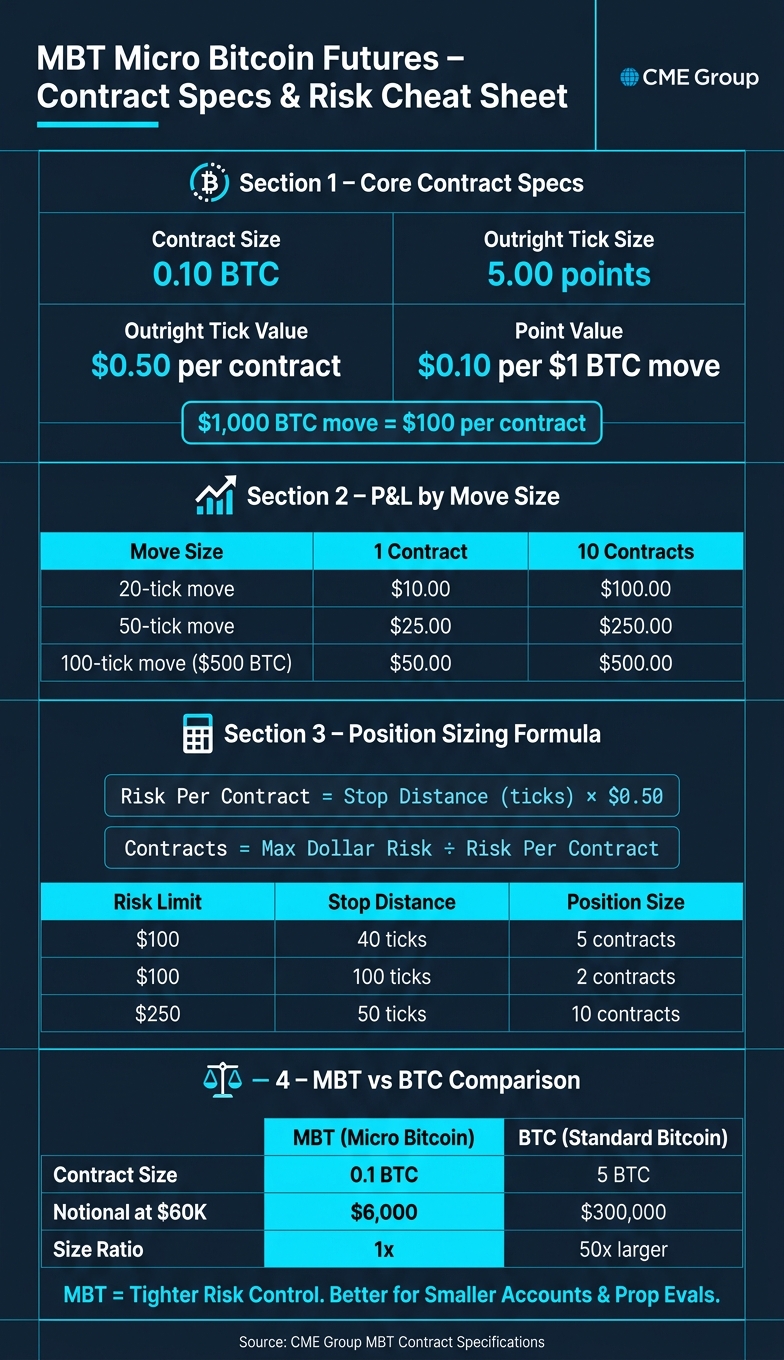
MBT vs BTC Futures: Contract Specs & Tick Value Cheat Sheet
Key MBT Numbers at a Glance
Use this quick reference to turn MBT price moves into dollar risk and position size.
| Spec | MBT Value |
|---|---|
| Contract Size | 0.10 BTC |
| Outright Tick Size | 5.00 points |
| Outright Tick Value | $0.50 per contract |
| Point Value | $0.10 per $1.00 move in Bitcoin per contract |
Source: CME Group MBT contract specifications
The MBT Numbers That Drive Risk
These are the numbers used in the P&L and position-sizing examples above.
Stick with these three numbers: 0.10 BTC per contract, $0.50 per tick, and $0.10 per $1.00 move. That’s the whole shortcut. Once you know them, you can turn MBT price changes into dollar risk fast.
Here’s the part that matters at the screen: a $1,000 Bitcoin move = $100 per contract.
That’s why MBT is easy to map out. Stops, targets, and contract count become simple math instead of guesswork.
FAQs
How do I calculate MBT risk before entering a trade?
Multiply your MBT contract count by the tick value. MBT moves in 5.00 index-point increments, which works out to $0.50 per tick for each contract.
Next, map out your stop in ticks. A 20-tick stop means $10.00 at risk per contract (20 × $0.50). Then multiply that by your position size to get your total risk on the trade.
What does cash-settled mean for MBT at expiration?
For the Micro Bitcoin (MBT) futures contract, cash-settled means you don’t get actual Bitcoin when the contract expires.
If you’re still in the trade at expiration, the position gets closed at the final settlement price. Your profit or loss is then posted to your account in U.S. dollars, not in Bitcoin.
How much dollar exposure does one MBT contract give me?
One Micro Bitcoin (MBT) futures contract gives you dollar exposure equal to the current Bitcoin price × 0.10 Bitcoin.
Example: if MBT is trading at $60,000.00, one contract has a notional value of $6,000.00.