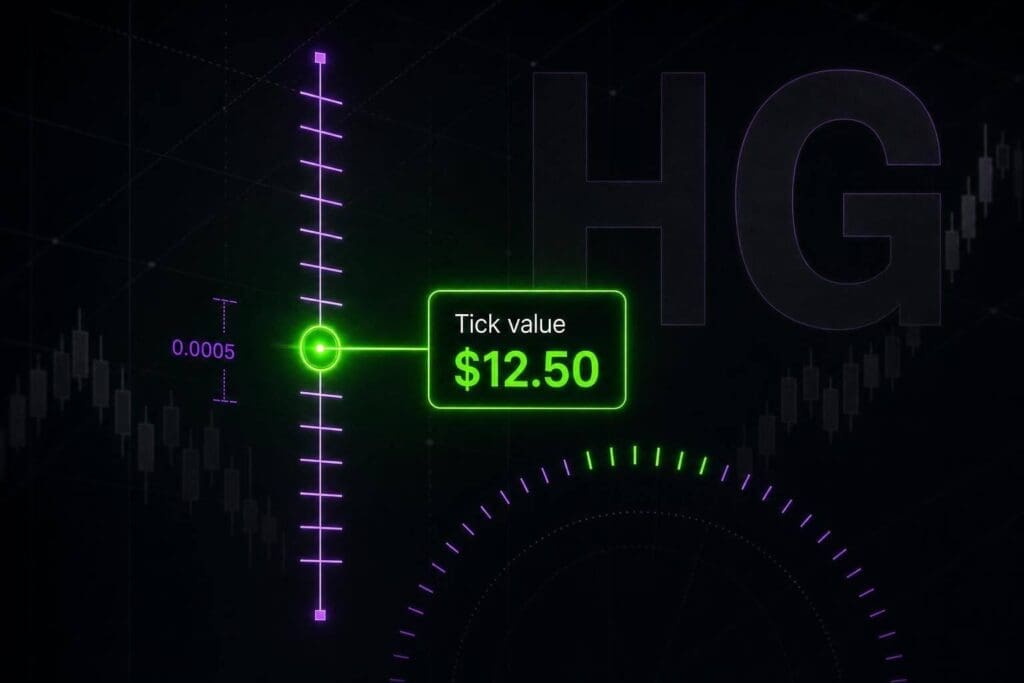
One HG tick is worth $12.50 per contract. That’s the number you need burned into your head before you touch copper. A move that looks tiny on the chart can turn into a fast hit to your P/L, and that gets ugly fast when you stack contracts.
I’ll keep this tight: the contract controls 25,000 pounds, the minimum move is $0.0005 per pound, and HG trades nearly 23 hours a day on Globex with a 5:00 PM to 6:00 PM ET daily break. I’ll also point out the listed contract months and the one thing that matters most here: turning ticks into dollar risk before you click buy or sell.
How to Calculate Profit or Loss on Futures Contracts
sbb-itb-46ae61d
Introduction
One HG copper futures contract controls 25,000 pounds of copper. The minimum price move is $0.0005 per pound, which works out to $12.50 per tick, per contract [1].
That tick value is the part that matters. It turns price movement into plain dollar risk and reward. This is the foundation for scaling funded accounts safely.
A 10-tick move is $125 per contract. A 20-tick move is $250. Add more contracts, and those numbers stack up fast, especially when copper starts moving with some heat.
Start with the contract specs. Then use the tick value to price every move in dollars.
HG Contract Specs at a Glance
Use these specs to turn HG price moves into dollar risk. That’s the part that matters.
Core Contract Details
HG copper futures trade on COMEX, which sits under CME Group. The symbol is HG, and each contract controls 25,000 pounds of copper.
| Spec | Detail |
|---|---|
| Exchange | COMEX (CME Group) |
| Symbol | HG |
| Contract Size | 25,000 pounds |
| Price Quotation | U.S. dollars and cents per pound |
| Tick Size | $0.0005 per pound |
| Tick Value | $12.50 per contract |
Those numbers drive the tick-value examples below.
How HG Prices Are Quoted
HG is quoted per pound, so even small decimal moves hit your P/L at the contract level.
A quote of 4.2500 means $4.2500 per pound. One tick higher is 4.2505. Ten ticks higher is 4.2550.
One contract’s notional value is:
price × 25,000 pounds
At $4.2500 per pound, one HG contract gives you $106,250 in notional copper exposure. That’s why tick math comes first. The per-pound quote is what the P/L examples that follow are built on.
How Much Is One HG Tick Worth?
HG moves in $0.0005 per pound ticks. Once you know the contract size, the math gets simple. More importantly, this is the number that decides your stop distance and position size.
HG Tick Size and Tick Value Formula
HG ticks by $0.0005 per pound. The contract size is 25,000 pounds, so one tick equals $12.50 per contract.
What a 1-Tick Move Looks Like in HG
If HG is trading at 4.2500 and moves to 4.2505, that’s 1 tick. On a long position, that means +$12.50.
If it moves from 4.2500 to 4.2550, that’s 10 ticks, not much on the chart, but it’s still $125 per contract. That’s why copper can sneak up on you. Small-looking moves add up fast. You can use a futures trading profit calculator to model these moves before entering a trade.
Here’s the dollar impact for one HG contract:
| Ticks | P/L per Contract |
|---|---|
| 1 | $12.50 |
| 5 | $62.50 |
| 10 | $125.00 |
| 50 | $625.00 |
Once you start stacking contracts, those numbers multiply fast.
What Does an HG Move Mean in Dollars?
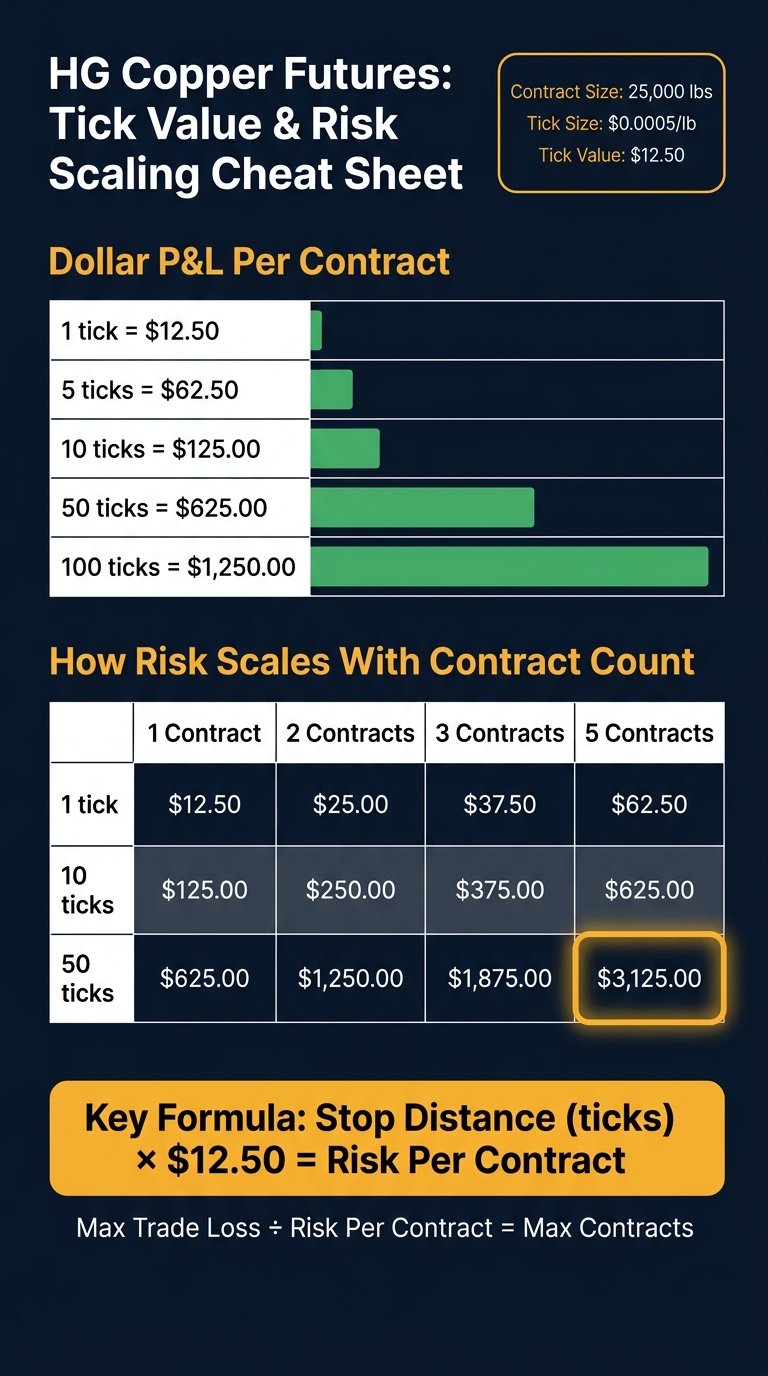
HG Copper Futures: Tick Value & Risk Scaling Cheat Sheet
Turn ticks into dollars before you pick size. That’s the part that keeps you out of dumb risk. Once you know the tick value, you can map any move to actual P/L and size the trade with a clear dollar limit.
P/L Examples for 1, 10, and 50 Ticks
Here’s the math for one contract: [1]
| Move | P/L per Contract (Long) | P/L per Contract (Short) |
|---|---|---|
| 1 tick | +$12.50 | −$12.50 |
| 10 ticks | +$125.00 | −$125.00 |
| 50 ticks | +$625.00 | −$625.00 |
Long and short P/L are the same size. The only thing that changes is direction.
How Risk Scales Across Multiple Contracts
Risk scales in a straight line with contract count. Double the contracts, double the dollar risk. That’s why you should size off max loss, not margin.
| Move | 1 Contract | 2 Contracts | 3 Contracts | 5 Contracts |
|---|---|---|---|---|
| 1 tick | $12.50 | $25.00 | $37.50 | $62.50 |
| 10 ticks | $125.00 | $250.00 | $375.00 | $625.00 |
| 50 ticks | $625.00 | $1,250.00 | $1,875.00 | $3,125.00 |
A 50-tick move on 5 contracts is $3,125.00. That adds up fast.
Using Tick Math to Set Stops and Size Positions
The formula is simple: risk per contract = stop distance in ticks × $12.50. Then take your max trade loss ÷ risk per contract to get contract count.
Example: a stop 20 ticks away means $250.00 per contract. If your max loss is $500.00, you can trade 2 contracts.
If you’re using funded futures accounts, this matters even more. Blow past your loss cap and the trade wasn’t just bad, it was avoidable. Do the math before entry so your stop, size, and dollar risk all line up with your limit. [1]
That same tick math also helps frame trading hours and contract-month risk.
HG Trading Hours and Contract Months
After you size risk by tick value, the next job is knowing when HG actually trades and which contract month you should be in.
HG Trading Hours
HG trades on CME Globex from Sunday 6:00 PM ET to Friday 5:00 PM ET, with a daily maintenance break from 5:00 PM to 6:00 PM ET each evening. [1] During that break, orders won’t fill, so don’t ignore it when you’re setting stops or planning exits.
Contract timing matters just as much as session timing.
HG Contract Months
HG is listed in March, May, July, September, and December. [1] In plain English, you usually want the front month because that’s where the liquidity is. As expiration gets close, roll into the next active contract instead of hanging around in a thinning market.
How HG Compares to Other Copper Futures Contracts
If HG’s $12.50 per tick feels too big for your account, look at Micro Copper instead.
HG vs Smaller Copper Contracts
CME Group offers a Micro Copper futures contract alongside standard HG. The whole point is simple: less dollar risk per tick and tighter position sizing. If HG is too heavy for your account, the micro gives you more control without forcing you to skip the trade setup.
When Standard HG May Be Too Large
Standard HG is too large when one contract alone blows past your risk limit. That matters even more in funded accounts, where tick value and volatility can trip drawdown rules fast.[1]
Don’t pick contract size just because margin looks easier. That’s how traders get smoked. Use your stop-based dollar risk instead. Take your stop distance, convert it into dollars, and do that math before you enter. That keeps your size lined up with the stop and the dollar risk you already decided on.
Bottom Line on HG Tick Value
Once you know the contract specs, this is the number that matters for risk: $12.50 per tick per contract. That means a 1-tick move is $12.50, a 10-tick move is $125, and a 100-tick move, or $0.05 per pound, is $1,250 per contract.[1]
Do the dollar math before you enter. A 20-tick stop is $250 of risk per contract. If that blows past your risk cap, cut size or pass on the setup. Same deal for position sizing. Your max risk tells you how many contracts you can carry. This is especially critical when trading through E8 Futures or other funded accounts where drawdown rules are strict.
That’s the whole point. Tick value turns HG from lines on a chart into actual dollar exposure. It gives you a clean way to set stops and size trades without guessing.
In HG, build every trade around $12.50 per tick.
FAQs
How do I calculate HG dollar risk from my stop size?
Multiply your stop-loss in ticks by the dollar value per tick. Keep it simple: count the ticks between your entry and stop, then multiply that number by HG’s tick value.
Example: a 10-tick stop with a $12.50 tick value = $125.00 risk per contract.
That number is your risk for one contract. If you trade 2 contracts, double it. Before you size up, check the current HG contract specs and tick value. Don’t wing it.
When should I roll to the next HG contract month?
Roll your HG copper futures position into the next contract month before the current one gets close to expiration. In practice, volume and liquidity usually shift to the next active month before the last trading day, so waiting too long can leave you trading a thinner book. Not ideal.
If you want to keep the position open and avoid physical delivery or settlement, roll it before expiration. For the exact dates and the right rollover window, check the official CME Group contract specs.
Is Micro Copper better if HG feels too large?
Yes. Micro Copper (QC) can be a solid alternative if the standard HG contract is too big for your risk plan.
The main edge is finer position sizing. You can dial in exposure more cleanly and keep it closer to your account size and max loss per trade. That matters. A contract that’s too large can wreck otherwise decent risk control.
That said, there’s a trade-off. Commissions can take a bigger bite out of the total cost on micro contracts, especially if you trade in and out often. Also, check that your platform actually supports Micro Copper (QC) before you place anything. Not every setup handles every micro contract the same way.