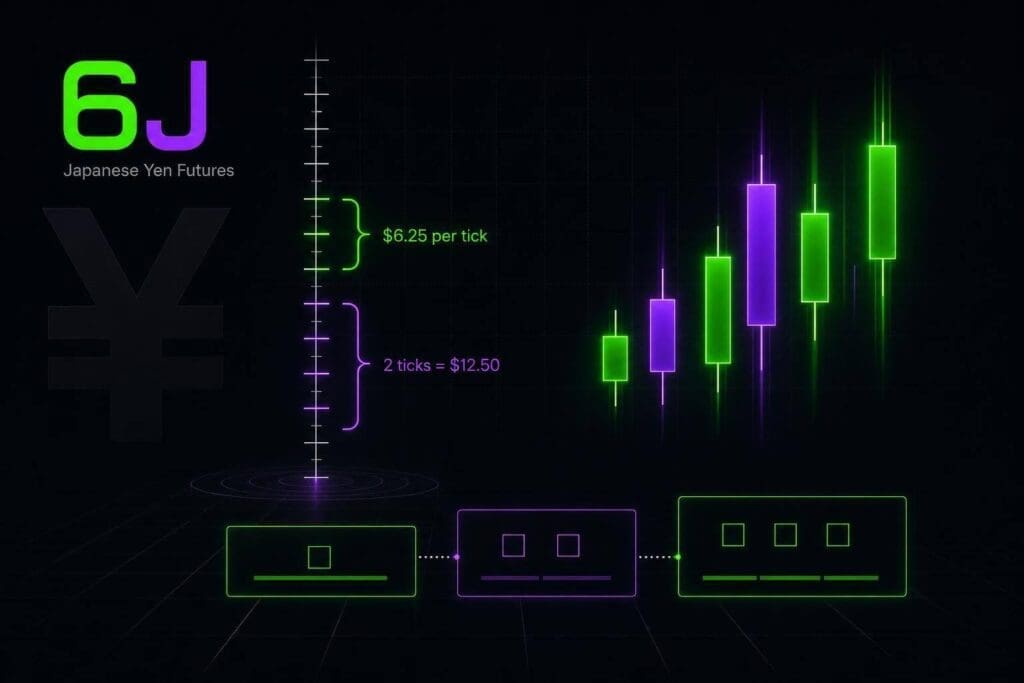
One 6J tick is $6.25 per contract. That’s the number you need first, because every stop, target, and size decision starts there. If you trade CME Japanese yen futures, the contract size is ¥12,500,000, the minimum tick is 0.0000005, and 2 ticks = $12.50. Simple math. No fluff.
I’m keeping this tight: what the contract is, how the tick math works, what a point is, and how to turn that into stop risk without screwing up your size. If you trade funded accounts with futures prop firms, this matters even more, because a dumb sizing mistake can chew through a daily loss limit fast.
Introduction
6J is CME’s Japanese yen futures contract [1]. If you trade it without knowing the specs, you’re guessing on risk. Bad idea.
The numbers below are what tell you what a tick is worth, how price moves hit your P&L, and how fast a trade can go from fine to ugly.
Next: contract specs, then the P&L math that turns ticks into dollars.
sbb-itb-46ae61d
How Much Is One 6J Tick Worth?
Once you’ve got the tick value straight, 6J gets a lot easier to size. This is how you turn a move on the chart into actual dollar risk and P&L.
6J Contract Specs at a Glance
Here are the core 6J specs in one spot, pulled from CME Group [1]:
| Contract Field | Specification |
|---|---|
| Contract Name | Japanese Yen Futures |
| Symbol | 6J |
| Exchange | CME Group |
| Contract Size | 12,500,000 Japanese Yen |
| Minimum Tick Size | 0.0000005 |
| Dollar Value per Tick | $6.25 |
| Point Value | 0.0000010 |
| Dollar Value per Point | $12.50 |
Tick vs. Point on 6J
On 6J, one tick = 0.0000005 and one point = 0.0000010. That means two ticks = one point.
This matters more than it sounds. If you mix up ticks and points, your risk math gets wrecked fast. You can end up doubling or cutting your estimate in half [1].
Check your platform before you click buy or sell. In the DOM and order entry, make sure it’s showing 0.0000005 per tick.
The rule here is dead simple: ticks and points are not the same on 6J. Know which one your platform uses before you place the trade.
Next up, turn that tick size into dollar P&L.
How 6J Pricing and Tick Value Work
Once you know the tick value, the rest is just turning price movement into dollars.
What a 6J Quote Means
6J is quoted in U.S. dollars per Japanese yen. If the price goes up, the yen is getting stronger. If it drops, the yen is getting weaker.
P&L Formula
Ticks moved × $6.25 × number of contracts = P&L
That math is dead simple. A 10-tick move equals $62.50 per contract. Trade 2 contracts, and that same move becomes $125.00. If you are trading through a funded account like E8 Futures, these calculations are vital for managing your drawdown limits. A 1-point move equals $12.50 per contract.
Tick Value vs. Notional Value
Here’s the part that trips people up: tick value stays fixed at $6.25. Notional value does not. It moves with price, using this formula:
12,500,000 × current 6J price
| Metric | Formula | Stability |
|---|---|---|
| Tick Value | Fixed by exchange | Fixed at $6.25 |
| Notional Value | 12,500,000 × 6J price | Changes with price |
| Core P&L | Ticks × $6.25 × contracts | Scales with position size |
That fixed tick value is the number you use for stops and position sizing. If your stop is 8 ticks, your risk is 8 × $6.25 = $50.00 per contract. That’s the number that matters when you’re sizing the trade.
How to Calculate 6J P&L and Stop Risk
6J Tick-Move Examples
Use this formula to turn ticks into dollar P&L per contract:
Ticks moved × $6.25 × number of contracts = P&L
| Ticks Moved | 1 Contract | 2 Contracts | 3 Contracts |
|---|---|---|---|
| 8 ticks | $50.00 | $100.00 | $150.00 |
| 12 ticks | $75.00 | $150.00 | $225.00 |
| 20 ticks | $125.00 | $250.00 | $375.00 |
| 40 ticks | $250.00 | $500.00 | $750.00 |
Nice and simple. If 6J moves 12 ticks in your favor and you’re holding 2 contracts, that’s $150.00 before costs. If it moves 20 ticks against you on 3 contracts, that’s -$375.00 before costs.
These figures are before commissions, fees, and slippage. Slippage can push fills away from your target price, so don’t treat the table like a promise. It’s just a clean way to map ticks to dollars. Actual fills can come in worse when slippage hits.
How to Price a Stop-Loss in Dollars
Start with the dollar amount you’re willing to lose on the trade. Then divide that risk limit by the per-contract stop risk to get your max size.[1] That’s the number you use for position sizing.
For example, if your stop works out to $62.50 per contract and your max trade risk is $250.00, you can take 4 contracts. If the math gives you 4.8 contracts, the answer is still 4, not 5. Round down. Always.
That keeps your size in line with the stop instead of guessing and hoping it works out.
How Many 6J Contracts Can You Trade Within Your Risk Limit?
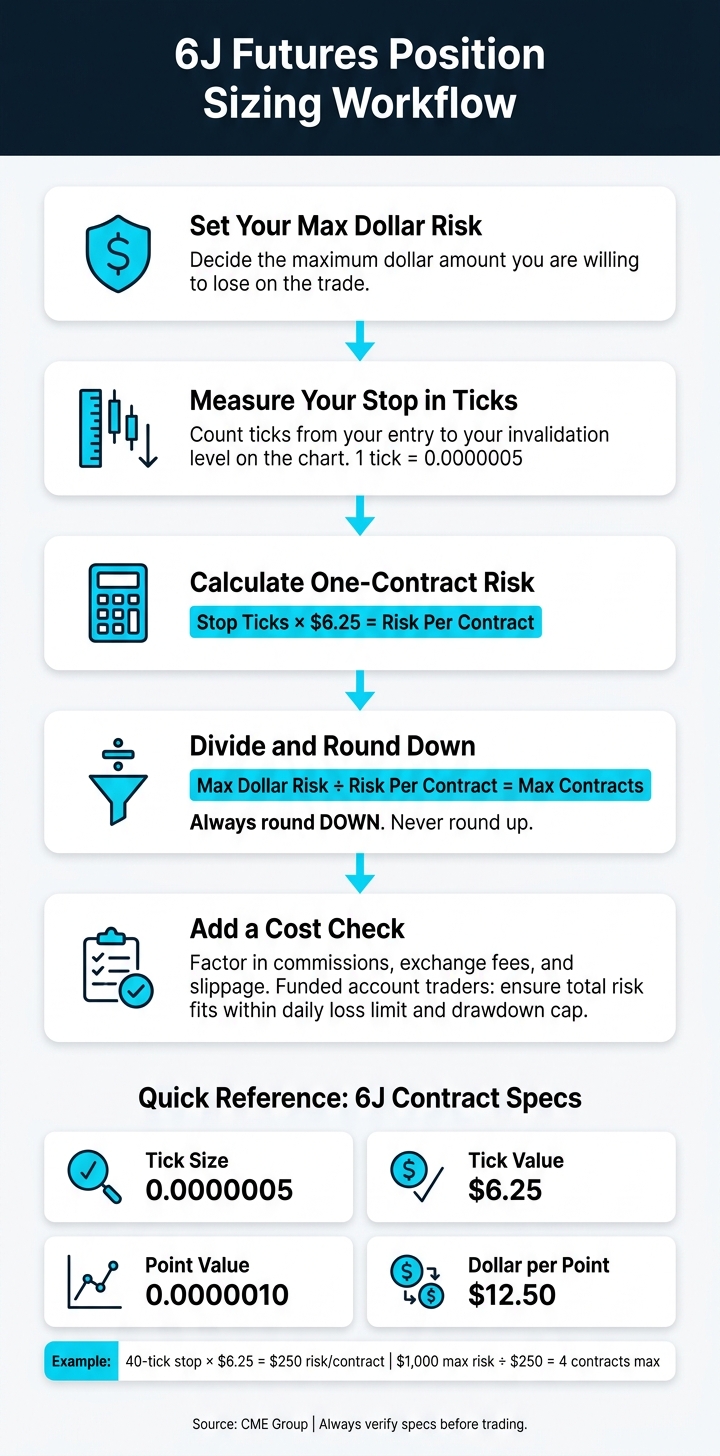
6J Futures Risk-Check Workflow: Tick Value to Position Size
Use the tick value to cap your size before you enter. That’s the whole job here: turn 6J ticks into a hard dollar number, then size the trade so your max loss stays inside that limit.
The 6J Position Size Formula
Max contracts = Maximum dollar risk ÷ (Stop ticks × $6.25), rounded down [1]
Base your size on the stop distance. Not margin. That’s where plenty of traders screw this up. Margin tells you what it takes to open the trade. It does not tell you what you can lose.
Position Sizing Examples
Use this table when you want the math done fast:
| Risk Limit | Stop Size (Ticks) | Risk Per Contract | Max Contracts (Rounded Down) |
|---|---|---|---|
| $500 | 40 ticks | $250.00 | 2 contracts |
| $1,000 | 32 ticks | $200.00 | 5 contracts |
| $250 | 15 ticks | $93.75 | 2 contracts |
| $1,500 | 50 ticks | $312.50 | 4 contracts |
Each setup keeps the worst-case loss inside the stated risk limit.
A Quick Risk-Check Workflow
Before you place the order, run through this:
- Set your max dollar risk – the most you’re willing to lose on the trade.
- Measure your stop in ticks – count from entry to your invalidation level on the chart.
- Calculate one-contract risk – multiply stop ticks by $6.25.
- Divide and round down – max risk ÷ one-contract risk, then drop the decimal.
- Add a cost check – factor in commissions, exchange fees, and expected slippage before you lock in size. [1]
If you’re in a funded account, those costs need to sit inside your daily loss limit and drawdown cap too. [1]
After size is locked, check trading hours and expiration before you send the order.
Other 6J Contract Details to Check Before You Trade
After using a futures risk management planner for sizing, check the execution stuff before you hit send. Good risk control starts with the boring details most traders skip: session hours, contract month, and expiration timing. Tick value matters, sure. But if you ignore when 6J trades or when the contract is rolling, you’re asking for dumb mistakes.
Exchange, Contract Months, and Trading Hours
6J trades on CME Globex. The contract follows the quarterly cycle:
- March (H)
- June (M)
- September (U)
- December (Z)
Electronic trading runs from Sunday 5:00 p.m. through Friday 4:00 p.m. CT. You should also check CME for the current daily maintenance break before placing trades [1].
Expiration and Holiday Schedule
Next, check expiration timing. If you’re trading close to expiry, pull up the official CME calendar and confirm the current expiration date, rollover dates, and holiday-shortened sessions [1]. That timing changes when you can enter, roll, or get out without friction.
Bottom Line
Use current CME trading hours and expiration dates to keep 6J stop risk tight.
FAQs
How do I convert ticks into dollar risk on 6J?
Multiply the number of ticks you’re risking by the $12.50 tick value for one 6J contract. The minimum tick size is 0.000001 per Japanese yen.
Example: a stop-loss set 10 ticks from entry puts $125.00 at risk per contract.
Why is 6J tick value fixed if the contract’s notional value changes?
The 6J tick value is fixed because the exchange sets a constant dollar amount for each minimum price move. It doesn’t change just because the Japanese Yen moves up or down.
That makes risk and position sizing a lot easier. You can calculate stops, target distance, and per-contract risk the same way every time. The contract’s notional value will move with the Yen, sure, but the tick value stays the same for P&L and stop-loss math.
How do I know if my platform shows ticks or points on 6J?
Check your platform docs, DOM settings, and instrument settings. For 6J, the platform should show the exchange-set tick size. If it doesn’t, your ladder, chart, and order entry can all feel off.
It’s worth checking this in a few places:
- Platform documentation
- DOM settings
- Instrument settings
- Chart window
- Order-entry window
Your goal is simple: make sure all of them match the official CME Group contract specs for 6J. If one screen shows a different increment, fix that first before you place trades.