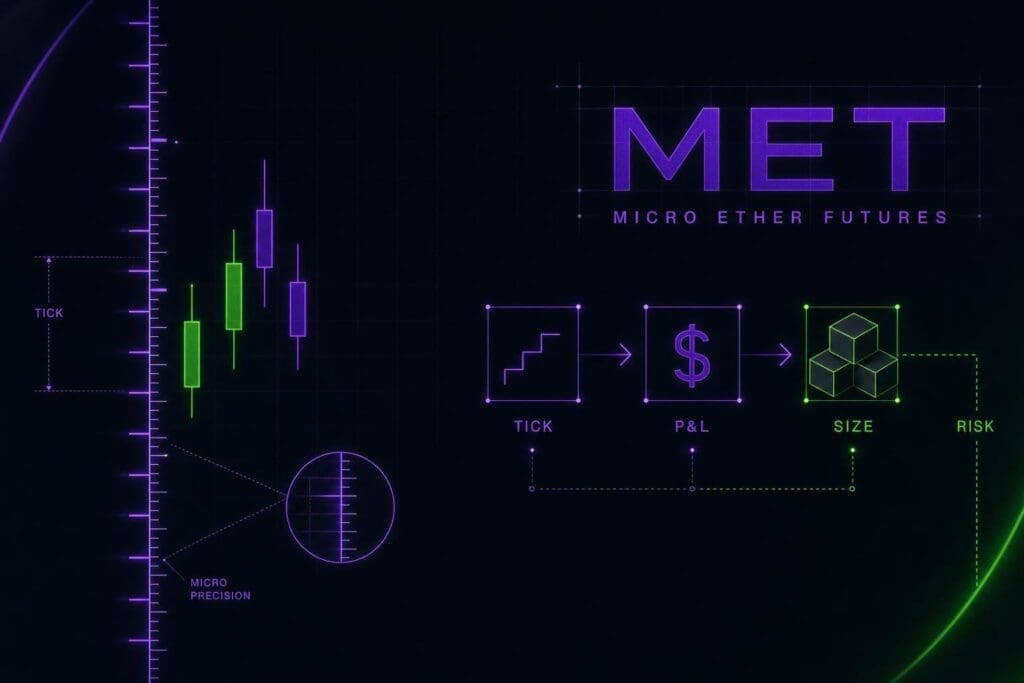
One MET tick is worth $0.05 per contract. That’s the only number you need first, because if your tick math is off, your stop, size, and P&L are off too. I’ll keep this tight: what MET controls, how the 0.50-point minimum tick turns into $0.05, and how to convert price movement into dollar risk without screwing up the order ticket.
MET is small, but bad math still hits your account the same way. A 20-tick move = $1.00 per contract, and a 50-tick stop = $2.50 per contract before fees. This precision is vital when evaluating best futures prop firms for funding. That’s the framework. Use it, and your sizing stays clean.
Introduction
MET’s tick value affects every P&L and position-sizing call you make. One tick in MET is worth $0.05 per contract. If price moves one tick in your favor, you make $0.05 per contract. If it moves one tick against you, you lose $0.05 per contract [1].
That number applies to outright contracts, and it reflects gross P&L before commissions and fees [1]. So if you’re sizing a trade, start with the gross tick value first. Then back out fees to get a cleaner net estimate [1].
The right way to handle MET is pretty simple: start with the contract specs, then use the P&L examples and sizing formulas to keep your risk and profit targets in line.
sbb-itb-46ae61d
MET Contract Specs
MET is CME’s Micro Ether futures contract (Globex: MET). It’s cash-settled and follows the Ether Reference Rate. Each contract controls 0.10 Ether. That’s the number that sits underneath every MET risk calc you do, whether you’re sizing a trade, setting a stop, or figuring out how many contracts you can carry.
Use these specs as your baseline for every MET P&L and sizing calc.
| Spec | Detail |
|---|---|
| Exchange | CME |
| Symbol | MET |
| Contract Size | 0.10 Ether |
| Min Tick | 0.50 points |
| Tick Value | $0.05 |
| $/Point | $0.10 |
| Settlement | Cash |
| Underlying | Ether Reference Rate |
How the Tick Value Is Calculated
A 1-point move in MET changes the contract value by $0.10. The tick math is simple:
0.50 points per tick × $0.10 per point = $0.05 per tick [1]
That gives you the fixed tick value. From there, you can turn any price move into dollar P&L fast.
How MET Price Movement Converts to Dollar P&L
Once you know the MET tick value is $0.05, the math gets simple. Any price move converts straight into dollar P&L. Positive ticks mean profit. Negative ticks mean loss.
MET P&L Formula
The formula is:
Ticks Moved × $0.05 × Number of Contracts = Gross P&L
MET Tick Value Examples
A 20-tick move pays $1.00 on 1 contract and $4.00 on 4 contracts. Those are gross numbers before fees. [1]
P&L Reference Table
Use this table as a quick cheat sheet for 1 contract. If you’re trading more than one, just multiply the dollar figure by your contract count.
| Ticks Moved | Point Move | Gross P&L (1 Contract) |
|---|---|---|
| 1 | 0.50 points | $0.05 |
| 10 | 5.00 points | $0.50 |
| 20 | 10.00 points | $1.00 |
| 50 | 25.00 points | $2.50 |
| 100 | 50.00 points | $5.00 |
This is the same conversion you use for risk sizing. If your stop is 20 ticks, that’s $1.00 per contract before fees. Trade 5 contracts, and that same 20-tick stop becomes $5.00.
MET Trading Hours and Expiration
Once you know MET tick value and P&L, the next risk filter is simple: trade the right month, during liquid hours. Get that wrong and execution gets sloppy fast. You can end up dealing with weak depth, wider spreads, or a bad roll window.
MET Trading Hours on CME Globex
MET trades almost 24 hours a day on CME Globex. The standard session runs from Sunday at 5:00 p.m. CT through Friday at 4:00 p.m. CT, with a daily maintenance break from 4:00 p.m. to 5:00 p.m. CT. [1]
Contract Months and Expiration Cycle
MET is listed in the nearest six consecutive monthly contracts. [1] The listing cycle also includes extra December contracts, and CME may also list weekly expirations. [1] Check the active month on your platform before you trade, and roll before liquidity starts moving out of that contract.
What to Verify Before Trading MET
Before you enter, make sure the market, contract, and cost stack all line up. Your broker, platform, and data feed need to match. If they don’t, you can get order errors or fills that don’t line up with what you expected.
Also verify:
- The active contract month
- The contract’s last trade date
- Data-feed quality
- Total trading costs, including commissions, exchange fees, routing fees, and data fees [1]
How to Size a MET Position
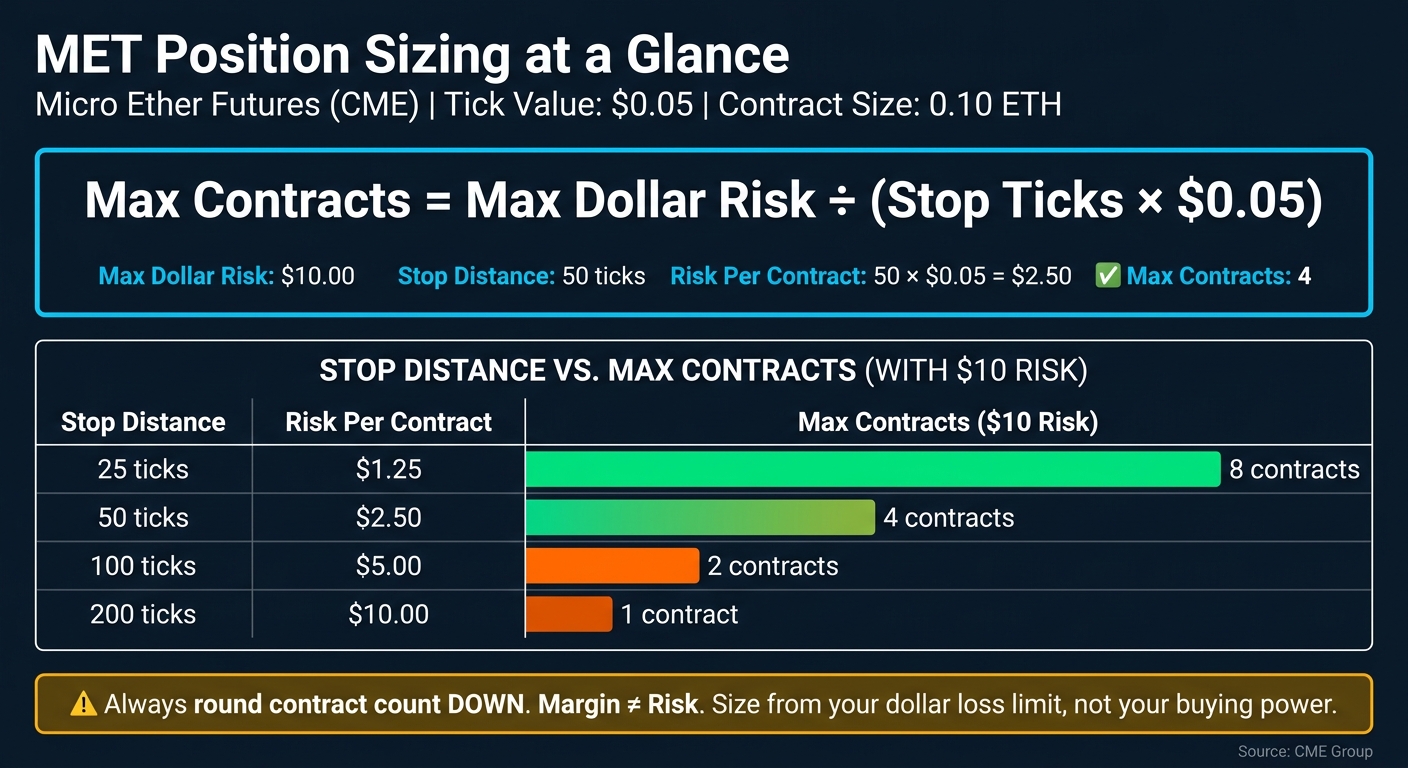
MET Micro Ether Futures: Stop Distance vs. Risk & Contract Count
Use the MET tick value to turn your stop into a contract count that fits your risk cap. Same math, every trade. No guessing.
Position Size Formula for MET
The formula is simple:
Max Contracts = Max Dollar Risk ÷ (Stop Ticks × $0.05) [1]
Always round down to a whole contract. If you round up, you’re taking more risk than your plan allows. That’s the kind of dumb mistake that adds up. Size the trade before you enter. [1]
Example: $10 Risk With a 50-Tick Stop
Here’s the quick math, or you can use a futures trading profit calculator for faster results.
50 ticks × $0.05 = $2.50 risk per contract
$10.00 ÷ $2.50 = 4 contracts
That puts the trade inside your max loss.
| Variable | Value | Calculation |
|---|---|---|
| Max Dollar Risk | $10.00 | Your risk limit |
| Stop Distance | 50 ticks | User-defined |
| MET Tick Value | $0.05 | CME specification |
| Risk Per Contract | $2.50 | 50 × $0.05 |
| Max Contracts | 4 contracts | $10.00 ÷ $2.50 |
How Wider Stops Reduce Contract Count
Wider stops cut your contract count. Every extra tick increases risk per contract, so you have to trade smaller if you want to stay inside the same dollar limit.
| Stop Distance | Risk Per Contract | Max Contracts ($10 Risk) |
|---|---|---|
| 25 ticks | $1.25 | 8 contracts |
| 50 ticks | $2.50 | 4 contracts |
| 100 ticks | $5.00 | 2 contracts |
| 200 ticks | $10.00 | 1 contract |
If your contract specs are wrong, the whole calculation is wrong. Check them before you enter.
MET Sizing Mistakes That Cost Traders Money
Wrong contract specs don’t just mess up the math. They mess up the trade.
With a micro contract like MET, a small mistake can blow your risk past the number you had in mind. That’s how traders end up taking a "small" setup that wasn’t small at all.
Common MET Tick Value Errors
Once you’ve got the basic MET math down, the next problem is bad inputs. The one I see most often is mixing up the 0.50-point minimum tick with a $0.50 tick value. They’re not the same. That 0.50-point tick equals $0.05, not $0.50.
The other common screw-up is confusing tick value with point value. Don’t lump them together. First, measure your stop in ticks. Then convert those ticks into dollars. That’s the clean way to do it, and it keeps your sizing from drifting.
Contract Details Traders Overlook
Low margin makes oversizing look harmless. It isn’t. Margin is not risk.
Your size should come from your dollar loss limit, not from how much buying power your platform shows. [1] If your max loss on the trade is $40, size from that number. Not from the fact that your account can open more contracts.
Expiration and rollover matter too. Ignore them, and you can get stuck trading a dead contract month with weak liquidity, sloppy fills, or an open position you didn’t mean to carry.
Pre-Trade MET Checklist
Before you send any MET order, run this quick check:
- Confirm contract size: 0.10 Ether per contract.
- Convert tick to dollars: the 0.50-point tick equals $0.05.
- Measure your stop in ticks: not price distance, not dollar guesses.
- Round your contract count down: never up.
- Include total fees: commissions and exchange fees. [1]
- Verify trading hours and expiration: check the active contract month before the session opens.
Use this every time. It keeps your MET sizing tied to the actual contract specs instead of whatever number looks fine in the order ticket.
Bottom Line on MET Tick Value
MET is the Micro Ether futures contract. Each 0.50-point tick = $0.05 per contract [1]. That’s the number that controls your P&L and your position size.
Use $0.05 per tick to turn your stop distance into dollar risk. Take your stop in ticks, multiply it by $0.05, then size the trade so it stays inside your risk cap. Also factor in commissions, exchange fees, and routing costs. On micros, those little charges stack up fast [1].
Check CME for current MET contract specs before you place a trade [1].
FAQs
How much is 1 MET point worth?
The info here doesn’t include the contract specs for Micro Ether (MET) futures.
If you need the point value for this CME Group contract, go straight to the official product specs on CME Group. That’s the only source you should trust for contract details like point value, tick size, and tick value.
Do MET fees affect my real P&L?
Yes. Fees hit your actual profit and loss.
Your gross P&L comes from the price move in the Micro Ether futures contract. Your net P&L is what’s left after the all-in costs get taken out.
Those costs can include:
- commissions
- exchange fees
- routing fees
- data costs
That money comes straight out of your gross gains. So even if your trade idea is right, fees still cut into the final number. And with micro contracts, that adds up fast.
How do I choose the right MET contract month?
Use the front-month contract. That’s the one with the nearest expiration date, and it usually has the most liquidity and the tightest bid-ask spreads. In plain English: fills tend to be easier, and you’re less likely to deal with sloppy execution.
Check the official product specs to confirm the active contract month and the expiration schedule. Then check your platform too. If it’s pointing at the wrong symbol, you can end up trading a thin back-month contract by mistake. That’s an avoidable screw-up.