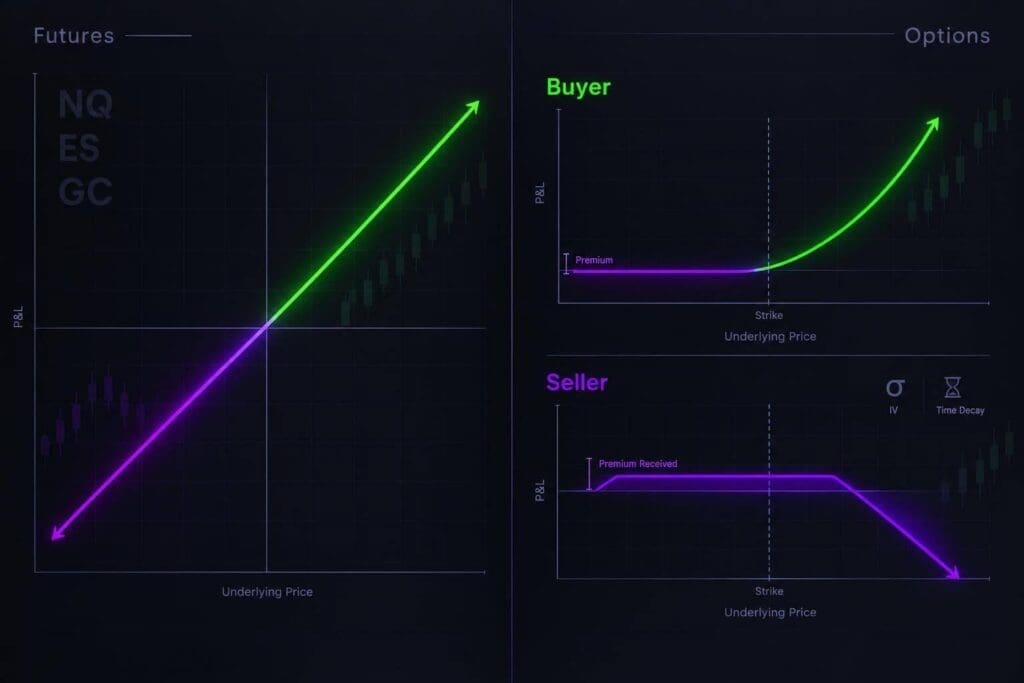
Futures give you direct price exposure. Options add a premium, a clock, and a different risk profile. I’d start with what your account can lose, not which trade needs less cash upfront. A $50 option can lose 100% of its premium, while a futures position can burn through its margin and drawdown limits and keep losing.
Here, I’ll break down the payoff math, expiration risks, and sizing rules that matter to your drawdown. Getting direction right isn’t enough. Your entry cost, time left, and position size still decide whether the trade pays. <u>Margin isn’t your risk budget.</u> Put the downside in dollars before you enter.
Futures vs Options at a Glance
Futures, option buyers, and option sellers feel the same price move differently. P&L, margin use, and time risk show you where those differences matter.
Here’s the side-by-side breakdown.
| Feature | Futures | Purchased options | Sold options |
|---|---|---|---|
| Rights and obligations | Both sides have an obligation. | Buyer has a right, not an obligation. | Seller has an obligation. |
| Payoff shape | Linear: each tick has a fixed dollar effect. | Nonlinear: upside depends on the market move. | Nonlinear: upside is limited; downside can be large or uncapped. |
| Margin and premiums | Post margin. | Pay a premium. | Receive a premium and usually post margin. |
| Potential losses | Can exceed margin. | Capped at the premium plus transaction costs. | Can far exceed the premium received; uncovered calls have uncapped risk. |
| Expiration | Must be closed or settled. | Can be closed, exercised, or expire. | Can be closed, expire, or be assigned. |
| Time decay | No option-style time decay. | Generally reduces remaining time value. | Works in the seller’s favor. |
| Volatility sensitivity | Mainly price-driven; bigger moves increase risk. | Rising implied volatility generally helps option value. | Rising implied volatility generally hurts the seller. |
| Risk priority | Tick risk, leverage, and available loss buffer. | Premium budget, time decay, and changing exposure. | Tail risk, margin increases, and assignment exposure. |
The next section shows how the same futures contract can produce different payoffs from the same price move.
sbb-itb-46ae61d
Same Futures Contract, Different Payoffs
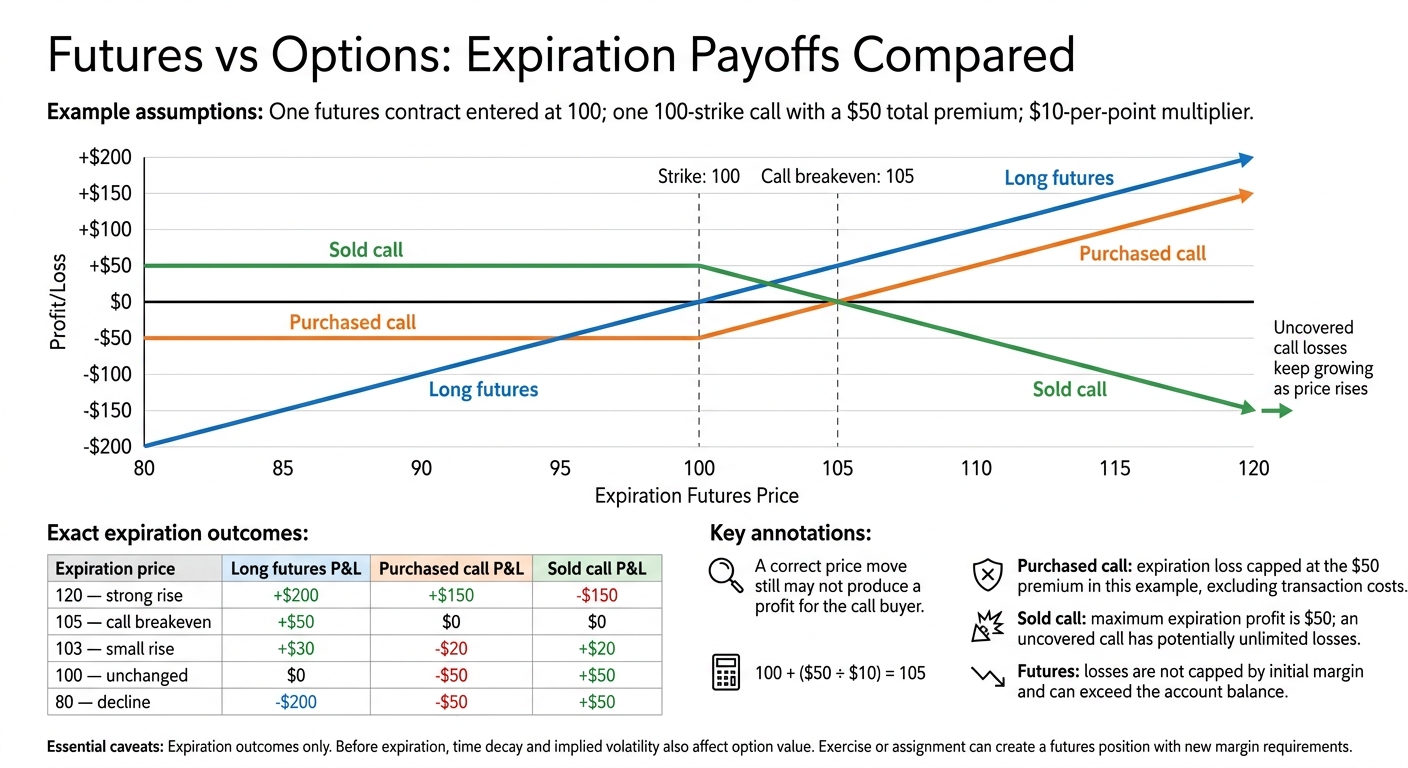
Futures vs Options: Expiration Payoffs Compared
Use this example: long one futures contract at 100 versus one 100-strike call for $50 with a $10-per-point multiplier. All figures are illustrative and exclude transaction costs. That difference shows up clearly in one expiration snapshot.
Payoffs When Prices Rise, Stay Flat, or Fall
Futures P&L = (expiration price − 100) × $10. Call P&L = max(expiration price − 100, 0) × $10 − $50.
Expiration price Long futures P&L Call P&L 120 – strong rise +$200 +$150 105 – call breakeven +$50 $0 103 – small rise +$30 −$20 100 – unchanged $0 −$50 80 – decline −$200 −$50 A correct price move still may not produce a profit for the call buyer. The call must recover its $50 premium; its expiration breakeven is 100 + ($50 ÷ $10) = 105.
Selling the Call Changes the Risk
The same example in reverse: selling the call flips the payoff. The seller keeps the full $50 premium only if the option expires at or below 100; losses grow as price rises. An uncovered call seller faces potentially unlimited losses. The buyer’s loss stays capped at the premium if the option expires worthless; exercise creates a futures position. Futures losses are not capped by initial margin and can exceed the account balance.[1]
This table shows expiration outcomes only. Before expiration, time decay and implied volatility can move the call away from this payoff.[1]
How Expiration, Time Decay, and Volatility Affect Returns
Futures Expiration vs Options Exercise
That expiration-day payoff table only shows the result at expiry, not what happens before it. Futures expire under their contract terms. Options can be exercised, assigned, or expire worthless.
For options, check the exercise rules, auto-exercise thresholds, settlement type, and expiration time. Exercise can leave you holding a futures position with new margin requirements handled through your broker or Futures Commission Merchant (FCM).[1] You’re not just closing out an option. The position you hold can change.
Why an Option Can Lose Despite a Favorable Price Move
The futures price can move your way while your option still loses value before expiration. The option’s value also depends on its strike, time left, and implied volatility.[1]
In the same long-call example, a rising futures price can lift the call, but time decay and a drop in implied volatility can still leave the option down. Being right on direction is not enough if those effects offset the price gain.[1]
Position Sizing for Futures Prop Traders
Futures, purchased options, and sold options need separate sizing rules. Once you understand the payoff difference, size each trade around the instrument’s risk.[1][3]
Size Futures by Tick Risk and Remaining Loss Buffer
Calculate planned risk = contracts × tick value × stop distance in ticks + slippage + fees. Use your remaining loss buffer to size the trade, not the account’s headline balance.[1]
A stop-market order can fill past its trigger price. Your stop loss is a plan, not a guarantee.[1][2]
Size Purchased Options by Premium and Changing Exposure
If options are permitted, calculate total premium at risk = contracts × quoted premium × contract multiplier, then add trading costs.[1][3]
Check the strike, expiration, implied volatility, liquidity, and delta before sizing. Unlike futures, an option’s futures-equivalent exposure changes as delta moves with price. Repeated full-premium losses can drain a small loss buffer, even though each trade has defined risk.[1][3]
Set a Separate Risk Budget for Option Selling
The buyer’s capped loss doesn’t apply to the seller. Don’t size naked short options by the premium collected. Budget for adverse moves, gaps, higher margin requirements, and assignment that can create a futures position. Check your loss buffer and collateral, not just entry margin.[1][3]
Bottom Line: Choose the Risk You Can Handle
Neither futures nor options are safer by default. Choose the risk profile your account can handle.[1] Direction is only part of the trade. You also need to know how losses can hit your account.
| Instrument | Payoff shape | Worst-case loss | Risk focus |
|---|---|---|---|
| Futures | Linear, tick-for-tick | Losses can exceed margin | Tick risk and loss buffer |
| Purchased options | Nonlinear; delta changes with price | Limited to the premium paid | Total premium at risk and changing exposure |
| Sold options | Nonlinear | Losses can exceed the premium received; naked call losses can be uncapped | Separate margin and assignment planning |
Exercise or assignment can turn the option into a futures position.
Before you enter, put the trade’s risk in dollars and compare it with your loss limit. Size to a defined risk limit, not the maximum position your margin allows.[1]
FAQs
How do I compare futures and options at equal risk?
Keep the same dollar risk budget per trade. For long futures, size your position around the largest adverse move you can tolerate and account for margin requirements. Losses can exceed your initial outlay.
For purchased options, keep the total premium paid within that budget. Your maximum loss is the premium, excluding spreads, fees, and slippage.
Match your planned exit timing to expiration. Factor in time decay and volatility when comparing potential gains and losses.
Can I avoid exercise by selling my option early?
Yes, you can typically avoid exercise by selling your option before it expires. That offsetting trade closes your position and lets you collect any remaining premium value. It also ends the rights or obligations tied to the position, so you can exit without waiting for expiration.
How does option delta affect my position size?
Option delta tells you how much an option’s price changes for a $1.00 move in the underlying futures price. To estimate your exposure, multiply the number of options by delta: 10 options × 0.50 delta = roughly 5 futures contracts worth of market exposure.
Delta doesn’t stay fixed. It changes as the underlying price moves, with gamma measuring that change. Adjust your position size as delta shifts to keep exposure within your account’s margin and volatility limits.