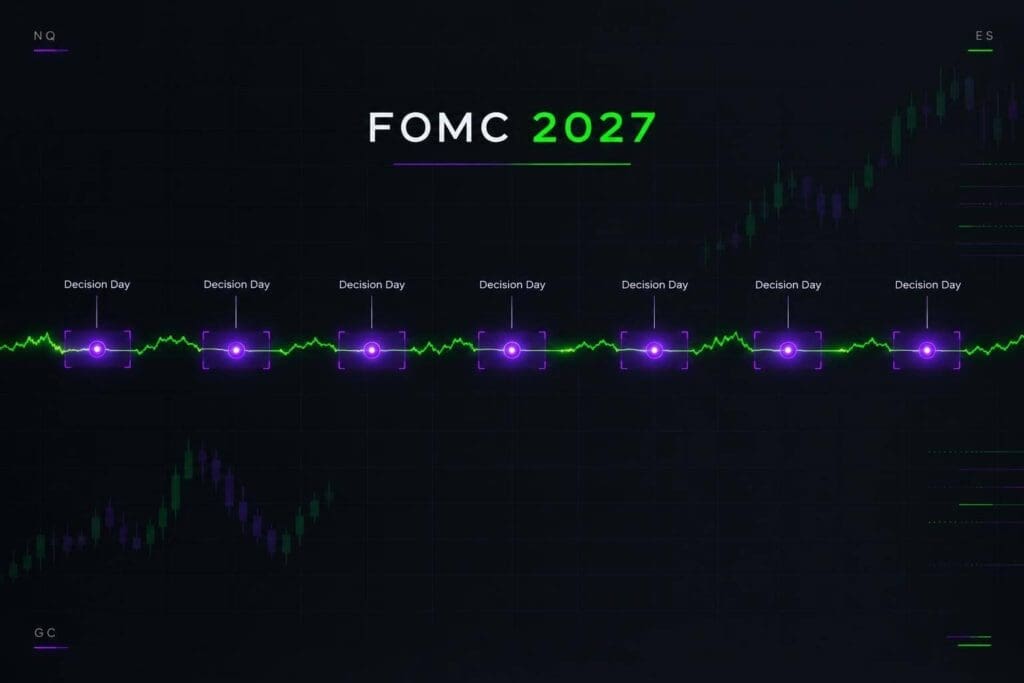
The 2027 FOMC calendar has eight tentative meetings, but the date alone won’t tell you whether you can trade. Your account’s news rules decide that. I’ll lay out the decision days, the scheduled 2:00 p.m. ET announcements, and the 2:30 p.m. press conferences, then explain what to check before either event.
The distinction matters: no new entries isn’t the same as <u>flat before news</u>, and permission to hold doesn’t settle whether working orders can stay live. As of October 17, 2026, the dates remain tentative. Use this schedule to plan, then confirm the Fed’s calendar and your exact account’s restrictions before placing orders. If your current firm’s rules are too restrictive, you may want to compare futures prop firms with more flexible news policies.
2027 FOMC Calendar: Tentative Dates and Announcement Times
The decision comes on each meeting’s second day. As of October 17, 2026, all dates below remain tentative. Before trading, check the Federal Reserve’s official FOMC calendar to confirm dates, release times, and press conference arrangements.
| Meeting dates | Decision day | Decision release | Press conference | Summary of Economic Projections | Status |
|---|---|---|---|---|---|
| January 26–27, 2027 | January 27, 2027 | 2:00 p.m. ET | 2:30 p.m. ET | No | Tentative |
| March 16–17, 2027 | March 17, 2027 | 2:00 p.m. ET | 2:30 p.m. ET | Yes | Tentative |
| April 27–28, 2027 | April 28, 2027 | 2:00 p.m. ET | 2:30 p.m. ET | No | Tentative |
| June 8–9, 2027 | June 9, 2027 | 2:00 p.m. ET | 2:30 p.m. ET | Yes | Tentative |
| July 27–28, 2027 | July 28, 2027 | 2:00 p.m. ET | 2:30 p.m. ET | No | Tentative |
| September 14–15, 2027 | September 15, 2027 | 2:00 p.m. ET | 2:30 p.m. ET | Yes | Tentative |
| October 26–27, 2027 | October 27, 2027 | 2:00 p.m. ET | 2:30 p.m. ET | No | Tentative |
| December 7–8, 2027 | December 8, 2027 | 2:00 p.m. ET | 2:30 p.m. ET | Yes | Tentative |
If you’re holding a position at 2:00 p.m. ET, you’re exposed to the announcement. Check your Tradeify news rules or other firm’s guidelines before that session.
The March, June, September, and December meetings also include the Summary of Economic Projections (SEP) and its interest-rate dot plot.
Beyond news events, you should also monitor your payout consistency to ensure compliance. The next section breaks down common prop-firm restrictions around these releases.
sbb-itb-46ae61d
1. Trading Allowed During Announcements
Once you’ve marked the 2027 decision days, check your firm’s rules for the FOMC release window. Trading can still be restricted around the 2:00 p.m. ET announcement. Check your account’s rules for entries, exits, open positions, and pending orders before placing a trade.
Entry and exit permissions
Confirm whether you can open or close trades during the release. Check whether you can modify stops and targets, use trade copying platforms, or run automation.
Existing-position requirements
Permission to enter trades doesn’t settle whether you can hold them. Check whether open positions can stay on through the announcement or whether you must be flat beforehand.
Pending-order handling
Check whether pending entry orders, stops, and targets can stay active or must be canceled before the release.
Confirm the exact FOMC blackout window and whether it applies to your account type: funded or evaluation.
2. Restrictions on New Entries
A no-new-entry rule stops you from opening trades during the blackout window. It doesn’t require you to close existing positions. A flat rule does: you must close all positions before the window starts.
Check the TradeDay rules page or your specific firm’s dashboard to confirm whether the entry ban covers the rate decision, the press conference, or both.
3. Requirements to Be Flat Before News
Flat before news means closing every open position before the deadline. Cutting your size doesn’t count. For the 2:00 p.m. ET FOMC release, make sure all exits are fully filled before your account’s cutoff.
Entry and exit permissions
The prop firm sets the rule, not the platform. Permission to enter trades, requirements for open positions, and restrictions on working orders are three separate checks. Don’t treat permission in one area as permission in another.
Pending-order handling
Check whether you must cancel pending entries and attached stop-loss or take-profit orders. After flattening, confirm that no working orders remain across any linked account. Pause automation and trade copiers so they can’t reopen exposure.
Restriction timing and account coverage
Check the firm-specific rules page for your account type’s flattening deadline in Eastern Time and its reentry time. Confirm whether the restriction covers the rate decision, the press conference, or both. Missing the flattening deadline can breach your account, so use proven prop firm strategies to maintain compliance.
4. Restrictions on Pending Orders
After checking position rules, confirm whether resting orders can stay live during the blackout window. Permission to hold a position doesn’t mean permission to leave orders working. A firm may let you hold trades through FOMC but still require you to cancel working orders before the blackout starts.
Pending-order handling
Check bracket and OCO (one-cancels-the-other) orders as linked groups, not separate tickets. Identify which orders open exposure and which close existing exposure. Then verify their status in your platform before the blackout begins.
Restriction timing and account coverage
Check DamnPropFirms’ firm-specific rules pages for the cancellation deadline and when you can resubmit orders for each account type.
Use the checklist below to confirm your deadline, order status, and account coverage before the next FOMC release.
FOMC Checklist Before Entering or Holding a Trade
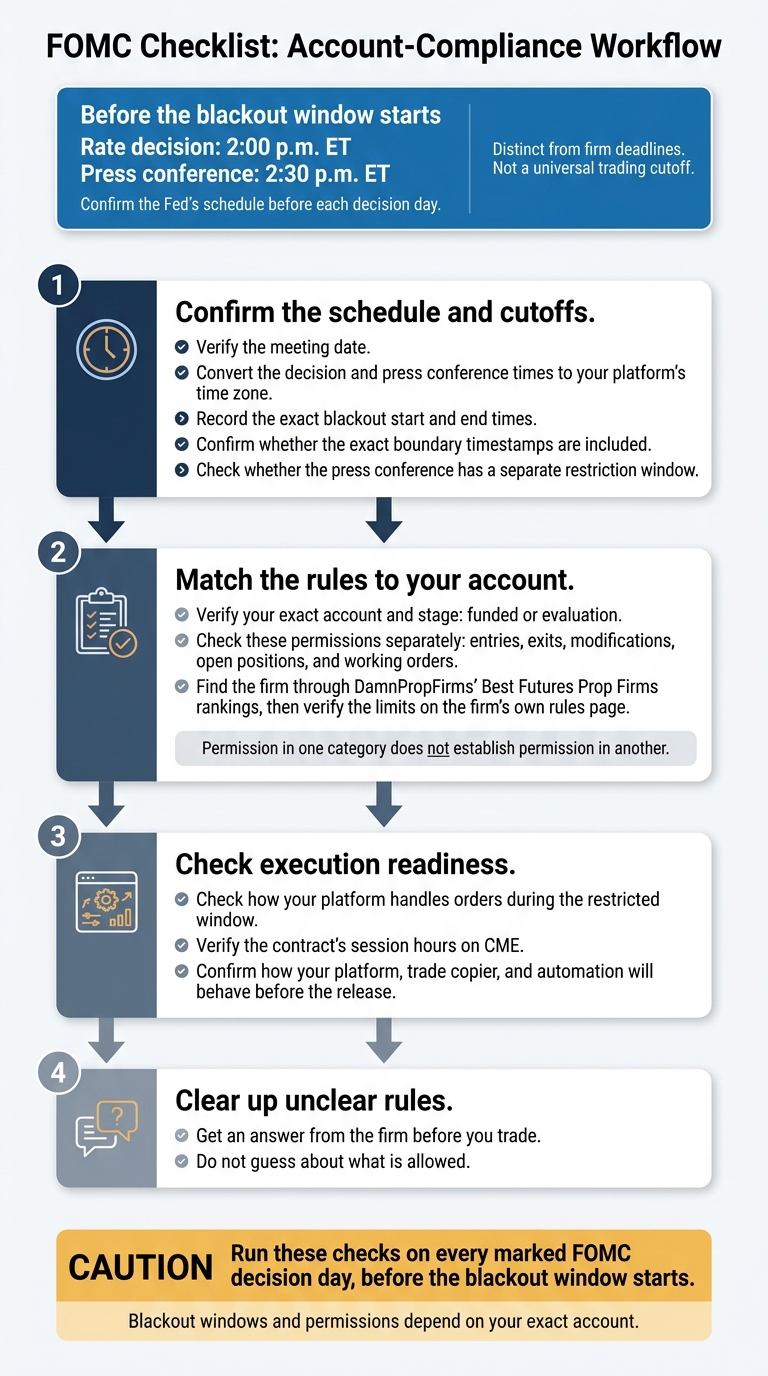
FOMC Trading Checklist: 4 Checks Before the Blackout
Run these checks on every marked FOMC decision day, before the blackout window starts.
- Confirm the schedule and cutoffs. Check the meeting date and convert the decision and press conference times to your platform’s time zone. Write down the exact blackout start and end times. Confirm whether the cutoffs include those exact timestamps and whether the press conference has a separate window.
- Match the rules to your account. Check the firm’s rules for your exact account and stage. Review entries, exits, modifications, open positions, and working orders separately. Use our Best Futures Prop Firms rankings to find the firm, then verify the limits on its own rule page.
- Check execution readiness. Once you’ve confirmed the deadline, check how your platform handles orders and automation during the window. Verify the contract’s session hours on CME, and confirm how your platform, futures copy trading tools, and automation will behave before the release.
- Clear up unclear rules. Get an answer from the firm before you trade. Don’t guess about what’s allowed.
Bottom Line: Mark Decision Days and Check Your Account’s Rules
Mark the eight tentative 2027 FOMC meetings on your calendar. For each decision day, flag 2:00 p.m. ET for the rate decision and 2:30 p.m. ET for the press conference. Check the Fed calendar before each decision day.
Then open your firm-specific rules page in DamnPropFirms’ futures prop firm directory. Confirm the rules for your exact account. Don’t assume firm-wide rules apply. Verify blackout windows for entries, open positions, and orders. Separately check pending orders, modification limits, and automation settings, including copiers.[1] Check those rules before you trade or hold through the release.
FAQs
Can an automatic stop-loss fill violate FOMC news rules?
Yes. An automatic stop-loss fill can violate a prop firm’s FOMC news rules. Automated orders still have to follow the firm’s restrictions, even when market movement triggers the stop.
Rules vary by firm. Before trading, check the site’s firm-specific rules pages, then confirm the details in the firm’s official help center. Verify whether stop-loss fills are exempt or prohibited during restricted FOMC windows.
When can I safely resume trading after FOMC?
Check your firm’s rules page on this site before trading after an FOMC announcement. Each firm sets its own restrictions, including news-trading limits, position-management requirements, and holding periods.
Regular futures market hours don’t override your firm’s rules. Confirm when you can resume trading and what you can hold through the announcement so you don’t violate your account terms.
Do FOMC restrictions apply to all futures contracts?
News-trading restrictions vary by prop firm. Some firms block trading across all futures contracts during major economic announcements. Others limit restrictions to specific high-liquidity indices or assets closely tied to interest rate changes.
Check this site’s firm-specific rules pages first. Then confirm your account’s restrictions in the firm’s official help center or your account agreement before placing or holding trades around an announcement.