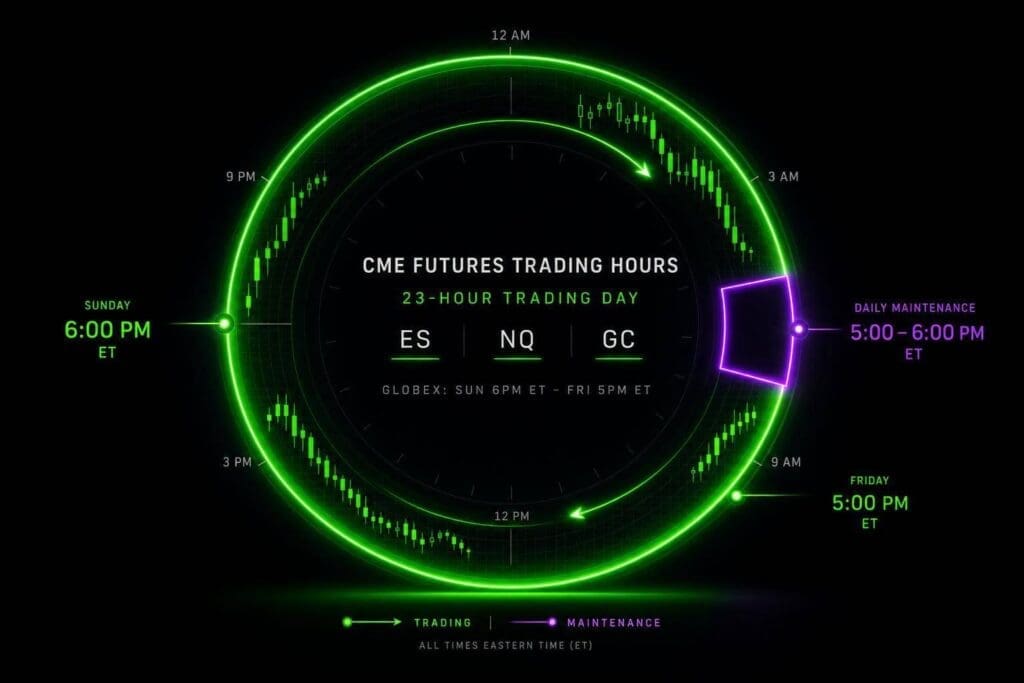
Most CME futures run almost 23 hours per day, with the main pattern being Sunday 6:00 PM ET to Friday 5:00 PM ET, plus a daily 5:00 PM to 6:00 PM ET halt. That’s the short version. If you trade ES, NQ, CL, or GC, those hours shape your fills, your risk, and whether you get caught holding stuff into a dead market. I’ll keep this tight and useful: the base schedule, the CT vs ET trap, where RTH fits in, and why that one-hour break is where dumb mistakes happen.
Regular vs Extended Trading Hours Explained (Futures Made Simple)
sbb-itb-46ae61d
CME Trading Hours in Plain English
CME posts its schedules by session type and time zone, not by the nicknames traders use all day. So if you want to avoid dumb timing mistakes, focus on three terms: Globex, RTH, and the maintenance break.
The Standard Globex Week
The standard Globex week opens Sunday at 5:00 PM CT and closes Friday at 4:00 PM CT. The one regular pause is the daily maintenance break from 4:00 PM to 5:00 PM CT.
Those are the big-picture hours. But the session that matters most still comes down to the contract you’re trading.
Globex vs RTH vs Pit Hours
Globex is CME’s near-23-hour electronic session. RTH is the daytime session tied to the cash market. Pit hours come from the old floor-trading setup, but they still matter for some settlement rules.
For equity index futures like ES and NQ, RTH runs from 8:30 AM to 3:00 PM CT. That’s usually the busiest window. For most traders, Globex and RTH are the two sessions that matter. Mix those up, and you can screw up entries, exits, and expectations fast.
Why does that matter? Because liquidity, spreads, and fill quality change by session. A setup that looks clean during RTH can trade very differently overnight.
Why CME Uses Central Time
CME publishes all official schedules in Central Time (CT). So if you trade from ET or any other time zone, convert it before you plan entries, exits, or session cutoffs. A bad clock conversion can turn into a missed open or a late exit. No drama. Just an avoidable mistake.
Once you use CT as your base clock, the product-specific sessions get a lot easier to follow.
How the Daily CME Maintenance Break Works
CME Globex shuts down for a one-hour maintenance break every day. That break is the main session gap you need to plan for. The part that trips people up isn’t the pause itself. It’s what happens to your working orders when the market goes dark.
When the Market Pauses Each Day
Globex pauses from 4:00 PM to 5:00 PM CT – 5:00 PM to 6:00 PM ET – Monday through Thursday. That same break hits ES, NQ, CL, and GC.
What Happens to Orders During the Halt
The session date rolls over during the break. In that window, you usually can’t modify or cancel resting orders. Charts often show a gap on the reopen, and session markers reset.
If your broker, platform, and data feed aren’t synced, things can get messy fast. Orders might reject. They might also display wrong. A synced setup usually handles the rollover cleanly. A mismatched setup is where the ugly stuff shows up.
That’s why the last few minutes before the halt matter.
Why This Break Causes Avoidable Mistakes
The biggest screwups happen when traders treat the break like normal market time. Don’t wait until the final seconds to place stops or exits. Slippage risk climbs fast when liquidity dries up.
Automated tools can also misfire during the halt and trigger rule violations on a funded account. That’s a dumb way to get burned. Before the break, flatten your risk or leave only the orders you actually want working.
ES and NQ Trading Hours
For ES and NQ, timing matters most around the cash open and cash close. Both trade on the same CME Globex schedule, so the key issue isn’t the open time. It’s when the order flow is thick enough to give you cleaner fills.
ES and NQ Globex Hours
ES and NQ share the same Globex schedule and keep trading outside the cash session, aside from the daily maintenance break. That means price can still move overnight, but fills get less clean, slippage can get worse, and spreads often widen.
ES and NQ Regular Trading Hours
RTH matches the U.S. cash market session and is usually the main window for prop traders.[1] This is when ES and NQ tend to trade best. Volume is heavier, spreads are tighter, and execution is usually cleaner.
Best Liquidity Windows for Index Traders
Build your session around a few key windows:
- Cash open
- Cash close
- Scheduled economic releases
Those are the periods most likely to move ES and NQ hard enough to change your fill quality and increase slippage.
CL and GC trade on a different rhythm, so their active hours need their own section.
CL and GC Trading Hours
CL and GC run on the same base CME Globex schedule, but that doesn’t mean they trade the same way. The clock matches. The catalysts don’t. That’s the part that matters when you’re deciding when to be at the screen.
CL Crude Oil Hours
CL can go from dead to violent fast, especially around EIA inventory releases. If you trade crude, don’t wait until the number hits to think about entries, stops, or size. Get your orders and risk in place before the report.
GC Gold Hours
GC trades on that same Globex clock, but gold reacts to a different mix of macro news and session handoffs. It can stay active when crude cools off, and it often trades with a different rhythm around major data.
How CL and GC Differ From ES and NQ
CL and GC don’t move on equity-index order flow. They move on energy and metals drivers. Same schedule, different beast. If you treat them like ES or NQ just because the hours line up, you’ll get smoked on execution when the market starts whipping around.
Holidays, Time Zones, and Non-Standard Sessions
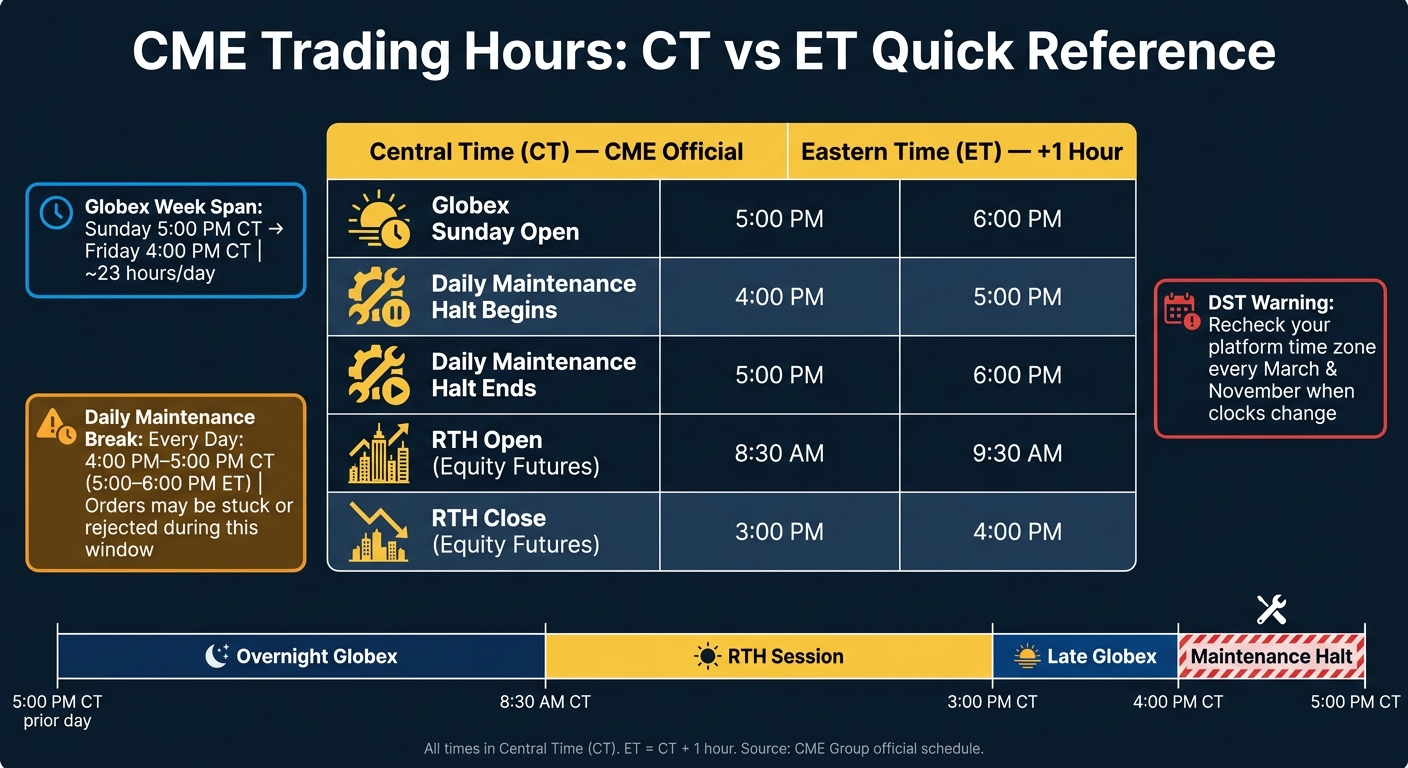
CME Trading Hours: CT vs ET Quick Reference Guide
Holiday calendars, daylight saving shifts, and oddball contract schedules are where CME hours start to get messy.
CT vs ET for U.S. Traders
CME runs on Central Time (CT). Eastern Time (ET) is one hour ahead.
| Session Event | Central Time (CT) | Eastern Time (ET) |
|---|---|---|
| Globex Sunday Open | 5:00 PM | 6:00 PM |
| Daily Maintenance Halt Begins | 4:00 PM | 5:00 PM |
| Daily Maintenance Halt Ends | 5:00 PM | 6:00 PM |
| RTH Open (Equity Futures) | 8:30 AM | 9:30 AM |
| RTH Close (Equity Futures) | 3:00 PM | 4:00 PM |
This matters most in March and November when daylight saving time shifts. If your platform clock is off, your charts, session markers, and order tickets can get out of sync with CME time fast. Recheck your platform time zone and offset when the clock changes.[1]
Holiday-Shortened Sessions
Around major U.S. holidays, CME sometimes cuts trading hours or changes reopen times. Don’t guess. Check the official CME Group holiday calendar before you place trades.[1]
Holiday sessions can be a pain. Liquidity often gets thinner, and slippage can get worse.[1]
That same warning applies to contracts that don’t stick to the usual Globex schedule.
Products With Non-Standard Hours
Big contracts like ES, NQ, CL, and GC usually follow the standard Globex setup, but some products have different maintenance windows or session times.[1] If you’re trading a contract for the first time, look up its hours on cmegroup.com and confirm the maintenance halt before you click buy or sell.[1]
Why CME Trading Hours Matter for Prop Traders
For prop traders, CME hours hit three things right away: fills, risk, and rule compliance. Once you know when the market opens and shuts, the part that matters is what those hours do to your execution and to the rules your firm expects you to follow.
Order Placement and Platform Setup
Before you place a trade, get your broker, platform, data feed, and session template on the same time zone. If one piece is off, your opens, closes, and halt times can shift with it. That’s not a small setup issue. It can cost you.
A bad platform clock can put you into the wrong session or leave working orders sitting there during the maintenance halt. One session off is enough to create a mess you didn’t mean to make.
Liquidity, Slippage, and Settlement Risk
Execution quality can change fast when the market moves from RTH into overnight Globex. Globex runs almost 23 hours, but overnight depth is thinner and spreads get wider. That usually means worse fills outside RTH.
Late-session volatility can also shove open positions deeper into drawdown. That matters even more if your firm watches open equity, not just closed P&L. [1]
A Simple Pre-Trade Session Checklist
Run this before every session:
- Confirm the contract’s exact hours and match your platform’s time zone – Check the exact session times and maintenance halt on CME Group for any contract outside ES, NQ, CL, and GC. Then make sure your session templates use the right offset.
- Check for holidays – Look at the CME Group holiday calendar before trading around any U.S. holiday. Early closes and delayed reopens can trip you up fast.
- Avoid the maintenance break – Be flat, or at least have your orders handled before the market pause. Otherwise, you can end up with stuck or rejected orders.
Bottom Line
The main takeaway is simple: timing matters just as much as direction.
ES, NQ, CL, and GC trade almost 23 hours a day on CME’s Central Time schedule, and that daily maintenance break is a hard stop. No wiggle room there.
Globex and RTH also behave very differently. Overnight Globex is open, but liquidity is thinner and slippage tends to be worse than during RTH. That changes how orders get filled. It also changes how clean your execution looks.
If you’re trading with futures prop firms, market hours don’t just matter for entries and exits. They hit fills, platform sync, and rule compliance too. That’s why CT alignment needs to be your default check before every trade.
Session timing isn’t some side detail. It’s part of the trade plan.
FAQs
Do CME trading hours change for daylight saving time?
Yes. CME trading hours do shift with daylight saving time because CME Group products follow local U.S. time.
Check session start and end times on the official CME site, especially during the spring and fall changeover weeks. That helps keep your platform settings and automated strategies lined up with the current market hours.
Should I hold futures positions through the daily maintenance break?
It comes down to your risk plan and your firm’s rules. CME Globex is open almost 23 hours a day, but the daily maintenance break is a dead zone where liquidity can thin out and settlement gets handled.
That matters. Spreads can get ugly, fills can get sloppy, and holding through that pause isn’t always worth it.
Check your firm’s guidelines before you hold anything into that window. Some firms want positions closed by certain times to cut gap risk or block overnight exposure. Go back and read the rules on session limits and position holding so you don’t get clipped by a rule you missed.
How do I find the exact hours for a specific CME contract?
Check the official CME Group website first. That’s the main source for contract specs and trading hours.
Search the ticker symbol you care about, like ES, NQ, CL, or GC. You’ll see that contract’s electronic session hours, the daily maintenance break, and the holiday calendar.