Profit sharing in futures prop firms allows traders to earn a percentage of profits by trading with the firm’s capital. Here’s how it works:
- Profit Splits: Most firms offer splits between 70%-90%, with some going up to 100%. For example, an 80% split on $10,000 profit means you keep $8,000.
- Evaluation Process: Traders must pass a challenge, hitting profit targets while following strict rules (e.g., drawdown limits). Only 20.35% pass evaluations.
- Funded Accounts: After passing, traders activate funded accounts (often simulated) to qualify for payouts.
- Payout Rules: Firms require minimum trading days, safety net balances, and consistency rules (e.g., no single day exceeding 50% of total profits).
- Profit Models: Firms use fixed splits (e.g., 80/20), tiered splits (increasing with performance), or performance-based splits (up to 100%).
Key Takeaway: Understand payout rules, fees, and split structures to choose the right firm for your trading goals. Firms like Apex Trader Funding and Take Profit Trader offer competitive options, but rules vary significantly.
Trader Harry’s Recommended Prop Firms for Payouts and Profit Splits
sbb-itb-46ae61d
How Profit Sharing Works
Futures prop firms follow a structured process where traders must complete an evaluation, demonstrate their abilities in a simulated environment, and then activate a funded account to qualify for payouts.
The Evaluation Process
Traders begin by purchasing a challenge account, where they trade simulated futures contracts. The objective is to reach a specific profit target while adhering to strict risk management rules, such as a maximum drawdown limit. For instance, Apex Trader Funding’s $50,000 EOD evaluation requires traders to achieve $3,000 in profit without exceeding a $2,000 drawdown.
The success rate for these evaluations is low – only 20.35% of accounts met the objectives between January 2024 and July 2025. This high failure rate highlights the evaluation’s role as a filter, ensuring that only traders with disciplined risk management and consistent strategies advance to the profit-sharing stage.
Getting a Funded Account
Once you pass the evaluation, you must activate your funded account within 7 calendar days to start earning payouts. Missing this activation window, as with Apex Trader Funding, results in losing your passing status.
Funded accounts typically operate in a simulated environment, where traders use demo accounts that replicate real market conditions. At MyFundedFutures, about 43.41% of participants who began the evaluation process eventually reached the simulated funded stage after one or more attempts. However, fewer than 1.01% of participants progress from simulated funded accounts to trading with live capital.
After activation, understanding how payouts are calculated becomes essential.
How Payouts and Splits Are Calculated
Payouts are based on closed trades only – any open positions at the time of a payout request will void the withdrawal. Before receiving your first payout, firms generally require traders to meet several conditions:
- Minimum Trading Days: Complete at least 5 qualifying trading days, earning a net profit of $100–$300 per day, depending on the account size.
- Safety Net Requirements: Your account balance must reach a "Safety Net" level, typically the drawdown limit plus $100, before withdrawing amounts beyond the minimum threshold.
- Consistency Rules: Many firms enforce a 50% consistency rule, meaning no single trading day can account for more than 50% of total profits.
"The 50% consistency rule means that no single profitable day can make up 50% or more of the total net profit earned since your last approved payout." – Apex Trader Funding
Profit splits generally range from 80/20 to 90/10, though some firms now provide 100% of approved payouts. For example, if you earn $5,000 on an account with an 80% split, your take-home profit would be $4,000. Under Apex Trader Funding’s 2026 policies, traders receive 100% of approved payouts, though a payout ladder caps withdrawals during the first six payouts to promote account stability.
Types of Profit Sharing Models
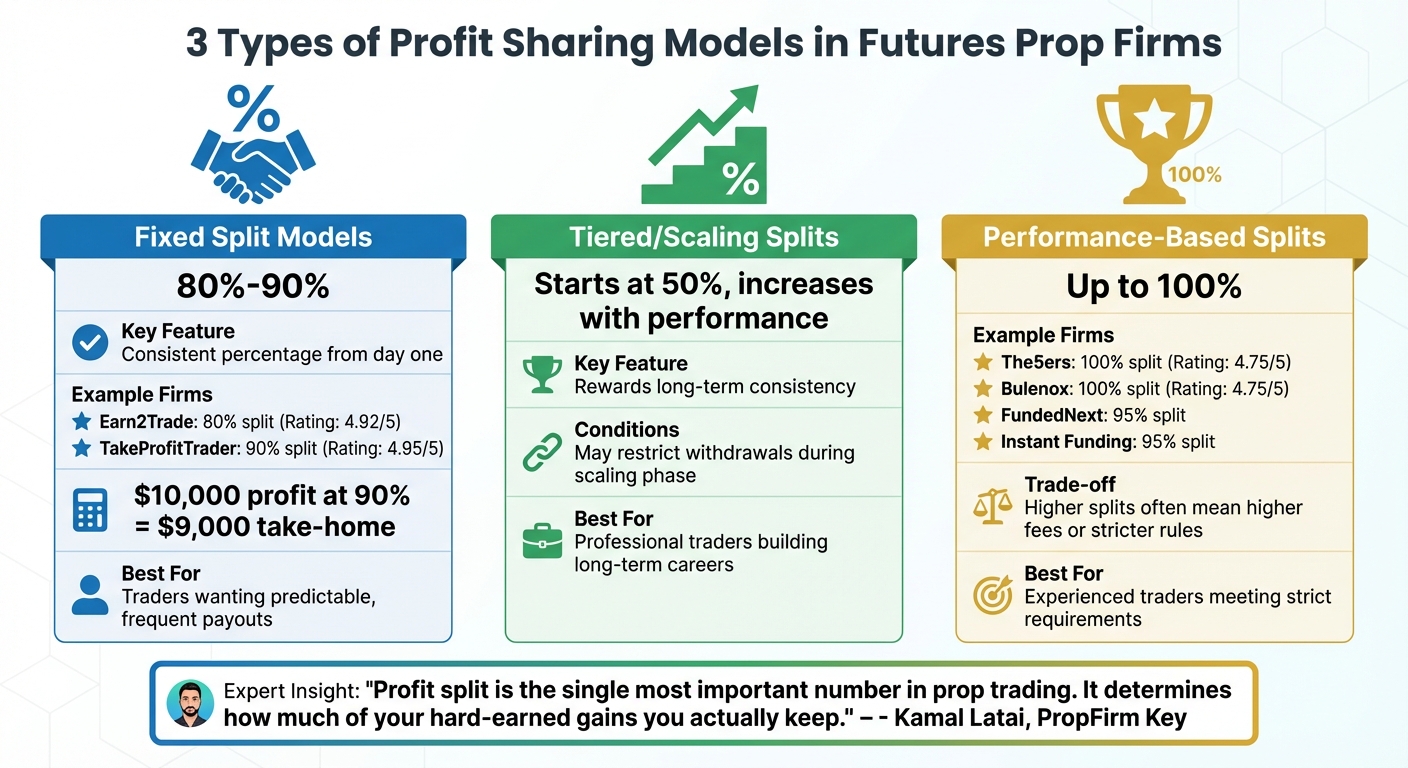
Futures Prop Firm Profit Sharing Models Comparison Chart
Futures prop firms generally use three main profit-sharing structures. Each one is crafted to balance trader earnings with the firm’s operations. Knowing these models can help you choose a firm that matches your trading style and income goals. Let’s dive into how fixed split models provide predictable earnings right from the start.
Fixed Split Models
Fixed split models offer traders a consistent profit percentage from the moment they begin. In 2026, the most common splits range from 80/20 to 90/10, meaning traders keep 80% to 90% of their profits, while the firm retains the rest. For example, a 90% split means you’d earn $1,000 more for every $10,000 in profits compared to an 80% split.
Some firms stand out in this category. Earn2Trade (rated 4.92/5) offers an 80% profit split but compensates with excellent educational tools and a proven payout history. On the other hand, TakeProfitTrader (rated 4.95/5) provides a 90% split, competing in a highly competitive market with at least 13 major firms vying for traders. With fixed models, you know exactly what percentage of your earnings you’ll keep before you even start trading.
"Profit split is the single most important number in prop trading. It determines how much of your hard-earned gains you actually keep." – Kamal Latai, Founder & Lead Analyst, PropFirm Key
Tiered or Scaling Splits
Tiered models reward steady, long-term performance by increasing your profit share or account size as you reach specific benchmarks. For instance, some firms may start you at a lower percentage – like 50% – and bump it up as you show consistent profitability over multiple payout cycles. This setup encourages disciplined trading and offers a path to grow your income faster than relying solely on account funding.
While scaling splits can be lucrative, they often come with conditions. Some firms may restrict withdrawals during the scaling phase. Fixed models may appeal more to traders who prefer frequent, smaller payouts, while tiered structures are better suited for those aiming to build a professional trading career with larger accounts over time.
Performance-Based Splits
Performance-based models take things a step further by offering profit shares as high as 100% to traders who meet strict risk and consistency requirements. As of March 2026, at least nine firms, including The5ers (rated 4.75/5), Bulenox (rated 4.75/5), and Aqua Futures, provide 100% splits. However, these firms often balance the high profit share with higher challenge fees or stricter drawdown rules.
Other firms, like FundedNext and Instant Funding, operate at the 95% level, offering a mix of high earnings potential and strong payout histories. While a 100% split might sound ideal, the actual value depends on factors like fees and rule complexity. For instance, a firm offering an 80% split with simpler rules and lower costs could deliver better overall returns than one advertising 100% but imposing higher fees or tough consistency thresholds.
Profit Sharing Examples from Top Futures Prop Firms
Apex Trader Funding

On March 1, 2026, Apex Trader Funding introduced a 100% profit split on approved payouts for new EOD and Intraday accounts. To qualify, traders must follow a 50% consistency rule and complete five trading days. Initial withdrawals are capped at $2,500, increasing to $5,000 by the sixth payout. For the first three payouts, accounts must maintain a "Safety Net" balance, which equals the drawdown limit plus maintain a "Safety Net" balance, which equals the drawdown limit plus $100.00.
Traders can manage up to 20 active Performance Accounts simultaneously, leveraging copy-trading tools for greater scaling opportunities. Notably, in April 2025, one trader achieved a single payout of $2,552,800.50, one of the largest on record. Another impressive example occurred in December 2024, when trader Patrick Wieland withdrew a total of $608,000. The cost of a $50,000 evaluation is approximately $37 (with an 85% discount) plus a $109 activation fee once funded.
These examples highlight how Apex’s profit-sharing structure can significantly impact trader earnings.
Take Profit Trader

Take Profit Trader offers an 80% profit split and allows traders to withdraw funds starting from day one. A $50,000 evaluation costs around $102, and there are no activation fees. Traders only need five qualifying trading days before requesting their first payout. Unlike Apex Trader Funding, this firm has no consistency rule or daily loss limits, appealing to traders who prefer fewer restrictions. However, news trading is not permitted on funded accounts. While the 80% split means traders keep $800 for every $1,000 earned (compared to Apex’s full 100%), the simpler rules and lower upfront costs may better align with some trading strategies.
FundedNext Futures and Other Top Firms
Other firms also showcase diverse profit-sharing models. FundedNext Futures offers splits up to 95% and features a Rapid Challenge, enabling payouts in as little as three days. Topstep provides traders with 100% of their first $10,000 in profits before transitioning to a 90/10 split. Meanwhile, firms like Alpha Futures, Tradeify, and Lucid Trading also offer competitive models tailored to different trading preferences.
These examples show how choosing the right profit-sharing structure can make a big difference in aligning with your trading style and goals.
What Profit Sharing Means for Traders
Maximizing Earnings with High Splits
At first glance, the difference between an 80% and a 100% profit split might not seem like a big deal. But over time, the gap becomes massive. Modern profit-sharing models, which now offer splits between 80% and 100%, are a far cry from the older 50-60% setups. To put it in perspective, if you earn $10,000, a 100% split means you keep the entire amount, while an 80% split leaves you with $8,000. That 20% difference adds up fast when you’re trading consistently month after month.
The real game-changer, however, lies in multi-account scaling. Firms like Apex Trader Funding allow traders to manage up to 20 active Performance Accounts at once. Using top trade copying platforms, you can replicate a single strategy across all accounts. For example, a $3,000 payout from one $50,000 account can multiply into $60,000 when mirrored across 20 accounts at the sixth payout level.
Staying compliant with firm rules, like the 50% consistency rule, is crucial. This rule requires spreading profits across multiple days to avoid disqualification. Ignoring it could lead to drawdown violations just before you qualify for payouts. By focusing on steady, repeatable gains, you not only protect your funded status but also maintain eligibility for withdrawals. To simplify these complexities, traders can use specialized tools to fine-tune their strategies and stay on track.
Using DamnPropFirms for Comparison and Tools
Finding the right profit-sharing model can feel overwhelming, given the number of variables to consider. That’s where DamnPropFirms comes in. This platform compiles verified reviews, payout structures, and fees from top prop firms, making it easier to compare options. Firms like Take Profit Trader, FundedNext Futures, and Topstep are all covered, giving traders a clear view of splits, payout caps, consistency rules, and activation fees.
Tools like the Consistency Rule Calculator are invaluable for staying compliant. This calculator helps you figure out how to rebalance your trading days if one day accounts for too much of your total profit. It shows how many smaller winning days you’ll need to meet the firm’s requirements and avoid disqualification before requesting a withdrawal. Similarly, the Apex Payout & Scaling Calculator helps you plan withdrawals strategically. It visualizes safety net requirements and projected payouts across single or multiple accounts, ensuring you don’t drop below the required balance.
These tools simplify complex rules into easy-to-understand metrics, reducing errors and boosting profitability. Plus, discount codes like "DGT" can cut evaluation costs by up to 90%, giving you a better return on your investment right from the start.
Conclusion
Profit sharing in futures prop firms involves more than just the split percentage – it also hinges on meeting payout criteria. Most firms offer splits between 70% and 80%, while some elite firms go as high as 90% or even 100%. But let’s be honest: a high split isn’t worth much if payout rules are too restrictive. That’s why understanding factors like consistency requirements, drawdown limits, and minimum trading days is so important.
"Successful trading isn’t just about making profits, it’s about keeping them." – Pipstone Capital
Rather than chasing the largest account size or highest split, it’s smarter to align with a firm that fits your trading style. For instance, a $50,000 account with an 80% split and straightforward rules might outperform a $150,000 account with a 90% split if the latter imposes overly strict conditions.
Some firms, like Apex Trader Funding, offer scaling models that let you grow your account gradually while unlocking better profit splits over time.
Platforms like DamnPropFirms make it easier to compare firms using futures prop firm reviews that break down payout structures, hidden fees, and rule complexities for firms such as Take Profit Trader, Alpha Futures, and Tradeify. They even offer tools like the Consistency Rule Calculator and discount codes (up to 90% off evaluation fees) to give traders an edge before they even start trading. By incorporating payout rules into your overall trading plan, you’ll be in a stronger position to retain the profits you work so hard to earn. Take the time to align your strategy with the right firm to maximize your potential.
FAQs
What fees actually reduce my take-home profit?
Fees can eat into your earnings, so it’s important to keep them in mind. These include profit splits, which usually range from 10% to 30% of your earnings, and per-trade costs, typically $6–$8 per round trip, plus clearing fees. On top of that, you may face monthly data and platform fees between $50 and $130, as well as activation or evaluation fees, which can range from $50 to over $1,000. These costs can add up quickly, so factor them in when figuring out your actual take-home profit.
How do I avoid failing a payout request?
To ensure your payout requests go through smoothly with futures prop firms, it’s crucial to follow their specific rules. These often include requirements like completing a minimum number of trading days, maintaining consistent profits, and respecting payout caps.
For instance, many firms mandate that traders complete 5–10 trading days before they can request a withdrawal. Breaking rules – such as surpassing daily profit limits or failing to meet the minimum trading days – can lead to delays or even denial of payouts.
By understanding the firm’s timelines and how profit splits work, you can avoid unnecessary hiccups and streamline the withdrawal process.
Is a 100% profit split really better than 80%?
A 100% profit split might sound like the dream deal, but it often comes with strings attached – like stricter rules, tougher evaluations, or payout conditions that can seriously cut into what you actually take home. On the other hand, an 80% split, while smaller, usually comes with more relaxed rules, easier evaluations, and steady payouts. At the end of the day, the right choice isn’t just about the percentage. It’s about understanding the firm’s rules, how challenging the evaluations are, and how consistent your trading performance is.