80–90% of traders fail their first prop firm challenge. The main reason? Breaching drawdown limits. These rules, designed to manage risk, often catch traders off guard. Here’s what you need to know to avoid failure:
- Types of Drawdown Rules:
- Daily Drawdown: Limits losses per trading day (e.g., 4–5% of account balance).
- Trailing Drawdown: Adjusts upward with equity gains but never resets downward.
- End-of-Day (EOD) Drawdown: Based on closed balance at market close.
- Common Mistakes:
- Increasing position size after early wins.
- Ignoring unrealized losses (floating P&L).
- Over-risking after losing trades.
- Starting the day with little room above drawdown limits.
- Misunderstanding EOD calculations.
- Key Strategies to Pass:
- Risk only 0.5–1% per trade.
- Set personal loss limits tighter than firm rules.
- Use hard stop-loss orders.
- Avoid over-leverage and correlated trades.
- Monitor equity in real-time, not just balance.
Mastering drawdown rules and disciplined risk management is the difference between passing and failing. Focus on small, consistent gains and avoid emotional trading to succeed.
Top 5 Mistakes That Make Traders FAIL Prop Firm Challenges!
5 Common Drawdown Mistakes That Cause Challenge Failures
Many traders fail prop trading challenges due to avoidable mistakes that lead to drawdown violations. Below are five common errors that can derail your evaluation and how to avoid them.
Increasing Position Size After Early Profits
Early wins can be a double-edged sword. While they boost confidence, they often lead traders to increase position sizes prematurely. This can be risky, especially with trailing drawdown limits. These limits adjust upward as your account equity grows, tightening your buffer. As Prop Trader HQ explains:
"Trailing drawdown is more punishing because it reduces your safety buffer as you win."
To safeguard your progress, consider reducing position sizes after a strong performance. Overconfidence can lead to larger trades, which may wipe out your gains and jeopardize your evaluation.
Forgetting About Unrealized Losses
Unrealized losses are a silent threat. Many prop firms calculate drawdown based on total equity, which includes floating losses on open trades. For example, holding a trade with an $800 floating loss might make your closed balance appear stable, but in reality, your equity is dangerously close to the drawdown limit. As Prop Trading Pros warns:
"Ignoring your floating PnL is the fastest way to fail."
To avoid this pitfall, use hard stop-loss orders for every trade. Relying on mental stops can leave you vulnerable to unexpected market moves that push your account over the limit.
Taking Bigger Risks After Losing Trades
Chasing losses is a common but costly mistake. After a losing trade, some traders increase their risk in an attempt to recover quickly. This impulsive behavior often results in breaching daily or overall drawdown limits. A better approach? Step away from the screen for 15 minutes after a loss. This brief pause can help you regain emotional control and stick to the principle of risking no more than 0.5% to 1% of your account per trade.
Starting the Day Too Close to Drawdown Limits
Beginning a trading session with little room above the drawdown threshold is a recipe for disaster. Even minor market fluctuations, like slippage or poor fills, can trigger violations. To avoid this, set a personal daily loss limit that’s 30% to 50% tighter than the firm’s rule. For example, if the firm allows a 5% daily drawdown, limit yourself to losses between 2.5% and 3.5%. This additional buffer can protect you from unexpected market swings.
Confusion About End-of-Day Calculations
End-of-day (EOD) drawdown rules can be tricky. Some firms base EOD limits on your closed balance at the session’s end, ignoring intraday fluctuations. While this might seem lenient, it can catch you off guard if you hold losing trades overnight. If those trades close at a loss that exceeds the EOD limit, your evaluation ends immediately. To avoid misunderstandings, make sure you fully understand your firm’s specific rules, including how and when the limits reset.
Being aware of these mistakes and how drawdown rules work can save you from costly errors, as explained further in the next section.
How Different Drawdown Rules Work
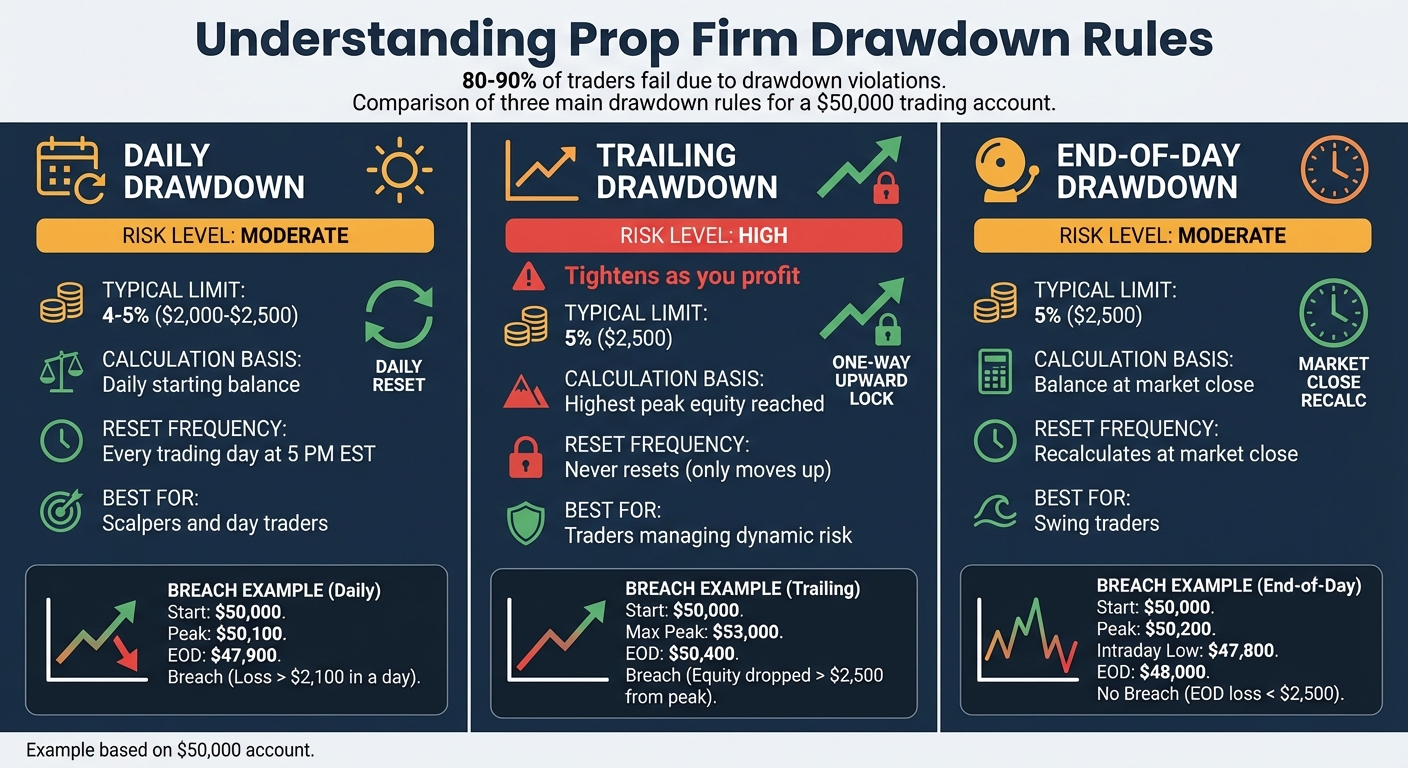
Prop Firm Drawdown Rules Comparison: Daily vs Trailing vs End-of-Day
Grasping how prop firms set and enforce drawdown limits is essential to steering clear of costly violations. Each type of drawdown rule operates differently, and what feels safe under one system might lead to trouble under another.
Daily vs. Trailing vs. End-of-Day Drawdown Rules
The three main drawdown types – daily, trailing, and end-of-day (EOD) – each have unique ways of resetting and calculating losses. Here’s a quick breakdown:
- Daily drawdown caps how much you can lose in a single trading day, resetting at 5 PM EST daily.
- Trailing drawdown adjusts upward with your account’s peak equity but doesn’t move back down.
- End-of-day drawdown recalculates your loss limit at market close, based on your closed balance.
Let’s compare these rules using a US$50,000 account:
| Feature | Daily Drawdown | Trailing Drawdown | End-of-Day Drawdown |
|---|---|---|---|
| Typical Limit | 4–5% (US$2,000–US$2,500) | 5% (US$2,500) | 5% (US$2,500) |
| Calculation Basis | Daily starting balance | Highest peak equity reached | Balance at market close |
| Reset Frequency | Every trading day | Never resets | Recalculates at market close |
| Risk Level | Moderate | High | Moderate |
| Best For | Scalpers and day traders | Traders managing dynamic risk | Swing traders |
These differences highlight why adjusting your risk strategies to fit each rule is non-negotiable. Misunderstanding them could derail your progress in a prop challenge.
For example, firms like Topstep and Tradeify use daily drawdown rules, while Apex Trader Funding relies on trailing drawdown. As FunderPro puts it:
"Trailing drawdown requires traders to protect profits as actively as principal. The more you gain, the tighter the room for error becomes relative to the new high-water mark."
Real Trading Scenarios That Trigger Violations
Now that we’ve outlined the rules, let’s dive into real-world examples of how traders can cross these limits.
Trailing Drawdown Example: Imagine your US$50,000 account grows to US$53,000 on an open trade. The trailing limit shifts upward from US$48,000 to US$51,000. If your equity dips below US$51,000, even briefly, you’ve violated the rule.
Daily Drawdown Example: Suppose your session starts at US$50,000 with a 5% daily limit (US$2,500). If you lose more than US$2,500 by the end of the day, regardless of recovery, the evaluation ends. ThinkCapital cautions:
"Most traders obsess over the overall drawdown while completely underestimating the daily drawdown limit. Lose $5,001 [on a $100k account] by market close? Challenge over."
End-of-Day Drawdown Example: Say your account closes Monday at US$52,000. The new 5% drawdown limit becomes US$49,400. If you hold an overnight position and lose US$2,700 on Tuesday, dropping your equity to US$49,300, you’ve breached the limit.
Effective drawdown management is a must to pass your prop evaluation. Tailor your approach to the rule in play – adjust position sizes, set stop losses, and monitor your equity constantly to stay within the limits.
sbb-itb-46ae61d
How to Avoid Drawdown Violations
Knowing the rules around drawdowns is one thing, but sticking to them is where most traders stumble. The reality is stark – 80% to 90% of traders fail their first prop firm challenge. The good news? You can bridge this gap with practical strategies.
Set Personal Loss Limits Below Firm Rules
The best traders don’t push their accounts to the edge. Instead, they create a cushion by setting personal loss limits well below the firm’s thresholds – typically 50-70% of the official allowance. For example, if your firm allows a 5% daily loss on a $50,000 account (that’s $2,500), aim to cap your losses at 2.5% ($1,250). This buffer protects you from unexpected slippage, commissions, and emotional decisions.
Start small. Limit your risk to 0.35% per trade until you’ve built up a 2% profit cushion. Once you’ve hit that, you can ease into the more standard 0.5-1% risk levels. Why? Statistics show that risking 0.35% per trade drastically lowers the chance of hitting the 10% maximum drawdown – even during a 15-trade losing streak. On the flip side, risking 2% per trade with a 55% win rate? That creates a 62% chance of blowing your account.
Adopt a simple rule: the "Two/Three Strikes" system. After two consecutive losses, stop trading and take a break. After three losses, shut down for the day. Here’s how it works: after the first loss, review your setup. After the second, take a mandatory 30-minute breather. If you hit three losses, close the platform entirely. This approach helps you avoid revenge trading, which is responsible for 60% of breached evaluations.
Once your loss limits are in place, focus on managing each trade with precision.
Use Stop Losses and Manage Position Size
Every trade should have a hard stop loss in place. This isn’t optional – it’s essential. Calculate your position size so you’re risking no more than 0.5% per trade. Don’t forget to account for hidden costs like commissions, spreads, and slippage. These small factors can push you over your daily loss limit, even by just a few cents, and end your challenge.
Adjust your risk based on how many trades you take daily. For a single trade per day, risking 1% might be fine. But if you’re taking two trades, drop it to 0.5%. For three or four trades, stick to 0.25% risk per trade. This strategy helps prevent multiple losses from snowballing into a violation.
Monitor Your Equity in Real Time
Tracking your equity (realized and unrealized P&L) is non-negotiable. Remember, prop firms count floating losses toward your drawdown limits. That means you need to monitor your "Net Liquidation Value" or "Equity", not just your account balance. Before every trade, calculate how far you are from your failure line. For accounts with trailing drawdowns, keep an eye on your high-water mark – this moves up with profits but never comes back down.
Use tools like DamnPropFirms‘ Consistency Rule Calculator to stay on top of your limits (https://damnpropfirms.com). Write down your trailing drawdown level and daily loss limit in dollar terms before each session. If you’re trading across multiple accounts, cloud-based dashboards can help you keep everything synchronized.
Avoid Over-Leverage and Correlated Trades
Trading multiple correlated positions can quickly magnify your losses. For example, trading ES, NQ, and YM futures at the same time isn’t diversification – it’s triple exposure to the same market movement. When the indices drop, all three positions lose value simultaneously, potentially triggering a violation in minutes.
Leverage compounds this danger. Using your full buying power in one direction can lead to wild equity swings, even with small market moves. Keep your exposure conservative, especially with trailing drawdown accounts, where unrealized gains push your failure threshold higher. If the trade reverses before you close it, you could breach the account – even if it’s technically still profitable relative to your starting balance.
Finally, end each trading day with a structured routine to keep your strategy grounded.
Build a Reliable End-of-Day Routine
Close all positions before the market closes or your firm’s session cutoff to avoid overnight hold violations. These often lead to automatic disqualification. Most firms reset daily drawdowns at 5:00 PM EST – this is your "daily breaker" point, which defines the starting equity for the next day’s loss limit.
At the end of your session, note the next day’s violation levels and lock in your new high-water mark if you’re profitable. Check your progress toward meeting minimum trading day requirements and consistency rules – many firms won’t allow a single trade to account for more than 30% of your total profit. Don’t forget to review the economic calendar for major news events like CPI, NFP, or FOMC announcements. Many firms restrict trading during these high-volatility periods.
Finally, journal not just your profits but also your behavioral patterns. Reflect on moments when you felt tempted to overtrade or ignore your stops. As FunderPro wisely advises:
"Stop trading before you stop thinking".
This discipline, developed during evaluations, lays the groundwork for success with a funded account.
Conclusion
Passing a prop firm challenge hinges less on having a perfect strategy and more on mastering disciplined risk management. Statistics reveal that 80–90% of traders fail their first attempt, with nearly 95% of failures tied to poor risk management practices. One of the biggest culprits? Daily drawdown limits, often capped at just 4–5%, which quietly derail more traders than any other rule.
The solution is straightforward but requires unwavering dedication. Keep your risk per trade between 0.5–1%, and always use enforced stop losses. To add an extra layer of protection, set your personal daily loss limits at 50–60% of the firm’s official threshold. Be mindful of equity-based drawdown rules, which count floating losses – meaning your account could breach its limit even with trades still open. If you’re dealing with a trailing drawdown, pay close attention to your high-water mark, as this threshold only moves upward with profits. These strategies are essential for navigating the common pitfalls of prop firm challenges.
This approach is widely endorsed by experts in the field. Pedro Taveira, Founder of LivingFromTrading, emphasizes:
"Risk management is the real reason traders pass prop firm challenges. A good strategy helps, but disciplined risk is what keeps your account alive long enough for the strategy to work".
Prop firm evaluations aren’t about predicting the market – they’re designed to test a trader’s discipline under pressure.
To further improve your chances, implement the "Two-Loss" rule, steer clear of revenge trading (which accounts for 60% of breached evaluations), and close all positions ahead of high-impact news events. With a 1:2 reward-to-risk ratio, a 35% win rate is enough to be profitable – but only if you stick to your drawdown limits.
For more tips and in-depth reviews of futures prop firms, visit DamnPropFirms. Explore detailed evaluations of firms like Apex Trader Funding, Tradeify, Lucid Trading, and Legends Trading.
FAQs
How do I calculate my drawdown “failure line” before placing a trade?
To figure out your drawdown "failure line", start by determining the maximum loss allowed under your proprietary trading firm’s drawdown rules – whether they’re static or trailing.
- Static Drawdown: This is a fixed amount. For example, if you’re trading with a $100,000 account and the drawdown limit is 8%, your "failure line" would be $92,000 ($100,000 – $8,000).
- Trailing Drawdown: This is tied to your highest equity point. If your account grows to $105,000 and the trailing limit is 8%, your new "failure line" would be $96,600 (8% below $105,000).
Keeping an eye on this limit is critical for managing risk and ensuring you stay within the firm’s guidelines while trading.
Does floating (unrealized) P&L count toward drawdown on my prop challenge?
Yes, unrealized (floating) P&L typically factors into drawdown during prop trading challenges if the rules state that drawdown is calculated based on account equity, which includes unrealized gains or losses. This is especially common with trailing drawdown rules. It’s crucial to carefully review your firm’s specific guidelines to fully understand how they calculate equity and drawdown.
What’s the safest risk per trade to avoid breaching daily or trailing drawdown?
A good rule of thumb for risk per trade is to keep it within 1-2% of your account balance. Sticking to this range can help protect you from hitting daily or trailing drawdown limits that many prop firms enforce. However, it’s crucial to align your risk tolerance with the specific guidelines of your prop firm. Incorporate this approach into a well-thought-out risk management plan to ensure consistent and sustainable trading.