The short version: the best time to trade futures is when your setup matches the session’s pace. More movement isn’t always better. If your fills get worse, your edge can disappear fast.
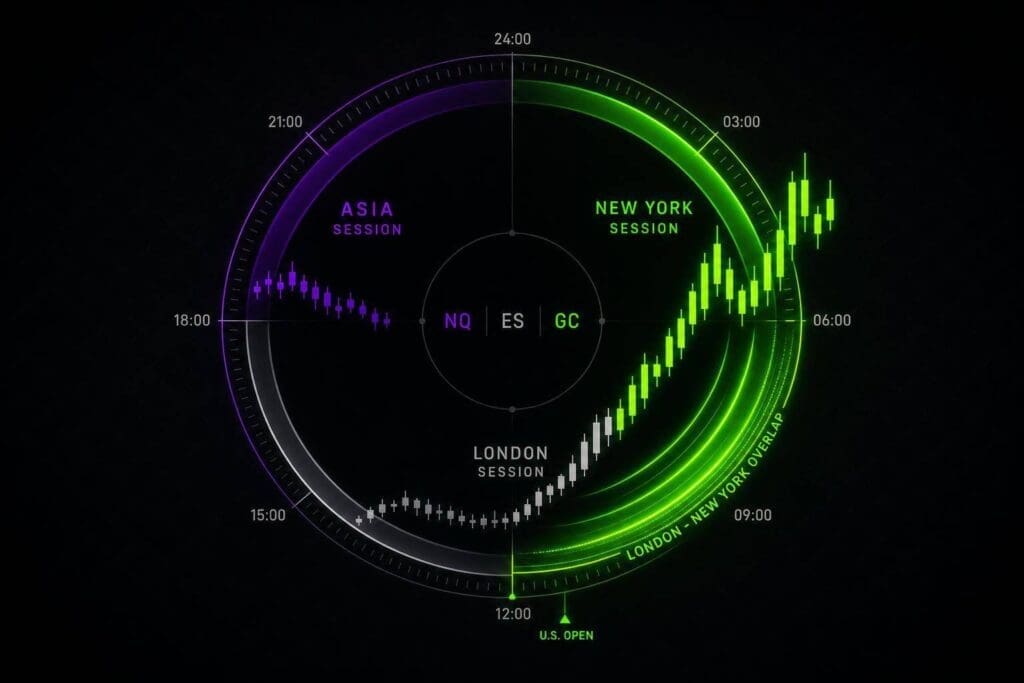
I’d break the day into a few simple windows: Asia for slower range trades, London for early trend flow, the London-New York overlap for the cleanest liquidity, the U.S. open for raw speed, midday for patience, and the close for planned late moves. If you trade ES, NQ, CL, or GC, that session choice matters just as much as your entry. Here’s the no-BS version of when each window tends to work, where it gets ugly, and who should be trading it.
1. Asian Session
The Asian session is usually the slowest part of the day for U.S.-listed futures. That changes how you should trade it. Fill quality matters more than speed, and patience matters more than trying to force action. Thin conditions can lead to more slippage and worse fills, especially in ES, NQ, GC, and CL.
Volatility and Liquidity
Volatility is usually muted, and market depth is thinner than it is during U.S. hours. In plain English, orders may take longer to fill, and price action often looks less clean. Moves can stall out fast, then drift, then pop for no good reason. That’s normal in this session.
Spread Quality
When volume is light, spreads and slippage can get worse. That’s why limit orders usually make more sense than urgent market orders here. If you smash market orders in a thin book, don’t act shocked when the fill sucks.
Strategy Fit
This session works better for patient, lower-speed execution. Think range trades or selective overnight continuation setups. It is usually a poor fit for fast scalps or breakout chasing, where one bad fill can wreck the whole trade. As Europe comes online, volume and pace usually get better.
sbb-itb-46ae61d
2. London/European Session
The London/European session is where things usually start to wake up. Volume picks up. Price starts moving with some intent. And that leads straight into the next big handoff: the London–New York overlap.
Volatility and Liquidity
GC (Gold) is often the busiest contract in this session, and it often puts in its best directional moves before the U.S. cash open[1]. ES, NQ, and CL usually trade better here than they do during the Asian session, but it’s not equal across the board. Some days Gold leads hard. Other days index futures and crude just grind.
Spread Quality
Spreads usually get better in this window, but don’t assume clean fills just because the market looks more active. Your data feed and order routing still matter.
Strategy Fit
London often sets the early tone, so trend setups usually make more sense than reactive scalp entries. If momentum builds early, this session tends to fit intraday trend trading best. The London Close can also give you a clean setup window if that’s part of how you read the day.
Once New York starts coming online, that overlap becomes the next key window for futures traders.
3. London–New York Overlap
As London winds down and New York gets going, liquidity and volatility hit their high point. This London–New York overlap is the main liquidity window of the day because Europe is still flattening or rotating positions while U.S. traders are just stepping in [1][2].
Liquidity, Volatility, and Spread Quality
ES has the deepest book and the tightest spread out of the four contracts, so it’s the easiest one to trade with size during this window [1]. NQ moves faster. It has bigger price swings, and its spread can change fast when news hits [1]. CL and GC both react to dollar movement and inventory-related data, and execution is usually cleanest in the first two U.S. hours while London is still active. That said, spreads in both can get ugly fast if liquidity drops around major releases [1].
| Contract | Overlap Characteristic | Spread Quality | Best Strategy Fit |
|---|---|---|---|
| ES | Maximum liquidity, deepest book | Tightest and most consistent | Scalping, large-size execution |
| NQ | High volatility, wider price range | Competitive, but dynamic near data | Momentum, intraday trend |
| CL | Trend intensity, dollar-driven | Volume-dependent | News trading, mean reversion |
| GC | Macro sensitivity | Tight during U.S. open hours | Safe-haven plays, scalping |
Strategy Fit
This is the window for scalping, breakouts, and intraday trend trades. Liquidity is there. Speed is there. Direction is usually cleaner too [2]. If you’re trading at this pace, low-latency feeds like Rithmic or CQG are common picks because fills matter more when the tape is moving hard [1].
Pay close attention to 8:30 a.m. ET and 9:30 a.m. ET. Data drops can cause slippage or sharp reversals, and the cash open can kick off an opening drive or trap traders in a false breakout [1]. The overlap starts losing steam around 11:00 a.m. to 12:00 p.m. ET as London closes [2].
As the overlap ends, the 9:30 a.m. ET U.S. open brings the next burst of volume and a different pace.
4. U.S. Open
The U.S. open is the fastest, highest-risk window for ES, NQ, CL, and GC[1]. At 9:30 a.m. ET, when the U.S. cash market opens, volatility usually kicks up again. Volume comes in heavy. Price moves fast. And your data feed and order routing matter more here than any indicator slapped on the chart. Low-latency setups like Rithmic or CQG are common picks because when the tape starts ripping, fills matter[1].
Strategy Fit
This is where speed matters most, but only if your execution is dialed in. The U.S. open fits scalping and fast intraday trading, especially if you’re comfortable working the DOM and reading order flow while things get hectic[1]. ES usually handles size best. NQ moves the fastest. CL can snap hard on headlines. GC often makes sharp moves around macro data.
Low day-trade margins can bait you into trading too big, so set your size and risk plan before the session starts[1]. That’s the core tradeoff at the open: more opportunity, but also more slippage risk at the exact same time.
That opening burst usually gives way to the midday lull.
5. Midday/Lunch Period
After the U.S. open cools off, midday usually gets quieter. The London close pulls out another chunk of flow, volume dries up, and the tape slows down. The crazy morning burst is gone. What you get instead is a more deliberate session.
This isn’t just a dead patch in the day. It’s a post-open reset, and that changes how you should trade it.
Thin order flow can mess with your fills. You might get slipped more than you’d like, and that stings if you’re trading for tight targets. Midday is where overtrading tends to smack people around. Patience usually pays better than speed.
Keep it simple:
- Trade only the clean setups
- Cut size down
- Keep risk limits tight
That slower stretch usually starts to pick up again later in the afternoon as the market heads toward the close.
6. U.S. Afternoon and Close
After the midday lull, the market usually starts leaning toward the close. Traders trim risk, close positions, and react to late-session order flow. The last hour can wake things up again.
Volatility
Once lunch is over, price action is often quiet for a while. Then the final hour kicks in, and movement tends to pick up as traders square positions and end-of-day flows hit the tape. It’s usually less explosive than the open, but there’s still enough action for planned trades instead of random stabs.
Strategy Fit
This window works well if you trade off prior-day levels, daily trend context, and late-session momentum. It also suits traders who want a slower pace than the open. Think of it as the middle ground: calmer than the morning rush, but still active enough for clean, structured setups.
Pros and Cons of Each Session Window
There’s no magic session that works for everyone. Your edge comes from lining up the session with how you trade, when you’re available, and how much speed and noise you can handle. That’s the whole game here.
Here’s the side-by-side view:
- Asian: quietest. Better for slower setups or automated strategies.
- London/European: better liquidity than Asia, with more trend development.
- London–New York Overlap: peak liquidity, tight spreads, and deep books. This is where fills and latency start to matter a lot.
- U.S. Open: biggest momentum, biggest pressure.
- Midday/Lunch: usually the choppiest part of the day. Range traders and bots can still do fine here.
- Afternoon/Close: calmer than the open, but still active enough for clean setups. The close can still jump on rebalance flow.
Use the table below to match each window to your pace and trade type.
| Session | Key Pros | Key Cons | Best Fit |
|---|---|---|---|
| Asian | Lower volatility; more predictable ranges | Less opportunity than busier sessions | Automated strategies; slower-paced traders |
| London/European | Trend establishment; stronger liquidity than Asia | Early hours for U.S.-based traders | Trend followers; breakout traders |
| London–New York Overlap | Peak liquidity; tight spreads; deep order books | Slippage and latency matter more | Scalpers; order flow traders |
| U.S. Open | Maximum momentum and volume | Fast pace punishes hesitation | Experienced scalpers; momentum traders |
| Midday/Lunch | Range-bound setups; lower stress | Choppy action; more false breakouts | Range traders; automated setups |
| U.S. Afternoon/Close | Structured setups; end-of-day flows | Less explosive than the open; close can still spike | Intraday trend traders; position closers |
One practical note on execution: charting-first platforms make more sense in slower sessions. DOM-focused tools make more sense at the U.S. Open. If you need ladder speed, use the tool built for speed. If you’re waiting on cleaner setups, a chart-first workflow is usually enough.
Next, match the session to your own schedule and trading style.
Which Session Fits Your Trading Style and Schedule
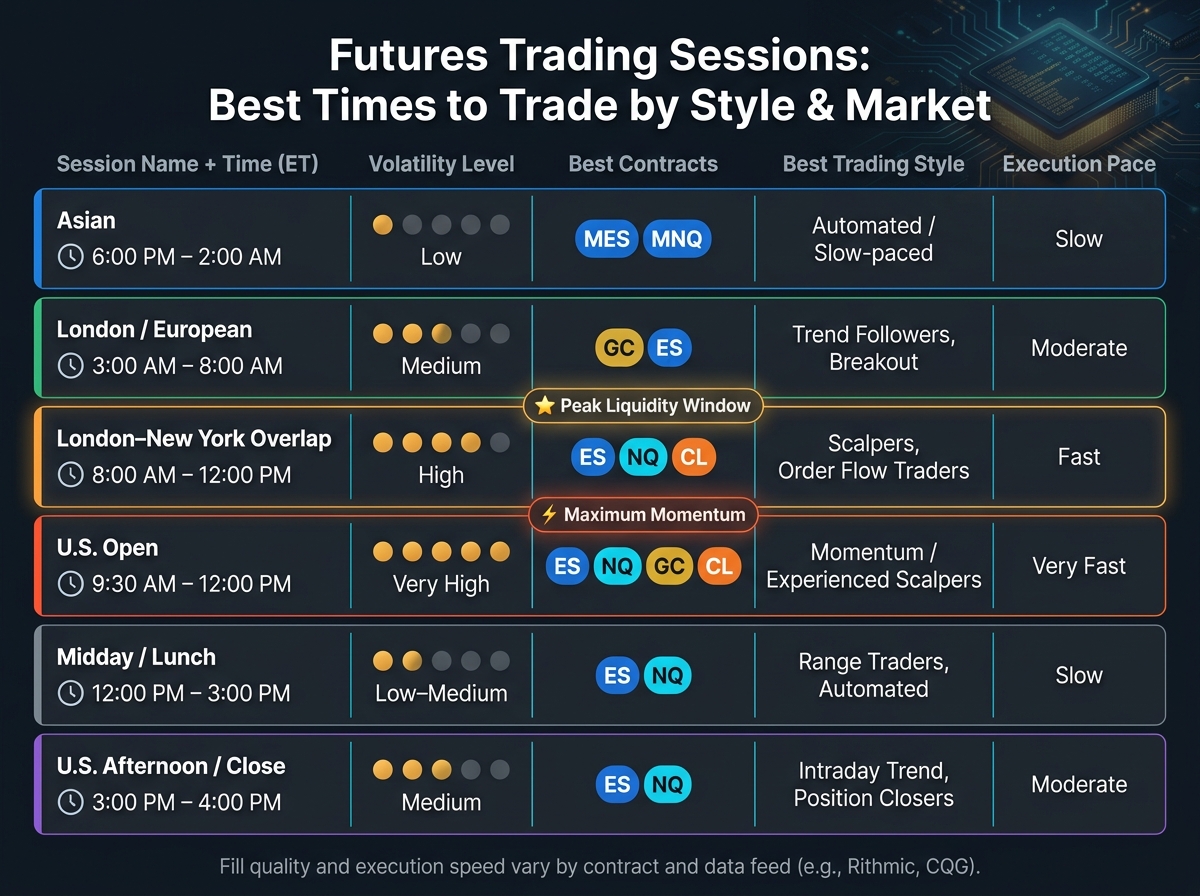
Futures Trading Sessions: Best Times to Trade by Style & Market
Once you’ve got the session breakdown, the next job is simple: line those hours up with how you trade in real life. Start with liquidity, volatility, and how fast you need fills. Then match that window to your setup.
Your schedule matters just as much as your strategy. If you scalp ES or NQ, the London–New York overlap is usually the cleanest fit. That’s where you get the most action, the best depth, and the tightest spreads. If you trade intraday trends in CL or GC, the U.S. open is usually where the market shows its hand. Breakout traders usually stick to the London open or U.S. open because those are the two windows that most often deliver the kind of hard move a breakout setup needs.
If you trade at night, the Asian session makes more sense. It’s slower and easier to manage if you don’t want nonstop whipsaws. If you’re up early, the London session is a solid fit for catching trend development before New York comes online.
Here’s the clean version.
| Trading Style | Best Session Window (ET) | Primary Products | Execution Pace |
|---|---|---|---|
| Scalper | London–New York overlap (8:00 a.m. – 12:00 p.m.) | ES, NQ, CL | Fast; deepest book, tightest spreads |
| Intraday Trend | U.S. open (9:30 a.m. – 12:00 p.m.) | ES, NQ, GC, CL | Fast; strong directional flow |
| Breakout Trader | London open (3:00 a.m.) / U.S. open (9:30 a.m.) | NQ, CL | Fast; sharp moves at session open |
| Night session | Asian session (6:00 p.m. – 2:00 a.m.) | MES, MNQ | Best for patient, lower-speed trading |
| Morning session | London session (3:00 a.m. – 8:00 a.m.) | GC, ES | Best for early trend development |
| Afternoon close | U.S. afternoon/close (3:00 p.m. – 4:00 p.m.) | ES, NQ | Moderate; end-of-day position flows |
The right session is the one that gives you opportunity without forcing you to trade faster than you should. Pick the window your strategy can execute cleanly.
FAQs
How do I pick the right futures session for my trading style?
Match your strategy to the session’s liquidity, volatility, and pace. Start with the style you trade: scalping, intraday trend following, or breakout trading. Then line that up with your actual schedule and the amount of risk you can handle without forcing trades.
Execution matters too. A setup can look great on paper and still fall apart if the market is thin or moving like a chainsaw. Trade the sessions where products like ES or NQ have enough liquidity for your size, and make sure your platform and data feed hold up when volume picks up and the tape gets busy.
Which session is best for beginners trading ES, NQ, CL, or GC?
There’s no one best session for beginners. With ES, NQ, CL, and GC, the main thing is simple: trade when the market has decent liquidity, and line that up with how you trade, whether that’s scalping or intraday work during CME Globex hours.
If you’re new, don’t get too hung up on finding some magic time of day. That’s not the edge. Your bigger issue is whether your setup makes sense on the boring stuff that hits your P&L fast:
- Execution
- Commissions
- Margin requirements
That stuff matters because it has to fit your risk plan. If your fills suck, your fees are too high, or the margin is too tight for the way you trade, the session choice won’t save you.
When should I avoid trading futures because of poor liquidity or choppy action?
In general, don’t trade futures during low-liquidity periods. That’s when chop tends to get worse and clean moves get harder to trust. You’ll usually see this outside a product’s main market hours, especially during the lunch lull from 11:30 AM to 1:30 PM ET and during the overnight session.
Be extra careful around market holidays and the last few minutes of a trading session. Lower volume can widen the bid-ask spread and make price action a lot less clean.