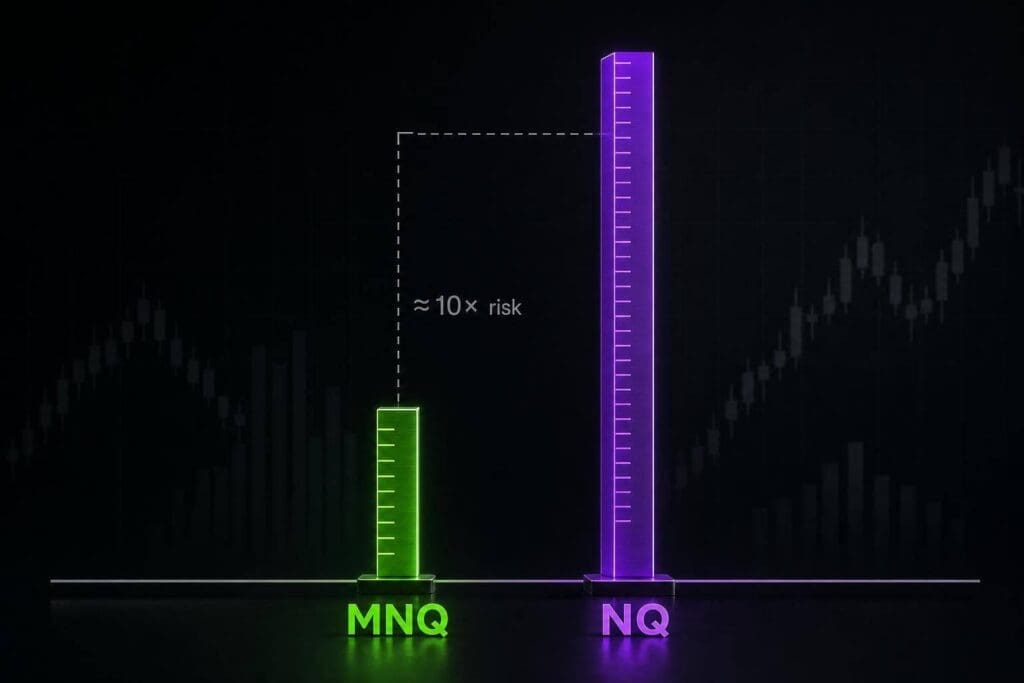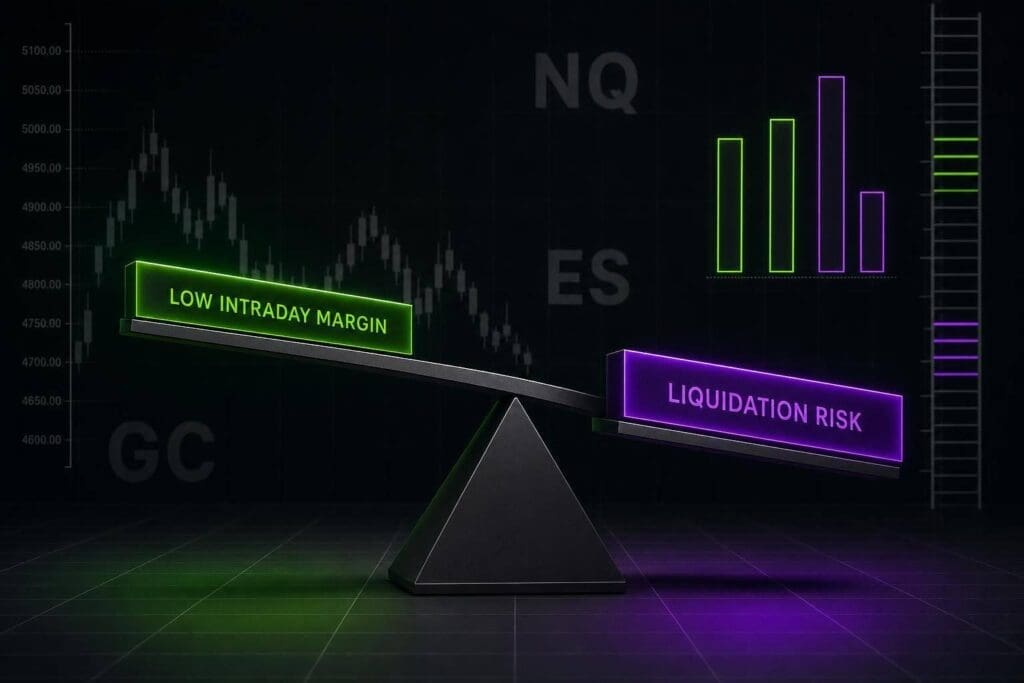
Short version: AMP posts the lowest day-trade margins in this group, NinjaTrader and Tradovate sit a bit higher on the common index and commodity contracts, and TradeStation is the one you need to verify live before you size anything. That’s the answer.
What matters more is the gap between cheap to enter and safe to hold. A $40 MES margin or $400 ES margin looks low, but one bad move, some slippage, and a late-session margin switch can wreck a small account fast. I’d use margin numbers as a filter, not as a sizing rule. Below, I’m cutting this down to the stuff that matters: the broker differences, the contract gaps, and where traders get smoked by cutoff risk.
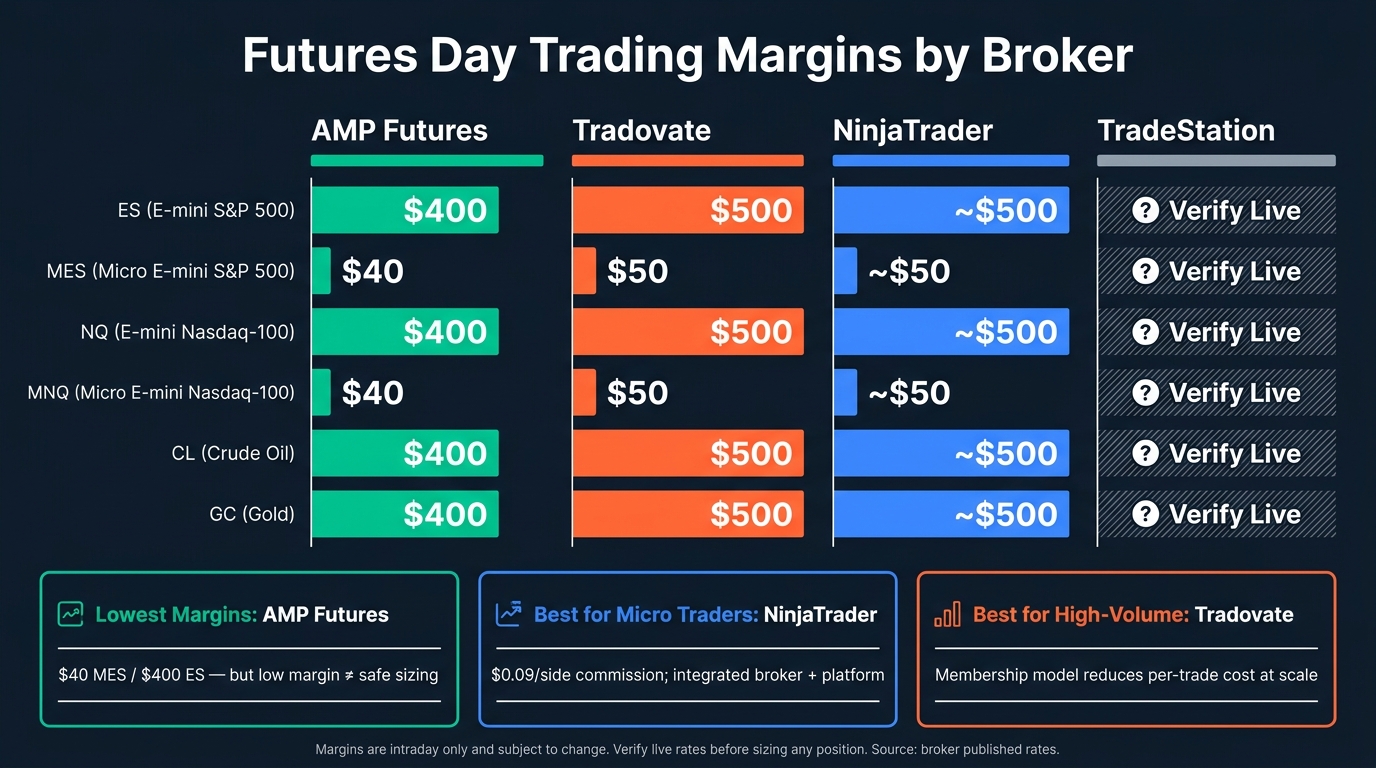
Futures Day Trading Margins by Broker: AMP vs NinjaTrader vs Tradovate vs TradeStation
1. NinjaTrader
NinjaTrader is both an FCM and a trading platform, so funding, clearing, and execution all sit in one account.[1]
For margin comparison, the cutoff matters more than the platform itself. NinjaTrader’s reduced intraday margin only applies during the day-trading window. Once that cutoff hits, your open positions have to meet the full overnight margin requirement, or the broker can liquidate them.[1]
sbb-itb-46ae61d
2. Tradovate
Tradovate offers lower intraday margins on futures contracts, which cuts the cash you need to day trade ES, MES, NQ, MNQ, CL, and GC.[1] That matters because margin numbers decide how much room you have before a trade starts choking your account.
Tradovate’s current intraday day-trade margins are about:
- ES (E-mini S&P 500): $500
- MES (Micro E-mini S&P 500): $50
- NQ (E-mini Nasdaq-100): $500
- MNQ (Micro E-mini Nasdaq-100): $50
- CL (Crude Oil): $500
- GC (Gold): $500
Those lower margins make it easier to get into a trade. They also make it easier to get over your skis. A $50 MES margin or $500 ES margin can look cheap, but that doesn’t mean the contract is cheap to hold when it starts moving against you.[1]
Tradovate can also bump margin requirements during volatile sessions. If you’re trading close to the minimum, that can turn into a forced liquidation fast.[1] Leave a buffer above the posted margin. That’s the safer move. This is especially true when trading with E8 Futures or other funded accounts where drawdown rules are strict.
Next, stack Tradovate’s margin levels against AMP Futures, because small contract-by-contract gaps can change how many lots you can carry.
3. AMP Futures
AMP posts some of the lowest day-trade margins in this comparison for ES, MES, NQ, MNQ, CL, and GC:
- ES (E-mini S&P 500): $400
- MES (Micro E-mini S&P 500): $40
- NQ (E-mini Nasdaq-100): $400
- MNQ (Micro E-mini Nasdaq-100): $40
- CL (Crude Oil): $400
- GC (Gold): $400
That sounds great on paper. And for active futures traders using a cloud-based trade copier, it can be. Lower margin means you can put on more size with less cash in the account. The flip side is obvious: it also gets a lot easier to oversize and blow past what your account can handle.[1]
AMP only gives you that intraday margin during its day-trading window. Once the cutoff hits, overnight margin takes over.[1] If you’re holding near the close, that matters. A lot.
Your all-in trading cost at AMP isn’t just the margin number. It also includes commissions, exchange fees, and routing fees. Check the fee stack for the exact contract you trade before you place size.[1]
Next up, stack those lower AMP requirements against TradeStation’s intraday margin policy.
4. TradeStation
TradeStation is a futures broker and FCM. The problem is simple: in this source set, there are no published intraday or overnight margins for ES, MES, NQ, MNQ, CL, or GC. The cutoff times and liquidation rules tied to those margins also aren’t listed here.
That makes TradeStation tougher to use as a clean margin benchmark for position sizing. If a broker shows contract-by-contract day-trade rates in plain sight, you can do the math fast. With TradeStation, you need to verify the current numbers first. Do that before you size a trade.
This matters more than it sounds. Small margin differences can change how much size you can hold, how much room you have in the trade, and how close you are to forced liquidation.
How Margin Differences Affect Your Trading
Those broker differences only matter when they hit your stop size and your session plan.
Posted margin is just the cost to get in. That’s it. What matters more is whether your account has enough room above that number to handle your stop, fees, slippage, and a few losers in a row.
Take MES. NinjaTrader can post day-trade margin as low as $50 per micro contract. Sounds cheap. But a 20-point move against you on MES costs $100 at $1.25 per tick since that’s 80 ticks × $1.25. Then tack on NinjaTrader’s commission of $0.09 per side per micro contract, exchange fees, and some breathing room for a short losing streak. Now your usable minimum account size for one MES contract is more like $500 to $1,000 [1].
Same deal at AMP with $40 margin and Tradovate with $50. Low posted margin doesn’t mean you’re well funded. It just means the broker lets you start small. You still need to check that the cushion is there before you add size.
Cutoff timing can make this messier. If you’re still in a trade when the intraday window ends, the broker can jump you from intraday margin to full exchange initial margin. An account that looked fine an hour ago can suddenly come up short if you didn’t plan for that switch [1].
In plain English, margin changes four things:
| Factor | AMP, NinjaTrader, Tradovate | TradeStation (verify current rates) |
|---|---|---|
| Account size needed | Lower starting point, but you need extra cash in the account or a small pullback can force liquidation | Not published here; verify before sizing |
| Position sizing flexibility | High; it’s easy to add contracts on ES, NQ, CL, or GC, which also makes it easy to get too big too fast | Not published here; verify before sizing |
| Session management | Critical; you need to exit ES, MES, NQ, MNQ, CL, or GC before intraday margin flips back to initial margin | Not published here; verify before sizing |
| Liquidation risk | Higher; the gap between your entry and trouble is thin | Not published here; verify before sizing |
The main point is simple: size by risk, not by margin. Use your stop distance in ticks, multiply it by the contract’s tick value, and use that number to decide how many contracts you can trade. Not the broker’s posted minimum. Stop distance comes first. Margin comes second.
That tradeoff gets a lot more obvious in the pros and cons below.
Pros and Cons by Broker
Those margin numbers only tell part of the story. Once you add platform cost, rule clarity, and how often you trade, the picture changes fast.
NinjaTrader keeps the broker and platform under one roof. That makes margin alerts and cutoff rules easier to follow because everything lives in one place. If you trade micros a lot, the $0.09 per side commission helps. The catch is simple: platform, data, and license fees can stack up. So no, the posted margin isn’t your full cost.
AMP Futures comes in with some of the lowest day-trade margins in this group and works with 50+ platforms. That sounds great on paper. It also makes it easier to oversize if you get sloppy. On third-party platforms, cutoff rules can be harder to track, and that’s where low margin stops looking cheap.
Tradovate makes more sense for high-volume traders. The cloud-based platform is clean, and the membership model can cut per-trade costs if you’re putting on enough trades. If you’re not trading much, those membership fees sting.
TradeStation is the odd one here. The current intraday rates in this source set aren’t laid out in the same format, so you can’t make a clean apples-to-apples comparison from what’s here. Check the current intraday rates directly before you size anything.
The table below shows where each broker makes sense and where the main headache sits.
| Broker | Pros | Cons | Best Fit |
|---|---|---|---|
| NinjaTrader | Integrated broker/platform; margin alerts and cutoff rules in one place; low micro commissions | Platform, data, and licensing fees can add up | Active micro traders who want integrated rules and predictable account handling |
| AMP Futures | Very low day-trade margins; broad platform support | Third-party platforms can make cutoff rules harder to track; low margins make oversizing easier | Low-cost traders who still control size carefully |
| Tradovate | Cloud-based platform; membership model lowers per-trade costs at higher volume | Membership fees hurt low-volume accounts | Higher-volume traders who can justify membership costs |
| TradeStation | – | Current standardized intraday rates are not available here for a clean comparison | Traders who need to confirm current rates before sizing |
Conclusion
No broker wins in every setup. AMP is the pick for the lowest day margins. NinjaTrader makes sense for micro traders. Tradovate works if you want cloud-based access. TradeStation is the one where you should check live margin before you size anything.
Whatever broker you use, posted margins are intraday guides, not promises. Brokers can change margin requirements around news, holidays, rollovers, and sharp volatility. Check the live margin page and confirm contract specs on cmegroup.com before you place a trade.[1]
That’s the part a lot of traders miss. A low margin number means nothing if it leaves no room for your stop-loss and no cash buffer when the market gets jumpy. Use margin as a filter, not your sizing method. Size the trade off stop distance and account buffer using a futures risk management planner.
FAQs
What is futures day-trade margin?
Futures day-trade margin is the minimum account balance you need to open and hold a position during the trading day.
It’s not the same as initial margin. Initial margin applies when you hold a position overnight, and the exchange sets it. Day-trade margin is set by your broker instead.
That difference matters. A lower day-trade margin lets you control a much bigger contract value with less money in the account. Good for capital efficiency, sure. But it also makes it way too easy to get over-leveraged and blow through your risk limits fast.
How much cash do I need per contract?
Your broker’s intraday margin for that contract is what matters. Lower margin gives you more buying power, but it also makes it easier to size too big and get hit with a liquidation margin call.
Use margin based on your risk plan, not just whichever broker posts the lowest number. Margin rates change by broker and by contract, so check the current requirement on your broker’s official website before you trade.
What happens if I hold past the intraday cutoff?
If you’re still in the trade after the intraday cutoff, your broker will usually switch you to the much higher overnight initial margin. If your account doesn’t have enough to cover it, the broker may liquidate the position.
Some firms also ban overnight holds and will auto-close open positions at the session close. Check your broker’s policy before you hold past the cutoff.