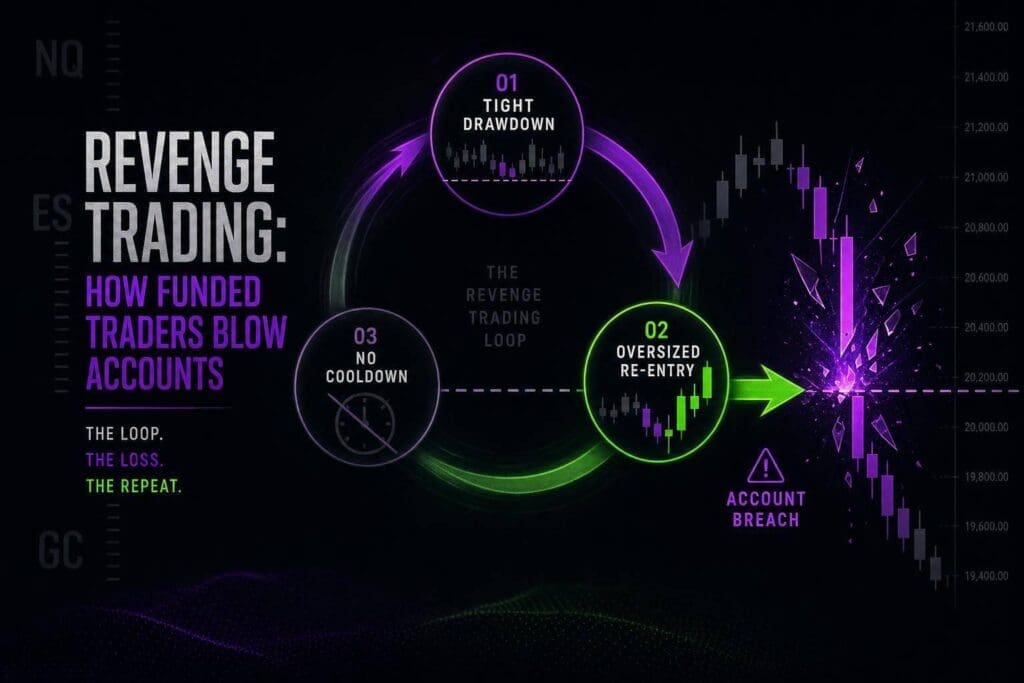
Revenge trading blows funded accounts for one simple reason: the first loss hurts, but the angry next trade does the damage. If you’re trading ES, NQ, MES, or MNQ with a tight daily loss limit, one bad re-entry can push you from a normal red day to a dead account fast. I’m going to keep this simple: what revenge trading looks like, why funded traders fall into it so fast, and the few rules that stop it before you torch the account.
The short version? Tight drawdown + oversized re-entry + no cooldown = blown account. If you don’t lock down your size, stop-for-the-day, and cooldown rules before the session starts, tilt will do it for you.
💥 I Just BLEW UP 18 Apex Trader Funding Accounts Because of ProjectX… My WORST Trading Day Ever

sbb-itb-46ae61d
Introduction
Revenge trading usually starts small. You take a clean loss, feel that sting, and then flip from following the plan to trying to win it back.
On a funded futures account, that switch gets expensive fast. The risk buffer is tight. You don’t have much room to screw around, so a few dumb trades can slam you into the daily loss limit before the session even settles down.
It usually looks the same. You chase the loss. You size up. You ditch the setup that got you here in the first place. That’s not trading. That’s revenge. One oversized re-entry in a volatile session can torch what little buffer you had left.
The trigger matters just as much as the trade itself. Once a loss puts you near the daily limit, the mission changes. You’re not there to execute your edge anymore. You’re trying to get even. That’s the point where accounts blow up.
First, look at what revenge trading looks like on a funded futures account.
What Revenge Trading Looks Like on a Funded Futures Account
Revenge trading starts when your goal stops being trade the setup and turns into get the money back. That usually means an instant re-entry, more size, and no patience instead of a clean, planned setup [1]. That’s the whole split: motive and execution. On a funded account, that urge gets dangerous fast because one bad click can shove you into a drawdown rule, and once panic kicks in, entries get sloppy in a hurry [1]. You’ll see it most clearly in when you re-enter, how big you size, and whether your stop still means anything.
Planned Re-Entries vs. Emotional Re-Entries
A planned re-entry has a reason behind it. Price pulls back to the 20-EMA. The prior day’s high breaks with volume confirmation. Your stop distance is set before you enter. Size stays in line with your normal risk. Same edge. New setup. Simple.
An emotional re-entry is the opposite. You get stopped out of an NQ long, then jump right back in because you’re annoyed. Or you start averaging down in a loser because taking the loss feels worse than it should. Now there’s no confirmation, no patience, no plan. Just the urge to make the red number go away. That’s when traders re-enter right away, bump size, and turn a small stop into a much bigger hit.
Planned re-entries follow rules. Revenge trades chase the loss, usually with more size and zero confirmation.
The Most Common Triggers
This pattern shows up in the same spots again and again: missed moves, fast stop-outs, and ugly choppy sessions. The cash open from 9:30 to 10:30 AM ET can bring sharp volatility spikes, which leads to rushed execution and quick stop-outs [2]. Miss a clean trend move, and a lot of traders start chasing price with more size and no clean trigger. Choppy, low-liquidity conditions make it worse. A couple of losses stack up, frustration builds, and now you’re not taking the next trade because it’s good. You’re taking it because you want the last two back [2].
Why Funded Traders Fall Into Revenge Mode So Fast
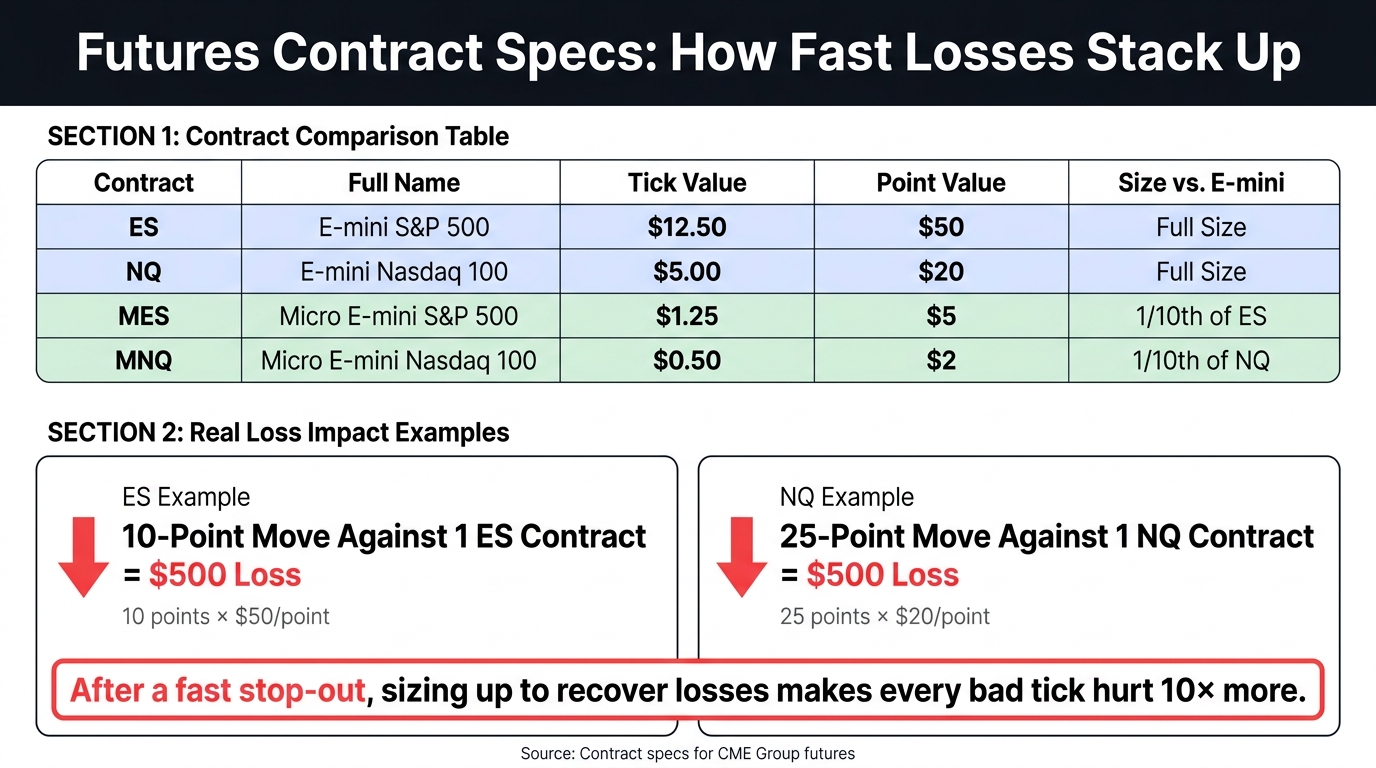
ES, NQ, MES & MNQ Contract Specs: Tick & Point Values Compared
Once that emotional re-entry shows up, the next issue is simple: why does it happen so damn fast? In funded accounts, revenge mode doesn’t need a long losing streak. One loss or one missed move can do it. Thin buffer. Tight risk rules. Too much size. And the switch from evaluation mode to funded mode hits harder than a lot of traders expect.
Losses Feel Bigger When a Rule Limit Is Close
A loss that feels normal in a personal account can feel like a five-alarm fire in a funded account if it shoves you toward the daily cap. Standard funded accounts usually come with a daily drawdown limit around 4% to 5% [1]. Once you’re close to that line, the clock starts messing with your head. The pressure shifts from trading well to getting it back before the session ends.
The trailing drawdown makes it worse. A lot of firms use a live trailing threshold tied to your intraday high-water mark, not just the balance at the close. So let’s say you’re up $800 in unrealized profit and the trade comes all the way back. Even if you exit flat, your buffer may still be smaller than it was before. That’s brutal. After a payout, that trailing threshold can leave the account with almost no room to breathe [1]. That’s the kind of setup that flips a trader from calm to panicked in a hurry and pushes them into revenge trading [1].
There’s also a mindset problem. Evaluations reward aggression. Funded accounts reward capital protection. If you bring that same evaluation mentality into a funded account, things can go south fast [1].
Why NQ and ES Make the Emotional Spiral Worse
Now add speed.
ES moves at $50 per point and $12.50 per tick. NQ moves at $20 per point and $5.00 per tick [2]. A 10-point move against one ES contract is a $500 hit. A 25-point move against one NQ contract is the same $500 loss [2].
| Contract | Tick Value | Point Value |
|---|---|---|
| ES (E-mini S&P 500) | $12.50 | $50 |
| NQ (E-mini Nasdaq 100) | $5.00 | $20 |
| MES (Micro E-mini S&P) | $1.25 | $5 |
| MNQ (Micro E-mini Nasdaq) | $0.50 | $2 |
After a fast stop-out in ES or NQ, a lot of traders start doing bad math in their head. Not math about risk. Math about how many contracts it would take to win it back on the next trade. That’s where one bad trade turns into oversizing, overtrading, and a bigger hole [1][2]. NQ is especially nasty here because it moves fast enough that there’s barely any space between the impulse and the click [2].
Micro contracts help because they cut the heat. MES and MNQ are 1/10th the size of the standard E-minis, which gives you more room to take a loss without feeling like the account is getting mugged [2]. If revenge trading keeps showing up in your stats, contract size isn’t some side issue. It’s part of the problem. And that pressure is often what turns one loss into the oversized re-entry that blows the account up.
How Revenge Trading Blows Evaluations and Funded Accounts
Knowing why revenge trading happens is the easy part. The damage usually doesn’t come from one giant trade. It comes from a bad chain of decisions, where each move makes the next one worse. After that first emotional re-entry, things often go on autopilot in the worst way.
The Typical Chain Reaction
The pattern is usually the same. You size up. You widen the stop. Then you keep taking shots until the daily loss limit gets tagged. Many funded accounts use a 4% to 5% daily drawdown limit, so one short emotional meltdown can kill an evaluation or funded account in a single session [1].
An ES and NQ Example With Real Risk Numbers
On a $5,000 account, a 0.5% risk cap is $25. A 6-tick MES stop is $7.50 per contract. A 6-tick ES stop is $75 per contract. The same 10x jump applies from MNQ to NQ [2].
That’s the part traders miss when they’re tilted. Sizing up after a loss doesn’t just speed up the attempt to get it back. It makes every bad tick hurt ten times more. What looked like a normal stop on micros can turn into a daily-limit problem fast on the bigger contract.
Warning Signs That Usually Appear Before an Account Blows Up
The red flags are usually obvious in hindsight:
- Adding to losers
- Chasing breakouts
- Moving or deleting stops
- Switching from ES to NQ just to get faster action
- Trading past a preset stop-for-the-day [1][2]
When those start stacking up, that’s the point to shut it down before the loss snowballs, following a funded account checklist to reset your process.
How to Stop Revenge Trading Before It Kills the Account
You need these fixes in place before the next impulse trade hits. That’s the whole point. Revenge trading usually follows a pretty clear chain: loss, frustration, bigger size, bad re-entry, then the stop gets moved or ignored. If you wait until you’re tilted, you’re already late.
These controls add friction where it matters. They slow you down before the next click.
Set a Personal Daily Loss Limit Below the Firm’s Threshold
Your personal stop should sit below the firm’s hard limit. A good range is 50% to 70% of the firm’s daily cap [7]. So if the account allows a $1,000 daily loss, your stop should be around $600 to $700. Hit that number, shut it down. No debate.
That buffer matters because one rough session doesn’t have to turn into a dead account.
The math is blunt. If you risk 0.5% per trade on a funded account, you can take 10 straight losses before hitting a 5% daily limit [1]. At 2% per trade, that same account gets wrecked fast. Just three losses in a row and you’re through the cap [1]. That’s why per-trade risk can’t be some random number you decide after the first red trade. It needs to be locked in before the session starts.
Use Cooldown Rules, Platform Lockouts, and Contract Caps
If the daily stop is the ceiling, cooldown rules are the deadbolt.
Keep it simple:
That kind of rule works because it cuts off the revenge loop early. You don’t get to sit there and fire right back just because the last trade pissed you off.
Platform controls help too. NinjaTrader lets you set position-size caps, so you can block oversized trades before tilt takes over [2]. That removes one of the dumbest revenge-trading moves: smashing the size button because you want the money back NOW. Some firm-side risk controls can also enforce daily loss limits when discipline falls apart [4] [5]. And if you set a contract cap at the start of the session, moving from MES to ES takes a deliberate override instead of one angry click [2].
Keep a Journal and a Reset Checklist After Losing Sessions
After a losing session, don’t just close the platform and pretend it didn’t happen. You want to find the exact point where the session went off the rails.
These four questions do most of the work:
- What triggered the tilt?
- Did the trade meet A-setup criteria?
- Was the stop honored?
- How far is the account from the daily loss limit?
That tells you whether the problem was the setup or you.
Tag each trade as "Plan", "Rule Breach", or "Revenge Trade". After a few weeks, that record gets hard to argue with [6]. You’ll see the pattern fast. Maybe the setup was fine and the damage came from the revenge re-entry. Maybe the first loss was normal and the second and third were pure tilt.
Use a short reset checklist too. Nothing fancy. Just enough to make sure the next session starts clean instead of dragging yesterday’s mess into today.
| Checklist Category | Items to Verify |
|---|---|
| Post-Loss Reset | Distance to daily loss limit, emotional state (tilt check), rule adherence |
| End of Day | Total P&L vs. daily cap, journal completed, screenshot saved |
| Pre-Session (Next Day) | Contract cap set, personal daily stop confirmed |
Risk Management Habits That Make Revenge Trading Harder to Do
Once you’ve got a reset checklist, the next layer is simple: build a process that makes the same screw-up harder to repeat.
Revenge trading gets ugly fast when risk isn’t locked down and size can change in the middle of a session. That’s the trap. You take a loss, get irritated, then decide your risk after the damage is done instead of before the session even starts. Pre-commitments kill that decision point.
The biggest failure usually starts with size. Oversizing is what turns one bad, emotional trade into a blown account.
Define Risk by Contract, Stop Distance, and Session Before You Trade
Don’t let emotion pick your size. Use the formula: Position Size = Max risk ÷ stop size × point value [8]. Run the math before the session starts, then round down so your risk stays inside the limit. That one habit matters. Oversizing is how a normal stop turns into a daily loss breach.
On funded accounts, MES and MNQ are often the smarter play because they keep dollar risk smaller. If volatility expands, cut size so your dollar risk stays the same. And if you’re watching both ES and NQ, treat them like one combined position. Holding both at once can slam your daily limit faster than you think [8].
Build a Daily Routine That Protects Account Longevity
Use the same routine every day: pre-market, in-session, post-session. Boring is good here. A fixed routine makes it much harder to fire back into the market out of frustration.
Before the open:
- Check the economic calendar for high-impact events like CPI, FOMC, and NFP
- Mark the time windows you won’t trade
- Confirm your personal daily loss limit is set below the firm’s threshold
- Make sure bracket orders are loaded
- Lock in your contract cap
That last part matters. If increasing size takes a deliberate override instead of one angry click, you’ve already made a revenge-trading spiral less likely.
During the session, track open P&L against your daily loss limit, not just your account balance. After the session, log your trades while the context is still fresh. Include what you felt and whether you actually followed your rules.
These habits work because they shut down impulse before the next trade even begins.
Bottom Line
Revenge trading usually doesn’t begin with some huge blowup. It finishes there.
The first loss is just the spark. What wrecks the account is everything that comes right after it: the angry re-entry, the oversized position, and the stop you suddenly decide not to respect. That’s the part that does the damage.
The fix isn’t fancy. It’s a short process you follow before tilt takes over:
- Set your own daily loss cap below the firm’s max loss limit as part of your risk management essentials
- Stop after two losing trades in a row
- Reset before you get back in
Those are process rules. They are not market calls.
In funded futures trading, discipline keeps your account alive faster than any “make it back” trade ever will. The trader who lasts is the one who shuts it down after the first loss, not the one who tries to win it all back in one stupid trade.
FAQs
How can I tell if I’m revenge trading?
You’re probably revenge trading when you take a loss and then instantly start forcing trades to win it back and get back to breakeven.
That usually shows up in a few obvious ways:
- You fire off back-to-back losing trades with no reset
- You blow past your pre-set daily loss limit
- You size up because the next setup feels like a sure thing
- You take trades that don’t match your plan just to make the P&L hurt less
A lot of tracking tools will catch this stuff too. They may flag high trade frequency, clusters of trades after a bad stretch, or entries placed after a red session. That matters, because revenge trading rarely looks like one bad click. It looks like a short spiral where discipline disappears fast.
Should I trade micros instead of ES or NQ after a loss?
Yes. After a loss, switching to micros instead of ES or NQ is usually the safer discipline play.
They cut your exposure fast. That gives you room to stay inside your pre-set daily cap or cooldown while you reset, settle down, and get back to your plan.
One more thing: if you’re trading minis and micros across correlated index products, treat them as combined exposure. They’re not separate bets if they move together.
What rules should I set before the session starts?
Set your risk rules before the session starts. No winging it once the market opens.
Use a personal daily loss limit that’s lower than your prop firm’s max loss cap. Give yourself room. If the firm cuts you off at, say, $1,000, don’t let your own limit sit there too. Set it lower and protect the account before the firm has to.
Put in a hard stop after two consecutive losses. Then step away for a mandatory 30-minute cooldown. That’s not fluff. Two back-to-back losses can flip you from calm to revenge trading fast.
Keep position sizing fixed off account equity. Not off mood. Not off how "good" the setup looks. If your size jumps around every time you feel hot, you’re asking for a dumb drawdown.
You also need to define your pre-approved A-setups ahead of time. If a trade doesn’t match one of them, you skip it. Simple.
Stay out of high-volatility news like FOMC or CPI. Those events can blow through levels, widen spreads, and make clean execution a mess.
Before the open, run a pre-session checklist:
- Confirm your internet connection
- Check the correct account is selected
- Verify your bracket order defaults
That last one matters more than people think. One wrong account or bad bracket template can wreck a clean day before the first trade is even on.