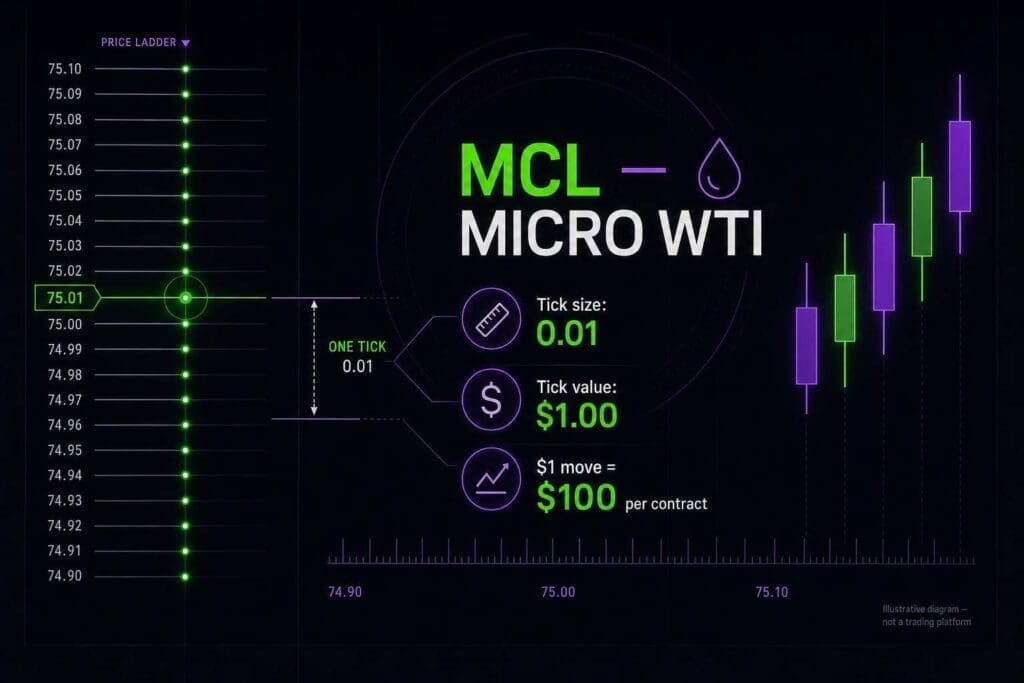
One MCL tick is $1.00. That’s the only number most traders need first, because it tells you what every one-cent move does to your P&L. If you’re trading Micro WTI crude, a $0.10 move is $10 per contract and a $1.00 move is $100 per contract. That’s the whole risk map.
I’ll keep this tight: what MCL controls, how the futures tick math works, how it stacks up against CL, and where traders screw up on order entry. If you trade funded accounts, this is the stuff that keeps a dumb symbol mistake from turning a normal stop into a nasty hit.
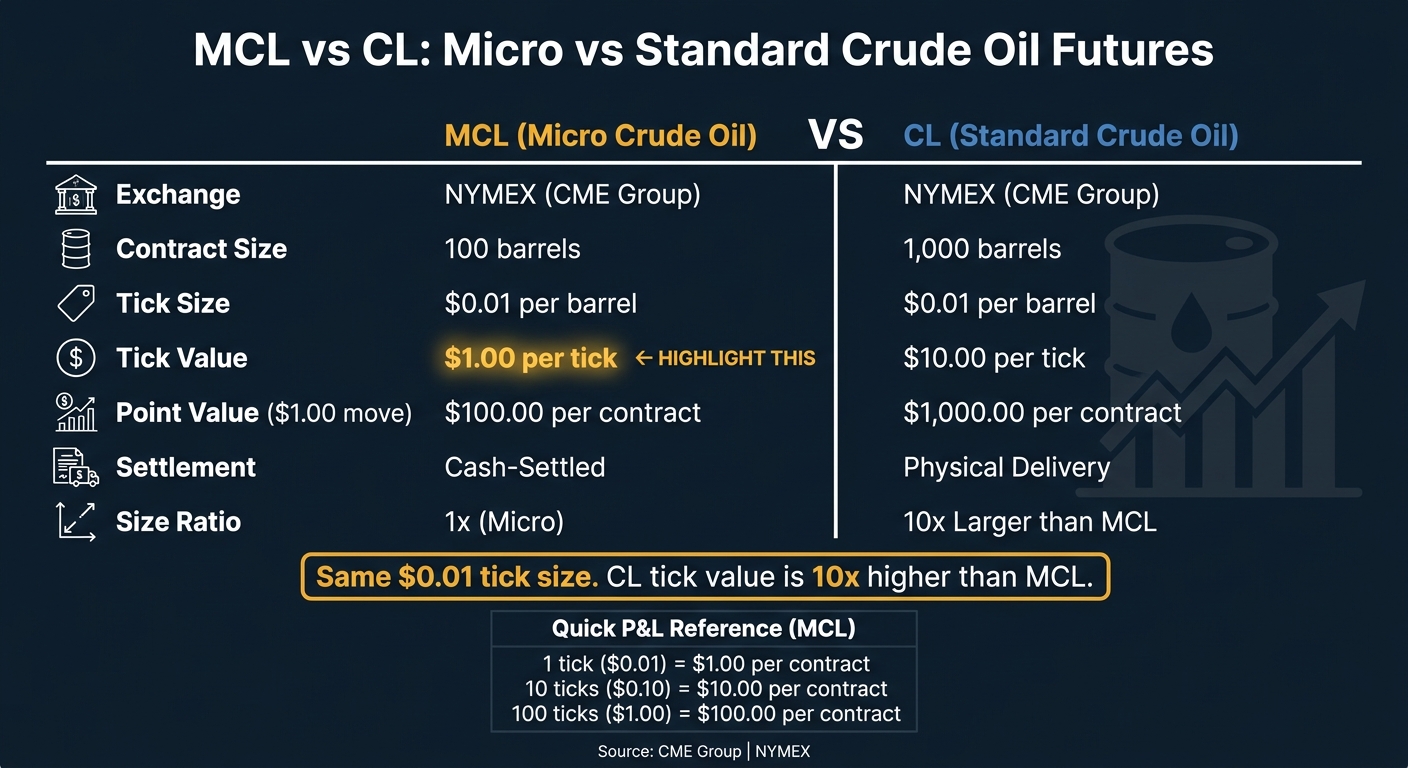
MCL vs CL Futures: Contract Specs & Tick Value Comparison
Micro Crude Futures Product Overview
sbb-itb-46ae61d
Introduction
MCL moves in $0.01 per barrel ticks, and each tick is worth $1.00 per contract. If MCL moves a full $1.00, your P&L changes by $100.00 per contract. That 10-to-1 size gap versus CL is a big deal if you’re trading inside tight prop-firm drawdown rules.[6]
That kind of precision isn’t just nice to know. It affects everything. One tick changes account risk, and most prop firms use unrealized trailing drawdowns that move up as you print new equity highs. So if you don’t know how price movement turns into dollars, you’re basically guessing on stops, targets, and scale-ins. Using a futures risk management planner can help eliminate that guesswork.[6]
This guide covers the specs that matter: tick size, tick value, contract size, trading hours, settlement, margin, and P&L examples. First up is what MCL is and how its specs stack up against CL.
What Is MCL and Why Do Its Specs Matter?
MCL is the Micro WTI Crude Oil futures contract on NYMEX. It tracks West Texas Intermediate (WTI) light sweet crude oil, the same benchmark as standard CL, but it’s one-tenth the size.[3] That one detail changes the math in a big way once you turn price movement into dollar risk.
In futures prop accounts, specs aren’t trivia. They tell you how much each tick costs, how much room your stop needs, and how many contracts you can carry without doing something dumb. That’s where MCL and CL split fast.
How MCL Compares to Standard CL
Standard CL covers 1,000 barrels, so each tick is worth $10.00. MCL covers 100 barrels, which cuts the tick value down to $1.00. Same $0.01 tick size. Very different dollar hit.
A full $1.00 move in CL equals $1,000 per contract. In MCL, that same move equals $100 per contract.[2][3] That’s the whole point of micros. You get the same crude market, just with less damage when price snaps against you.
| Feature | Standard Crude Oil (CL) | Micro Crude Oil (MCL) |
|---|---|---|
| Exchange | NYMEX (CME Group) | NYMEX (CME Group) |
| Contract Size | 1,000 barrels | 100 barrels |
| Tick Size | $0.01 | $0.01 |
| Tick Value | $10.00 | $1.00 |
| Point Value | $1,000.00 | $100.00 |
| Settlement | Physical delivery | Cash-settled |
Settlement is another spec you can’t ignore, mainly near expiration. MCL is cash-settled to the NYMEX WTI settlement price. CL can lead to physical delivery of crude oil.[3][4]
That doesn’t matter much if you’re flat well before expiration, which most traders at the best futures prop firms should be anyway. But it still matters. Contract specs have a way of biting people who treat them like fine print.
How Much Is One MCL Tick Worth?
Now get to the part that hits your P&L.
MCL Price Quote, Tick Size, and Tick Value
MCL moves in $0.01 per barrel increments. Since one MCL contract controls 100 barrels, every $0.01 move is worth $1.00 per contract.[4][6]
The math is dead simple:
$0.01 × 100 barrels = $1.00 per tick
So every single tick up or down adds or subtracts $1.00 per contract.
What a $1.00 Move Is Worth in MCL
If crude moves $1.00, that equals $100.00 per MCL contract.[6] That’s the whole point of MCL. You still get crude oil movement, but without the bigger swings that come with a larger contract.
That smaller size makes it easier to manage risk, especially if you use tighter stops or just don’t want oversized crude exposure.
Next, the contract specs show how MCL is quoted, traded, and settled.
MCL Contract Specs at a Glance
Before you place a trade, get the basic MCL numbers straight. This is the stuff that matters on the order ticket.
| Spec | Detail |
|---|---|
| Symbol | MCL |
| Exchange | NYMEX (CME Group) |
| Contract Size | 100 U.S. barrels |
| Minimum Tick Size | $0.01 per barrel |
| Tick Value | $1.00 per contract |
| Quote | USD per barrel |
| Trading Hours | Sunday 6:00 PM – Friday 5:00 PM ET, with a 60-minute daily break from 5:00 PM to 6:00 PM ET |
| Contract Months | All 12 calendar months |
| Settlement | Cash-settled |
| Last Trading Day | 1 business day before the CL contract’s last trading day |
Source: CME Group
Contract Size, Months, and Trading Hours
MCL is the Micro WTI crude oil contract, and the size is simple: 100 U.S. barrels. It trades in all 12 calendar months, so you’re not dealing with a thin list of expirations.
On the schedule side, CME Globex runs from Sunday 6:00 PM to Friday 5:00 PM ET, with a 60-minute break from 5:00 PM to 6:00 PM ET each day.[3][4] If you trade around the reopen, pay attention. That hour matters, especially if you’re managing stops or planning entries near the session reset.
Settlement, Expiration, and Margin
Settlement and expiration start to matter a lot more once the front month gets close to the end.
MCL is cash-settled against the CL settlement price at expiration, so there’s no physical delivery and no barrels changing hands.[3][4] Open positions settle to the CL settlement price for that same month, and the last trading day is 1 business day before the CL contract’s last trading day.[3][5]
Margin is the next number most traders check right after size and settlement. As of July 2026, CME listed initial margin at $850.30 and intraday margin at $212.58.[4] Those numbers can change, so don’t hard-code them into your risk plan and assume they’ll stay there.
How to Calculate MCL P&L From Price Movement
Once you’ve got the contract specs down, the next step is turning MCL price movement into dollars. The math is simple:
(Price Change ÷ $0.01) × $1.00 × Number of Contracts
That’s the number you use to keep your stops and size inside prop-firm risk limits. No guesswork. Just straight math.
1-Tick, 10-Tick, and 100-Tick P&L Examples
A 1-tick move ($0.01) is worth $1.00.
A 10-tick move ($0.10) is worth $10.00.
A 100-tick move is worth $100.00 per contract [6].
Small moves add up fast in MCL. That’s the whole point. If you’re off by 20 or 30 ticks with too much size on, the loss stacks a lot faster than some traders expect.
Scaling P&L Across Multiple Contracts
If you trade more than one contract, just multiply the single-contract P&L. Here’s how the same move scales across 1, 3, and 5 MCL contracts:
| Price Move | Ticks | 1 Contract | 3 Contracts | 5 Contracts |
|---|---|---|---|---|
| $0.01 | 1 | $1.00 | $3.00 | $5.00 |
| $0.10 | 10 | $10.00 | $30.00 | $50.00 |
| $1.00 | 100 | $100.00 | $300.00 | $500.00 |
Commissions hit per contract, so they chip away at net P&L. At about $2.12 per round trip, that cost matters, especially if you’re scalping or trading bigger size. The gross P&L in the table does not include commissions.
Use these numbers as your baseline for stop placement and position sizing.
Using MCL Tick Value to Size Risk in a Prop Firm Account
MCL pays $1.00 per tick, and that makes risk math dead simple. Use that number against your drawdown limit, then turn it into a stop size and contract count. In a prop account, your actual risk cap is the smaller of your trailing drawdown or daily loss limit, not the flashy account balance.
Setting Stops and Targets Based on Dollar Risk
The math is simple:
Position size = risk dollars ÷ (stop ticks × $1)
A clean rule is to risk 0.5% to 1% of available drawdown per trade. This is one of several strategies for passing prop firm challenges that prioritize capital preservation.
Here’s what that looks like on common account sizes:
| Account Size | Drawdown Limit | 1% Risk Amount | Contracts (20-Tick Stop) |
|---|---|---|---|
| $50,000 | $2,000 | $20 | 1 contract |
| $100,000 | $3,000 | $30 | 1 contract |
| $150,000 | $4,500 | $45 | 2 contracts |
Calculated using 1% of the drawdown limit and MCL’s $1.00 tick value [6].
One catch: trailing drawdowns move up when you make new equity highs. That means open profit can shrink the room you have for the next trade right away.
Common MCL Order-Entry Mistakes to Avoid
Once you size the trade, the next job is not screwing up the ticket.
The big mistake is sending a CL order when you meant MCL. CL is 10x bigger than MCL, so the same stop turns into 10x the dollar risk [1][3][6]. A 50-tick stop is $50 on MCL but $500 on CL.
The next screw-up is reusing a CL bracket or ATM template without resizing it for MCL. That trips people up all the time. A 10-tick bracket is $100 on CL and $10 on MCL, so your contract size has to match the template [1][6].
If your platform lets you save presets, label them clearly. Keep one setup for MCL and a separate one for CL. Mixing them up is an easy way to blow past your risk plan for no good reason.
Bottom Line
MCL keeps crude oil risk simple. The contract is 100 barrels, the tick is $0.01, and each tick is worth $1.00. That makes it easy to price the trade before you click buy or sell.
Once you run through the P&L examples, the point is pretty clear: MCL turns crude oil movement into small, predictable dollar moves. You can map those moves straight to your stop, your target, and your prop firm drawdown limits without doing mental gymnastics.
This matters most when you set size and place your stop. If you send CL instead of MCL, your risk jumps 10x. Check the symbol before the order goes live. MCL, not CL.
FAQs
How much margin do I need to trade MCL?
In a personal futures account, the margin for Micro WTI Crude Oil (MCL) depends on your broker and what’s going on in the market. A common intraday figure is around $290 per contract, but that number can move when volatility picks up.
If you’re trading through a proprietary trading firm, margin doesn’t work the same way. You’re usually not dealing with broker-style margin in the normal sense. Instead, you have to stay inside the firm’s position limits and drawdown rules.
When should I roll an MCL contract to the next month?
Roll your MCL contract before the current month hits its expiration or last trading date. If you don’t, you’ll need to close the position or, on some instruments, deal with settlement rules.
If you want to stay in the market without a gap, move into the next liquid contract month as the front month gets close to the end. Don’t guess on the date. Check your exact contract on the official CME Group website.
Does MCL track the same crude oil market as CL?
Yes. MCL tracks the same WTI crude oil market as standard CL futures. Both trade on NYMEX under CME Group.
The big difference is size. MCL is 1/10th of a standard CL contract, so it’s a lot easier to use if you don’t want full-size crude exposure.
It’s also cash-settled, using the daily settlement price of the standard NYMEX WTI (CL) futures contract.