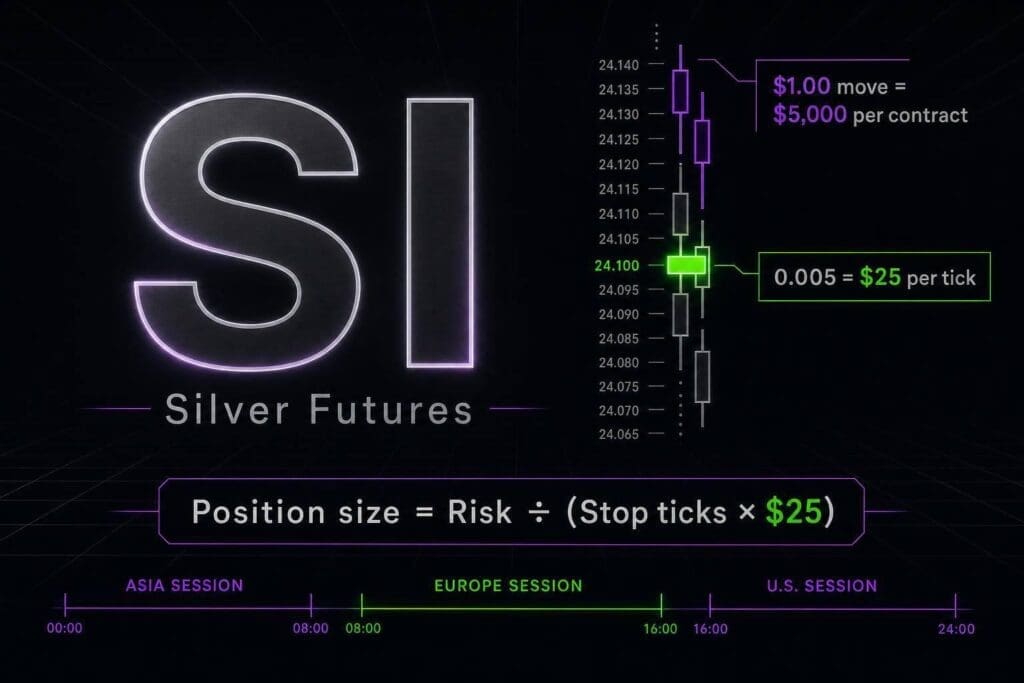
One SI tick is worth $25 per contract. That’s the number that matters. If silver moves 10 ticks against you, you’re down $250 on one contract before fees. A full $1.00 move is $5,000. So yeah, SI can smack a small account hard if your size is off.
I’ll keep this tight. You’ll get the SI contract math, the contract size behind it, the session timing, and the stop-risk math you should do before you click buy or sell. If standard SI is too big, I’ll also point to the smaller silver contract that makes more sense for tighter risk.
Futures Contract Specs
Introduction
SI is the standard CME silver futures contract. Its tick value sits at the center of every risk calculation in this guide. Start with the contract specs. Then do the math so your risk size isn’t a guess.
Silver can move hard, and the dollar swings add up fast. A 10-tick stop on one SI contract is $250. On two contracts, it’s $500. That’s why you should convert ticks to dollars before you place the trade, not after.
Next: the exact SI contract specs and the math behind tick value.
Quick Answer: SI Tick Value at a Glance
SI is the standard COMEX silver futures contract.
Here’s the SI price-to-dollar conversion without the fluff.
The tick size is $0.005 per troy ounce. That equals $25.00 per contract for each tick. A 1-point move is worth $5,000.00 per contract [2][4].
| Move | Increment | $ per Contract |
|---|---|---|
| 1 Tick | $0.005/oz | $25.00 |
| 10 Ticks | $0.050/oz | $250.00 |
| 1 Point | $1.000/oz | $5,000.00 |
Those numbers don’t change. Use them every time you map SI risk, stops, or profit targets.
Next, break down the SI contract specs behind that math.
What Is the SI Silver Futures Contract?
SI is CME Group’s standard silver futures contract on COMEX, the metals exchange of CME Group [1][3]. You can trade it electronically on CME Globex [1][3]. The contract is quoted in U.S. dollars per troy ounce [2].
One SI contract equals 5,000 troy ounces of 99.9% pure silver [2][6]. So if silver is trading at $30.00 per ounce, one contract has a notional value of $150,000. That’s not small. It also tells you why tick value matters so much on SI. The contract size is what drives the tick math.
Exchange and Product Context
CME Group also lists E-mini Silver (QI) at 2,500 troy ounces and Micro Silver (SIL) at 1,000 troy ounces [2][5].
| Contract | Symbol | Size (Troy Oz) |
|---|---|---|
| Standard Silver | SI | 5,000 |
| E-mini Silver | QI | 2,500 |
| Micro Silver | SIL | 1,000 |
Before you place an order, make sure you’ve got the right symbol. SI, QI, and SIL are not interchangeable. The contract size changes, and so does the dollar risk [5]. Then check the contract month and trading hours before you do anything.
Core SI Contract Specs
Use these specs to check SI tick value, trading hours, and rollover timing. This is the stuff that turns a $25 tick into actual risk rules you can trade with.
| Specification | Details |
|---|---|
| Contract Size | 5,000 troy ounces |
| Quoted | U.S. dollars per troy ounce |
| Minimum Tick | 0.005 per troy ounce |
| Tick Value | $25.00 per tick |
| Point Value | $5,000.00 per $1.00 move |
| Active Contract Months | March (H), May (K), July (N), September (U), December (Z) |
| Last Trading Day | Third-to-last business day of the contract month |
| CME Globex Hours | Sunday 6:00 p.m. ET to Friday 5:00 p.m. ET |
| Daily Maintenance Break | 5:00 p.m. to 6:00 p.m. ET (daily) |
Contract Size, Tick Size, and Point Value
SI moves in 0.005 increments per troy ounce, and each one of those minimum moves is worth $25.00 per contract [2][4]. That’s the number that hits your P&L every time price moves one tick.
The math gets big fast. A full $1.00 move in SI equals $5,000 per contract. That’s why silver can feel slow for a few minutes, then smack you hard once it starts moving.
Next up is timing. Contract months and session hours matter because they keep you out of dumb mistakes, like sitting in the wrong month or trying to manage risk when the market is shut.
Contract Months and Last Trading Day
The main SI contract months are March, May, July, September, and December [2][3]. Those are the months with the most action.
Trading ends on the third-to-last business day of the contract month [1]. That date matters more than people think. If you trade SI regularly, keep an eye on rollover so you don’t get stuck watching volume dry up in the expiring contract.
CME Globex Trading Hours

SI trades electronically on CME Globex from Sunday 6:00 p.m. ET through Friday 5:00 p.m. ET [2][3]. There’s also a daily 60-minute maintenance break from 5:00 p.m. to 6:00 p.m. ET [2][3].
Those session boundaries matter. Your stops and order management only work while the market is open, so you need to know exactly when SI is trading and when it isn’t.
sbb-itb-46ae61d
How to Calculate SI Tick Value, P&L, and Dollar Risk
Now turn the contract specs into trade math. This is the part that matters when you’re setting a stop, figuring contract count, or checking if a trade even fits your risk limit.
Tick Value Formula
The tick value is the contract size multiplied by the minimum tick increment:
0.005 × 5,000 = $25.00 per tick [2][4]
That means every 1-tick move in SI is worth $25.00 per contract. Simple. If your stop is 4 ticks, that’s $100 per contract. If it’s 12 ticks, that’s $300.
Point Value and P&L Formula
A full $1.00 move in SI equals $5,000 per contract [2]. That works out to 200 ticks.
Use this P&L formula:
(Exit Price − Entry Price) × 5,000 = Dollar P&L per contract [2]
So if SI moves from 29.500 to 29.600, that’s a $0.10 move. Multiply 0.10 × 5,000, and you get $500 per contract.
A $0.10 stop equals 20 ticks, or $500 per contract. For stop math, use ticks × $25.
Here’s the math in plain numbers:
- 1 tick = $25
- 10 ticks = $250
- 1 full point ($1.00) = $5,000
That’s the framework you use to size risk fast without overthinking it.
Dollar Value of a 1-Tick, 10-Tick, and 1-Point Move in SI
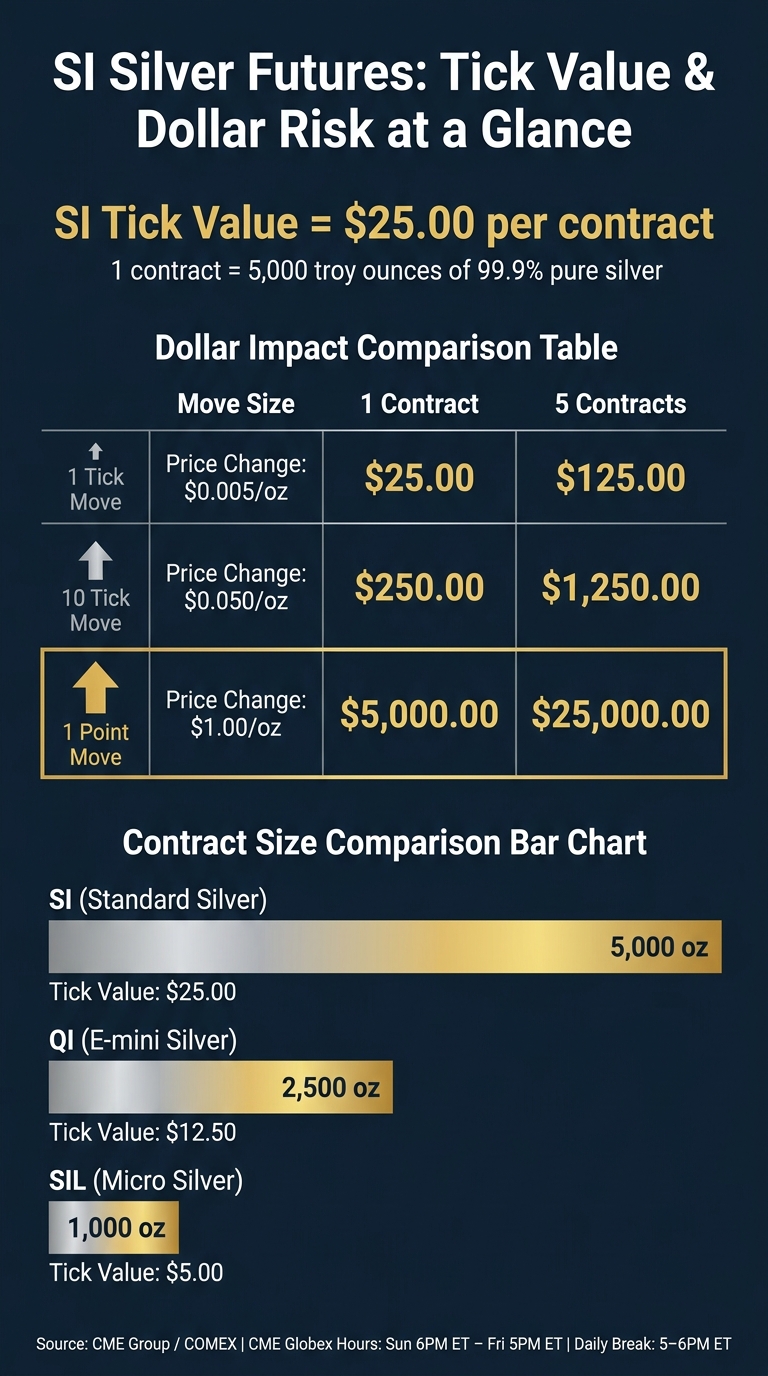
SI Silver Futures: Tick Value & Dollar Risk at a Glance
Here’s the dollar hit from common SI moves. This is the part that matters when you’re setting a stop or mapping a target. Price movement is one thing. Dollar movement is what smacks your P&L.
1-Tick Move
1 tick = $25.00 per contract [4][2].
10-Tick Move
10 ticks = $250.00 per contract [2].
On 5 contracts, that’s $1,250.00.
1-Point Move
1 point = $5,000.00 per contract [1].
On 5 contracts, that’s $25,000.00.
| Move | Price Change | Dollar Impact (1 Contract) | Dollar Impact (5 Contracts) |
|---|---|---|---|
| 1 Tick | $0.005 | $25.00 | $125.00 |
| 10 Ticks | $0.05 | $250.00 | $1,250.00 |
| 1 Point | $1.00 | $5,000.00 | $25,000.00 |
That table makes SI pretty clear: even a small move adds up fast once you size up.
Using SI Tick Value for Position Sizing and Stop Placement
Use the SI tick value to turn stop distance into dollar risk. The formula is simple: stop distance in ticks × $25.00 = dollar risk per contract [7].
A 20-tick stop = $500.00 per contract.
A 40-tick stop = $1,000.00 per contract.
And 1 point = 200 ticks = $5,000.00 per contract.
That’s why SI can bite hard if your stop is too loose. The math gets big fast.
Risk-Per-Contract Math
Stop ticks × $25.00 = dollar risk per contract [7].
Position Sizing Workflow
- Define your risk budget. Use your max risk per trade.
- Set your stop distance. Mark the price level that kills the trade idea, then count the ticks from entry to that level.
- Calculate risk per contract. Multiply stop ticks by $25.00.
- Divide your risk budget by that number, then round down.
Quick example:
If your risk budget is $1,200.00 and your stop is 40 ticks, your risk per contract is $1,000.00. That means you can take 1 contract, not 2.
Round down. Always. If 2 contracts puts you over budget, it’s not your size.
Internal Calculators and Related Guides
Use the internal position size calculator if you want to skip the hand math.
Bottom Line: Know Your SI Tick Math Before You Size Up
Once you know the contract specs, the next job is simple: turn ticks into dollar risk.
SI moves in $25 per tick, so you can map any stop straight to a cash number. That matters because price movement by itself doesn’t tell you much. Dollar risk does.
The same math applies to P&L. A $1.00 move = $5,000 per contract. That’s why you should size SI from tick risk, not gut feel.
If the standard SI contract is too big for your risk limit, Micro Silver (SIL) gives you a 1,000-ounce contract with a $5.00 tick value per $0.005 move [1]. That’s a much smaller hit per tick.
Keep it simple:
- Measure your stop in ticks
- Multiply by the tick value
- Cut size if the risk is too high
Use the tick value first. Then decide if SI fits your stop distance and contract count.
FAQs
How many SI contracts can I trade with my risk budget?
Take your total risk budget and divide it by the risk per SI contract based on your stop-loss distance.
For SI, each $0.005 tick is worth $25 per contract.
So if your stop is 20 ticks, your risk is $500 per contract ($25 × 20). If your total risk budget is $2,000, you can trade up to 4 contracts ($2,000 ÷ $500), assuming you also meet the initial margin requirement.
When should I roll an SI contract to the next month?
Roll your SI silver futures contract into the next active month before first notice day. That date hits before the contract’s actual expiration, and that’s the one that matters.
Miss that window and you can get stuck with contract delivery obligations, including physical delivery of 5,000 troy ounces of silver. That’s not a joke, and it’s not something you want to learn the hard way.
For the exact first notice and expiration dates, check the official CME Group calendar for your contract month.
Should I trade SI or Micro Silver for smaller risk?
Yes. Trading E-micro Silver (SO) is a common way to take smaller risk and size positions with more precision than the standard SI silver futures contract.
SO controls 1,000 troy ounces, which is one-fifth the size of the standard 5,000-ounce SI contract. That smaller contract size makes it easier to match your risk to your account size. It also gives you more room to fine-tune exposure and stop-loss distance without taking on too much size.