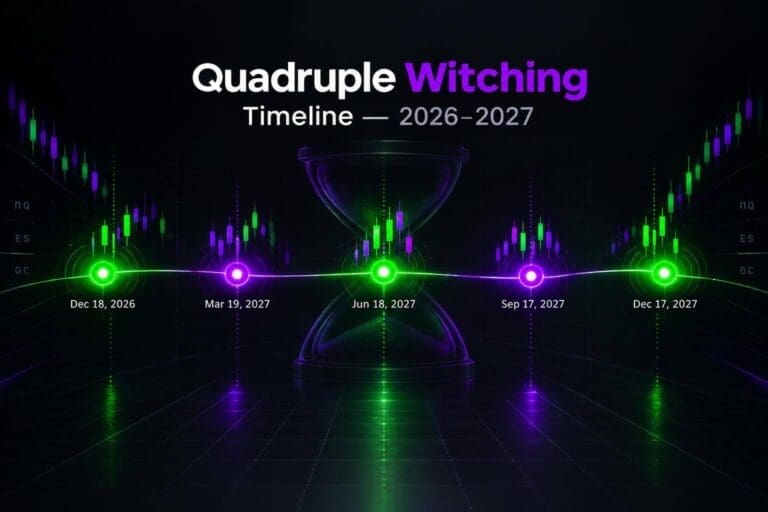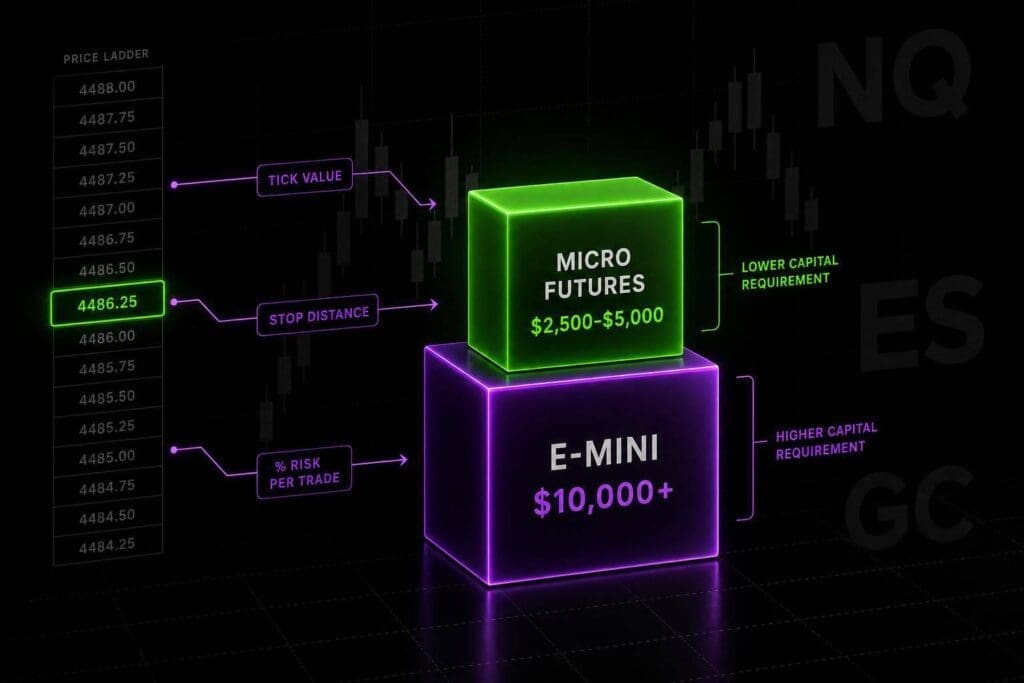
You don’t need $25,000 to day trade futures, but you do need more than the broker’s bare-minimum margin. The short version: $2,500 to $5,000 is where micro futures start to make sense, while $10,000+ is where one standard E-mini can start to fit if your stop is tight and your risk is under control. That’s the part that matters.
I’m going to keep this simple: forget the deposit marketing, focus on tick value, stop size, and percent risk. A tiny account can place a trade. That doesn’t mean it can survive a normal losing streak. If your stop doesn’t fit your account, the contract is too big. End of story.
Why the Minimum Deposit Is the Wrong Number to Focus On
The minimum deposit sounds like the number that matters. It usually isn’t.
What matters is whether your account can take normal heat and live through a bad week without getting wrecked. The better question is simple: can this account support the stop-loss you need on the contract you want to trade?
Futures Have No PDT Rule, but Small Accounts Are Still Risky
Futures don’t have the PDT rule, but that doesn’t make small accounts safe. Leverage and volatility can still hit hard [2][3]. The issue isn’t what it costs to get in. The issue is whether the account can survive normal market noise.
Margin Gets You Into a Trade; Capital Keeps You Trading
Margin gets you into the position. It does not tell you what the trade can cost if it moves against you [4][5].
Typical intraday day margins are roughly $400-$500 for ES and as low as $40-$50 for MES [3]. That looks cheap on the surface. But price movement is what does the damage. A 10-point move in ES is a $500 loss, which is enough to smoke a small day-margin deposit [4]. That’s the trap. Low day margin can make an account look usable when it isn’t.
Your account size is what keeps you in the game during a normal losing streak [2]. If you risk 0.5% to 1% of account equity per trade [2][3], the math gets blunt fast. It tells you whether the account can support the contract and stop size you need. A lot of the time, it can’t.
That’s where the gap shows up. Exchange margin and broker day margin are not the same thing, and that difference matters a lot when your account is small.
sbb-itb-46ae61d
How Futures Margin Actually Works
Futures margin has two separate layers: exchange margin and broker day margin.
Exchange Margin vs. Broker Day Margin
The CME sets the base margin requirement for every futures contract it lists. Exchange margin is the minimum needed to hold the contract, while maintenance margin is the equity line that keeps the position open [5]. If your account drops under maintenance, your broker can hit you with a margin call or just flatten the trade for you [5].
Then your broker adds its own number on top: day margin. That applies only to trades opened and closed in the same session [5][6]. Brokers set day margin on their own, and it can be way lower than exchange margin because they’re trying to pull in retail flow [5][6]. That’s the key difference:
- Exchange margin is the hard floor.
- Broker day margin is just an intraday pass.
Margin also moves when volatility picks up, so check current requirements at cmegroup.com and with your broker before you size anything [5][6].
That gap matters, because the next issue isn’t what it costs to click in. It’s what the contract can do to your account if it moves against you.
Why Low Day Margin Creates a False Sense of Safety
Low day margin doesn’t make a contract safer. It just makes it cheaper to enter. Your exposure stays the same even if your broker lets you in with less cash up front [4][3].
That’s why day margin by itself tells you almost nothing about how much capital you should trade with. This table shows the gap between the small entry number and the actual size of the contract.
| Contract | Symbol | Point Value | Typical Day Margin | Approx. Notional Value |
|---|---|---|---|---|
| E-mini S&P 500 | ES | $50/pt | $400–$500 [3] | ~$370,000 |
| Micro E-mini S&P 500 | MES | $5/pt | $40–$50 [3] | ~$37,000 |
| E-mini Nasdaq 100 | NQ | $20/pt | $500–$700 [3] | ~$420,000 |
| Micro E-mini Nasdaq 100 | MNQ | $2/pt | $50–$70 [3] | ~$42,000 |
| Crude Oil | CL | $1,000/pt | $1,000–$1,500 [3] | ~$70,000 |
| Micro Gold | MGC | $10/pt | $100–$150 [3] | ~$27,000 |
The day margin column looks cheap. The notional value column is the slap in the face. That’s the leverage you’re taking on, and it’s why sizing off margin minimums is a bad habit [1].
Next comes the number that matters most: what each contract can cost you per tick and per stop.
What MES, MNQ, ES, NQ, CL, and MGC Actually Risk Per Trade
Margin tells you what it takes to open the trade. Tick value tells you what it costs when the trade goes against you. That’s the number that matters when you’re setting a stop. Mix those up, and your risk math gets ugly fast.
Tick Values for the Most Common Day Trading Contracts
Here’s how six common day-trading contracts stack up:
| Contract | Symbol | Tick Size | Tick Value | Point Value |
|---|---|---|---|---|
| E-mini S&P 500 | ES | 0.25 | $12.50 | $50 |
| Micro E-mini S&P 500 | MES | 0.25 | $1.25 | $5 |
| E-mini Nasdaq 100 | NQ | 0.25 | $5.00 | $20 |
| Micro E-mini Nasdaq 100 | MNQ | 0.25 | $0.50 | $2 |
| Crude Oil (WTI) | CL | 0.01 | $10.00 | $1,000 |
| Micro Gold | MGC | 0.10 | $1.00 | $10 |
Source: CME Group contract specifications
CL is the odd one here. A $1.00 move is worth $1,000 per contract.
Now put those tick values into plain trade risk.
A Simple Risk Formula
Use this formula:
Risk per trade = Ticks in stop × Tick value × Number of contracts
Here’s what that looks like with futures contract sizes and common stops:
| Setup | Contract | Stop Distance | Calculation | Total Risk |
|---|---|---|---|---|
| Scalp | 1 MES | 4 ticks (1 pt) | 4 × $1.25 × 1 | $5.00 |
| Day trade | 1 ES | 12 ticks (3 pts) | 12 × $12.50 × 1 | $150.00 |
| Tech breakout | 2 MNQ | 20 ticks (5 pts) | 20 × $0.50 × 2 | $20.00 |
| Oil reversal | 1 CL | 10 ticks ($0.10) | 10 × $10.00 × 1 | $100.00 |
| Gold micro | 5 MGC | 15 ticks (1.5 pts) | 15 × $1.00 × 5 | $75.00 |
This is why small accounts usually belong in micros, not minis.
Why the Same Setup Costs Much Less in Micros Than in Minis
Same chart. Same entry. Same stop. Very different dollar risk.
On a $5,000 account, if you’re risking 0.5%, your max loss is $25 per trade. A 6-tick stop on 1 ES costs $75. That’s 3x your limit. The same 6-tick stop on MES costs $7.50, which means you could trade 3 contracts and still stay under $25 [3].
That’s the whole point. Micros let you size the trade to fit the account instead of forcing the account to carry more risk than it should.
That sizing gap is what separates an account you can actually trade from one that only looks tradable because the margin requirement seems low.
What You Can Realistically Trade With a $500 Account
Which Contracts a $500 Account Can Access
With $500, the math is brutal. You can meet day margin on a micro contract, but you don’t have much room to get hit and keep trading.
Intraday margin on micros can be as low as $40 to $100 per contract [1][3]. That puts MES, MNQ, and MGC in play at this account size. That’s it. Even then, you’re basically looking at one micro contract at a time with very little room for a wider stop.
Why a Normal Losing Streak Wipes Out a $500 Account
If you stick to 0.5% to 1% risk, a $500 account gives you just $2.50 to $5 per trade. That’s a tiny buffer.
A 1-point stop on MES costs $5, which already maxes out that range. If you need something more normal, like a 4-point stop, now you’re risking $20 on one trade. That’s 4% of the account gone on a single loss.
And here’s the part people don’t like to hear: a normal losing streak doesn’t have to be dramatic. Five to eight losing trades happens [2]. At $20 per loss, that kind of run chews through a $500 account in a hurry.
Commissions make it worse. Micro round-trips run about $1.00 each [4][5]. On a small account, that cost matters. A lot.
That’s the minimum reality behind a $500 account.
What You Can Realistically Trade With a $2,500 Account
Why $2,500–$5,000 Is the Workable Range for Micro Futures
Compared with a $500 account, $2,500 is where micro futures stop feeling like a coin flip and start feeling usable. At that size, you can actually apply risk control instead of just trying not to blow up.
At 1% risk per trade, you’re risking $25 [3]. That’s enough room for a stop that makes sense. A 20-tick stop on 1 MES contract costs $25. A 50-tick stop on 1 MNQ contract also costs $25 [3].
Risk Math for MES, MNQ, and MGC at This Account Size
The clean way to judge a $2,500 account is by stop cost, not whether your broker lets you click the buy button.
| Contract | Tick Value | 10-Tick Stop Risk | 20-Tick Stop Risk | % Risk on $2,500 |
|---|---|---|---|---|
| MES (S&P 500 Micro) | $1.25 | $12.50 | $25.00 | 0.5%–1.0% |
| MNQ (Micro E-mini Nasdaq 100) | $0.50 | $5.00 | $10.00 | 0.2%–0.4% |
| MGC (Micro Gold) | $1.00 | $10.00 | $20.00 | 0.4%–0.8% |
This is the part that matters. Tick value decides whether a contract fits your account.
MNQ has the lowest dollar risk per stop here. A 20-tick stop is just $10, or 0.4% of the account. MES is still the default starting point for most traders in this range. MGC lands in the middle.
You also need a hard daily loss cap. Keep it around 2% to 3%, or about $50 to $75 [2][3]. Hit that number, stop for the day. No revenge trading. No "one more setup."
More money at this level doesn’t just buy more contract access. It buys breathing room for stops and drawdown. Past this range, the next call is whether micros still fit or if stepping up to 1 standard contract makes sense.
What You Can Realistically Trade With $10,000 or More
At $10,000, standard contracts start to become an option. But that doesn’t mean they make sense for every setup. You can trade one ES or one NQ contract at this size, but only if your stop size and risk cap still fit the account. Accessible is not the same as tradeable.
When Trading One ES or One NQ Contract Starts to Make Sense
If you risk a conservative 0.5% per trade on a $10,000 account, your stop-loss budget is $50 [3]. On ES, with a $12.50 tick value, that gives you just 4 ticks of stop room [3]. For most intraday setups, that’s too tight.
So yes, a $10,000 account puts ES on the table. Barely. Unless your stop is very tight, there isn’t much room to work with. Many traders see $25,000+ as a more comfortable starting point for full-size E-mini trading [2]. At that size, a 1% risk budget gives you $250 per trade, which lets you place stops based on market structure instead of forcing everything around account limits.
NQ is even tougher. It moves more than ES and usually needs either more capital or smaller size, like micros [3]. One standard NQ contract on a $10,000 account hits the same stop-size problem, just faster.
Why Crude Oil Needs More Capital Than Most Traders Expect
CL looks manageable on paper until you do the actual math. Its $10 tick value and sensitivity to news usually demand wider stops [2]. On a $10,000 account with a $50 risk budget, you get only 5 ticks of stop room. That’s not much breathing room for crude.
That’s why CL often needs a bigger capital buffer than ES or NQ, even when the broker’s day margin looks cheap [2] [4]. Day margin can make a contract look affordable. Your stop size tells you if it’s sane.
Multiple Micros vs. One Standard Contract at the Same Account Size
This is why a lot of traders at this account size still stick with micros. Trading 5 to 10 MES contracts can be more practical than trading 1 ES [3]. You get more control over size, cleaner scaling out, and tighter control over dollar risk [3].
With one standard contract, you lose that flexibility. You’re either in or out. With micros, you can trim size, stagger exits, and match position size to the setup instead of forcing the setup to fit the contract.
Use tick value and stop size to make the call, not day margin. That’s the part that matters when you’re deciding whether to stay in micros or move up to a standard contract. The next step is a simple sizing framework that matches contract choice to account size.
A Simple Framework to Match Your Account Size to the Right Futures Contract
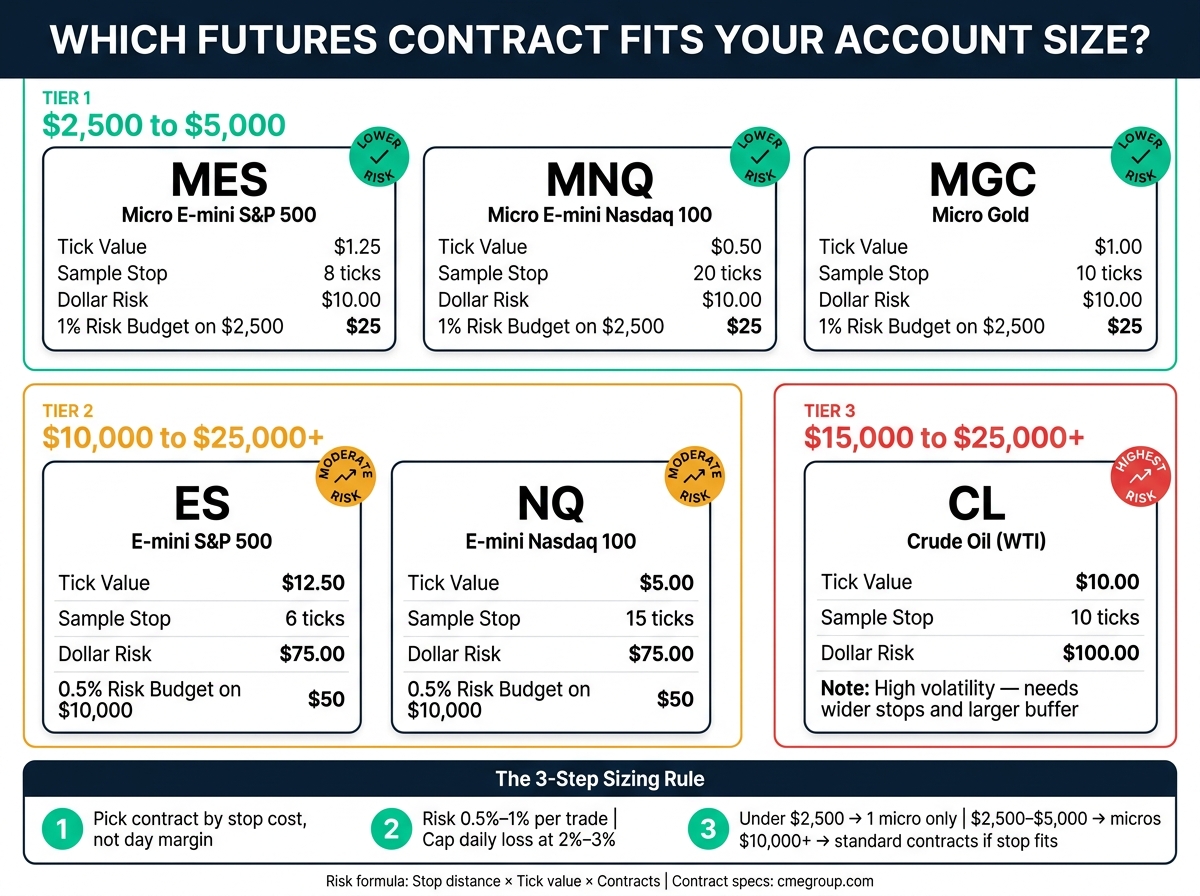
Futures Contract Account Size Guide: Match Your Capital to the Right Contract
Use this three-step check before every trade: contract risk, account risk, then size. That shifts the question from "How much is the deposit?" to "Does the stop fit the account?"
Step 1: Pick Your Contract Based on Tick Value, Not Day Margin
Pick the contract by stop cost, not day margin. A 10-tick stop costs $125 on ES and $12.50 on MES [3]. Same setup. Very different damage if you’re wrong.
That’s the filter that matters. Use it on every contract in this article.
Step 2: Set Your Risk Per Trade and Drawdown Limit
Set risk at 0.5% to 1% of account equity per trade [3][2]. Use the same math from the $500, $2,500, and $10,000 examples to make the call.
Cap daily loss at 2% to 3%. When you hit it, stop trading [3][2]. No negotiating with yourself after that.
If the daily loss cap is too small for your stop, the contract is too big for the account. Plain and simple.
Step 3: Trade Micros, Cut Size, or Wait Until You Have More Capital
When the math doesn’t work, the answer isn’t complicated: cut size or sit out.
Use this rule set:
- Under $2,500: stick to one micro
- $2,500 to $5,000: use micros if you want room to manage risk
- $10,000+: one ES or NQ contract may fit, but only if the stop still fits your risk cap [2][3]
Use the same formula every time: risk = stop distance × tick value × contracts [3].
Bottom Line: Which Account Size Fits Your Trading Style?
Using the stop-cost math above, the cleanest takeaway is simple: match the account to the contract, not your ego. Day margin gets you into the trade. Stop risk decides if the account sticks around.
$2,500 to $5,000 is the practical floor for trading micros with sane risk. At $2,500, a 0.5% to 1% risk cap gives you $12.50 to $25 per trade. That’s workable for MES, MNQ, and MGC [3][2].
At $10,000, a $50 to $100 risk budget can handle a decent ES or NQ stop. Once the stop fits the account, standard contracts are on the table. Before that, micros make more sense. CL needs more cash here because each tick is $10, so the table’s $15,000+ range is the safer floor [3][2].
Contract-by-Contract Summary Table
Here’s the quick match between account size and contract.
| Contract | Tick Value | Sample Stop | Dollar Risk | Practical Account Range |
|---|---|---|---|---|
| Micro E-mini S&P 500 (MES) | $1.25 | 8 ticks | $10.00 | $2,500 – $5,000 |
| Micro E-mini Nasdaq (MNQ) | $0.50 | 20 ticks | $10.00 | $2,500 – $5,000 |
| Micro Gold (MGC) | $1.00 | 10 ticks | $10.00 | $2,500 – $5,000 |
| E-mini S&P 500 (ES) | $12.50 | 6 ticks | $75.00 | $10,000 – $25,000+ |
| E-mini Nasdaq 100 (NQ) | $5.00 | 15 ticks | $75.00 | $10,000 – $25,000+ |
| Crude Oil (CL) | $10.00 | 10 ticks | $100.00 | $15,000 – $25,000+ |
Contract specs sourced from cmegroup.com.
If your account doesn’t line up with the suggested range for the contract you want, the Step 3 framework still stands: trade micros, cut size, or wait. The math doesn’t care how strong the setup looks. It only cares whether the stop fits the account.
FAQs
How many losing trades should my account handle?
Your account needs enough room to take a normal losing streak without blowing through your risk limits. A good rule of thumb is 5 to 8 losing trades in a row.
Most traders keep risk per trade around 0.25% to 1% of account equity. Here’s why that matters: if you risk 1% per trade and your daily loss cap is 3%, then three straight losses shuts you down for the day. That’s not a bug. It’s the point. It keeps a bad session from turning into revenge trading and even more damage.
When should I move from micros to E-minis?
Move from micros to E-minis only after about six months of steady results and when your account can handle the bigger swings.
A solid rule of thumb is $10,000 to $25,000 before you touch contracts like ES or NQ. That gives you room to keep risk per trade around 0.5% to 1% without forcing stops that are either too tight to survive normal price movement or too wide for your account.
Do commissions change the minimum account size?
Not in the strict sense. Commissions don’t change the minimum cash needed to open the account. What they do change is how much money you have left to trade with once you’re live.
On small accounts, that matters a lot. Per-contract costs add up fast and chip away at your equity trade after trade. If you’re sizing your starting balance, don’t look at margin alone. Include commissions, exchange fees, and data subscriptions too.