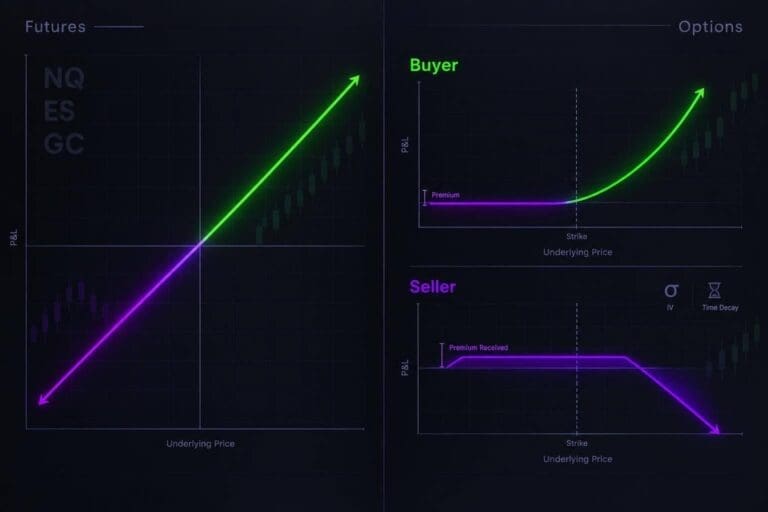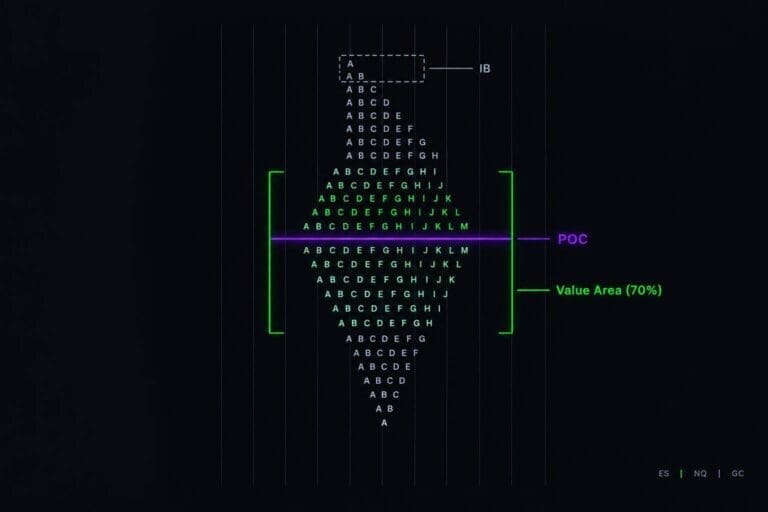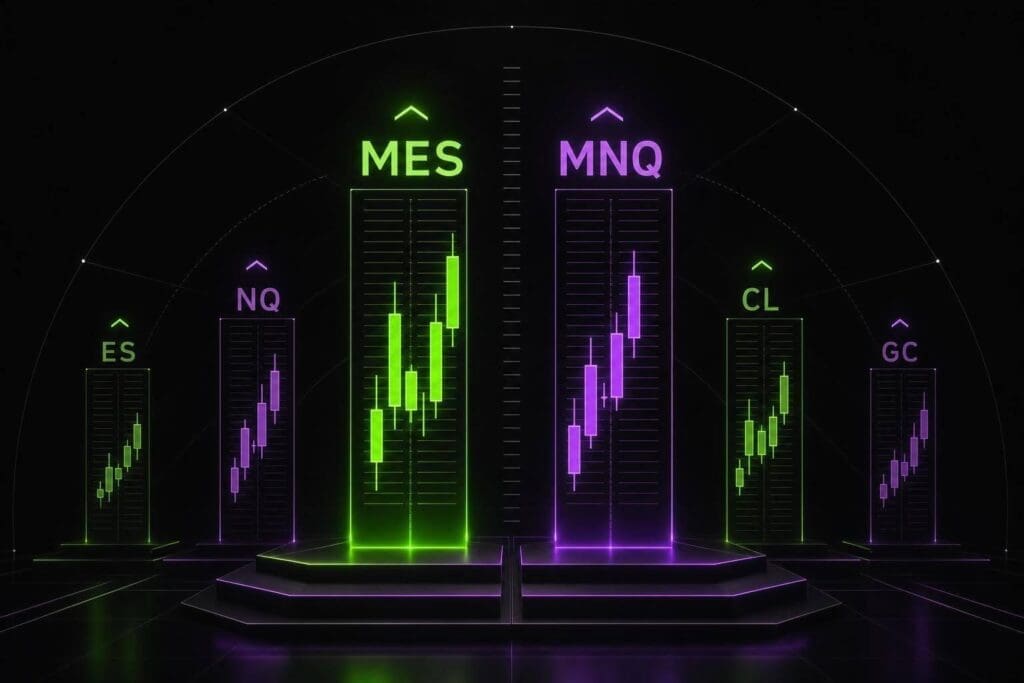
If I had to cut through the noise, I’d say this: most day traders should start with micros, and most index traders should start with MES. You get liquid markets, clean chart structure, and far less dollar pain when you screw up a trade. If you want more speed, go to MNQ. If you want news-driven movement, look at MCL or MGC before touching the full-size contracts.
I’m not going to rehash every spec from the full guide. This is the stripped-down version: which contracts make sense, who they fit, and where traders usually get into trouble. The whole game is matching tick value, volatility, and account size so one bad trade doesn’t turn into a dumb week.
Why Trade a Small-Sized Futures Contract?
sbb-itb-46ae61d
1. ES
ES is the benchmark contract. It’s liquid, moves enough to matter, and gives you a clean baseline when you’re comparing day-trade setups.
Liquidity
ES is one of the most liquid futures contracts in the world, with more than 1.5 million contracts traded per day. Even when things speed up, it often holds a one-tick spread [2][4].
Tick Risk
These are the numbers that matter: $12.50 per tick and $50 per point [1][2]. That means a 10-point move against you is $500 per contract. A 4-point stop is $200. Intraday margin usually falls between $400 and $1,500 per contract, depending on the broker [1][2].
That’s the trade-off with ES. It’s not wild like NQ or CL, but it still hits hard enough that sloppy sizing gets expensive fast.
Volatility
ES sits in the middle on volatility. It’s usually cleaner and less violent than NQ or CL [1]. That’s a big reason so many traders start here. Institutional flow also helps ES react well around support, resistance, VWAP, and opening-range levels [1].
Session Fit
The best trading windows are 9:30–11:30 a.m. ET and 2:00–4:00 p.m. ET [1]. The open tends to give you the best directional moves. Midday often turns into chop [1][3].
Also, don’t get cute around big news. Be flat at least five minutes before high-impact releases like FOMC or CPI [2].
| Feature | E-mini S&P 500 (ES) |
|---|---|
| Tick Size | 0.25 points |
| Tick Value | $12.50 |
| Point Value | $50.00 |
| Intraday Margin | $400–$1,500 |
| Active Window | 9:30–11:30 a.m. ET / 2:00–4:00 p.m. ET |
| Liquidity | Extremely High |
| Volatility | Medium |
ES makes sense for experienced traders with bigger accounts. If you want the same S&P 500 exposure without the same dollar hit per tick, MES is the obvious next step.
2. MES
If ES lines up with your setup but the dollar swings feel too big, MES is the scaled-down version. Same S&P 500 exposure. Just less heat. MES is 1/10 the size of ES, so you’re trading the same market structure with much lower tick risk.
Liquidity
MES trades well during U.S. Regular Trading Hours, and the spread often holds at one tick. That’s good enough for active intraday trading. Overnight, volume gets thinner. If you’re trying to scalp outside the main session, fills usually get worse.
Tick Risk
MES has a $1.25 tick value and a $5.00 point value [1][2]. That difference matters more than people think. A 10-point move in MES is $50, while the same move in ES is $500. Big gap. That’s why MES makes more sense for smaller accounts and tighter risk caps.
Intraday margin usually lands around $40–$100 per contract, compared with $400–$1,500 for ES [1][2].
MES works well if you want:
- smaller swings
- finer position sizing
- cleaner partial exits
- less brutal drawdowns than ES
Volatility
MES moves just like ES in price terms. The only thing that changes is the contract size. You still get the same chart, the same setups, and the same percentage move. You just don’t take the same dollar hit. That lower pressure makes it easier to hold valid trades and test setups live [1][3].
Session Fit
Use MES in the same U.S. session windows you’d use for ES. The best action is still during the core cash hours, especially 9:30–11:30 a.m. ET and 2:00–4:00 p.m. ET [1][2]. Overnight scalping is where this contract gets annoying. Liquidity drops, slippage climbs, and the edge gets thinner.
| Feature | Micro E-mini S&P 500 (MES) |
|---|---|
| Tick Size | 0.25 points |
| Tick Value | $1.25 [1] |
| Point Value | $5.00 [1][2] |
| Intraday Margin | $40–$100 [1][2] |
| Active Window | 9:30–11:30 a.m. ET / 2:00–4:00 p.m. ET [1][2] |
| Liquidity | Very High [1] |
| Volatility | Medium (identical % move to ES) [1] |
If you want the same index structure but more speed and bigger moves, the next contract is NQ.
3. NQ
NQ tracks the tech-heavy Nasdaq-100. It moves faster than ES, swings more, and snaps back harder. That gives you more opportunity, but it also means more ways to get smacked if your sizing is off.
Liquidity
NQ has strong liquidity during U.S. hours, but it’s still thinner than ES. You’ll notice that around news. Spreads can widen, and moves can get jumpy fast. Since NQ leans hard on tech, it tends to react sharply to earnings and sector headlines [1][2].
Tick Risk
One tick in NQ is 0.25 index points, and that tick is worth $5.00 per contract. A full point is worth $20.00 [1][2]. Intraday margin usually falls between $500 and $2,500, depending on the broker [1][2].
This is where people get careless. NQ loves fast reversals and ugly stop runs, so the same stop that feels fine on ES often gets chewed up here [1]. You usually need to give the trade more room. That also means you need tighter control over size and total risk.
Volatility
NQ puts up bigger intraday ranges and faster directional bursts than ES [1]. That’s why momentum setups, like opening range breakouts, often fit this contract well. When NQ picks a direction, it actually goes.
Of course, that cuts both ways. If you oversize, NQ can punish you in a hurry [1][2].
Session Fit
The best trading windows for NQ are usually the U.S. cash open (9:30–10:30 a.m. ET) and the afternoon close (3:30–4:00 p.m. ET) [2]. Those are the periods when it tends to move with purpose.
Midday is a different story. The stretch around 12:00–1:00 p.m. ET is often slower, choppier, and just weird enough to burn traders who force setups [3].
| Feature | E-mini Nasdaq-100 (NQ) |
|---|---|
| Tick Size | 0.25 points |
| Tick Value | $5.00 |
| Point Value | $20.00 |
| Intraday Margin | $500–$2,500 |
| Active Window | 9:30–10:30 a.m. ET / 3:30–4:00 p.m. ET |
| Liquidity | High |
| Volatility | High – fast momentum, sharp reversals |
If $5.00 per tick feels too big, trade MNQ instead. Same market. One-tenth the size.
4. MNQ
MNQ is the cleaner NQ alternative for smaller accounts and tight drawdown limits. Same Nasdaq behavior. Less damage per contract. That matters when the market gets jumpy.
Liquidity
MNQ has solid liquidity during U.S. hours, and spreads are usually tightest during Regular Trading Hours from 9:30 a.m. to 4:00 p.m. ET [2]. Outside that window, volume drops off and spreads get wider. If you scalp overnight, slippage becomes a bigger problem [2]. In fast Nasdaq moves, clean fills aren’t a nice bonus. They’re the whole game.
Tick Risk
MNQ trades in 0.25-point increments, and each tick is worth $0.50 per contract. One full point is $2.00 [1][2]. Typical intraday margin is around $50–$100 [1][2].
Here’s the part most traders care about: a 20-point stop on MNQ is $40 of risk. That same 20-point stop on NQ is $400 [2]. Big difference. MNQ lets you trade Nasdaq movement without chewing through your drawdown on one bad entry.
Volatility
MNQ moves like NQ. Fast pushes, hard reversals, and those momentum bursts that can rip in either direction. It’s a good fit for momentum setups like opening range breakouts because you still get the move, just with less contract risk hanging over the trade [2].
Session Fit
The best trading window for MNQ is the U.S. cash open from 9:30 to 11:30 a.m. ET, when liquidity and momentum are strongest [1][2]. The 3:30 to 4:00 p.m. ET close can also get active [3]. Midday is often choppy and thin by comparison, so don’t force it when volume dries up [3].
If you want more control over size, MNQ does that better than NQ. Ten MNQ contracts equal one NQ contract in notional exposure [1]. So instead of jumping from 1 NQ to 2 NQ, you can scale in finer steps with MNQ at 10% increments.
| Feature | Micro Nasdaq-100 (MNQ) |
|---|---|
| Tick Size | 0.25 points |
| Tick Value | $0.50 |
| Point Value | $2.00 |
| Intraday Margin | $50–$100 |
| Active Window | 9:30–11:30 a.m. ET / 3:30–4:00 p.m. ET |
| Liquidity | High |
| Volatility | High – same price action as NQ |
5. CL
If you want more speed and more headline risk than the index contracts, CL is the next step. Crude Oil is one of the most liquid day-trading futures out there, with 1 million+ contracts traded per day and tight spreads during the active parts of the session [1].
Liquidity
Liquidity is the main reason traders stick with CL. During the U.S. morning, big orders can usually get filled with less slippage, especially when U.S. hours line up with energy-market flow [1].
Tick Risk
CL trades in 0.01 increments, and each tick is worth $10.00 per contract [1][2]. So if crude moves 1.00, that’s $1,000 per contract [3]. Intraday margin usually falls somewhere around $500 to $1,500, depending on the broker [1][2].
That math gets real fast. A 10-tick stop is $100 in risk on one contract. If you size CL like it’s ES, you’re asking for a rough day. Keep the size under control.
Volatility
CL is fast, liquid, and touchy around news. It can rip on supply and demand shifts, OPEC headlines, geopolitical news, and economic data [1][3]. One of the biggest scheduled catalysts each week is the EIA Petroleum Status Report, which comes out every Wednesday at 10:30 a.m. ET [1][2].
That report can kick off a sharp move in seconds [1]. Best move? Be flat at least five minutes before big energy releases like EIA inventories or OPEC announcements [2].
Session Fit
The cleanest moves usually show up during the U.S. morning session and the Europe/U.S. overlap [1]. For most day traders, the best window is 9:30 a.m. to 12:00 p.m. ET.
| Feature | Crude Oil (CL) |
|---|---|
| Tick Size | 0.01 |
| Tick Value | $10.00 |
| Point Value | $1,000.00 |
| Intraday Margin | ~$500–$1,500 |
| Active Window | 9:30 a.m.–12:00 p.m. ET |
| Liquidity | Very High (~1M+ contracts/day) |
| Volatility | High – fast spikes around news events |
If CL feels too big, MCL gives you the same market with one-tenth the dollar risk.
6. MCL
Micro Crude Oil (MCL) tracks CL at one-tenth the size [1].
Liquidity
MCL has enough volume for retail day trading during normal U.S. hours. Spreads are usually fine in the main session, and fills tend to be cleaner than what you get in thin overnight trade [1][2].
Tick Risk
MCL uses the same 0.01 tick as CL, but the math is way easier on your account. Each tick is worth $1 instead of $10 [1][2]. This is double the MNQ tick value of $0.50. That means a 10-point move equals $100 per contract. Intraday margin usually sits around $50 to $100 [1][2].
Volatility
MCL moves on the same crude news as CL, including the weekly EIA inventory release [1][2]. When that number hits, price can jump hard and fast. If you don’t have a clear plan, stay flat. At the very least, treat that window with respect.
A lot of traders use MCL as a lower-stress way to work on energy setups before moving to full-size CL [1]. Same market. Less dollar heat.
Session Fit
Trade MCL in the U.S. morning if you want crude exposure without the bigger swings that come with CL.
| Feature | Micro Crude Oil (MCL) |
|---|---|
| Tick Size | 0.01 |
| Tick Value | $1.00 |
| Point Value | $100.00 |
| Intraday Margin | ~$50–$100 |
| Active Window | 9:30 a.m.–12:00 p.m. ET |
| Liquidity | Enough for retail day trading |
| Volatility | High; matches CL’s behavior |
If you want a commodity contract that isn’t pushed around by crude headlines every other minute, gold is the next one to look at.
7. GC
Gold futures (GC) give you macro exposure without the nonstop chaos you get in crude. It sits in a sweet spot: calmer than NQ or CL, but still active enough for solid day trading. That’s why a lot of traders use GC to read macro direction. Just don’t get lazy with the tick size.
Liquidity
GC has enough depth for clean fills and tight spreads during U.S. morning hours [1]. That’s when it tends to trade best, especially if the session has a clear macro driver behind it.
Tick Risk
GC trades in 0.10 increments, and each tick is worth $10.00 [1][5]. A 1-point move equals $100 per contract [3]. That adds up fast. If your account size is tight, or you’re still dialing in execution, MGC gives you the same market with less tick risk.
Volatility
Gold can move hard on CPI, FOMC, and NFP, so staying flat at least 5 minutes before those releases is the smart move [1][2]. It also reacts to rate expectations and Treasury moves, which is why GC often feels like a clean macro product when the market has a clear theme. The overnight sessions in Europe and Asia often help set the directional bias for the U.S. day [6].
Session Fit
GC usually trades best in the U.S. morning, especially around 8:30 a.m., 10:00 a.m., and 10:30 a.m. ET [1]. If you trade it, check the overnight price action before the open. That can give you a solid read on bias heading into the session [6].
| Feature | Gold (GC) |
|---|---|
| Tick Size | 0.10 [1][5] |
| Tick Value | $10.00 [1][5] |
| Point Value | $100.00 [3] |
| Active Window | U.S. morning, especially around 8:30 a.m., 10:00 a.m., and 10:30 a.m. ET [1] |
| Liquidity | Sufficient for retail day trading during U.S. morning hours [1] |
| Volatility | Moderate; sensitive to macro releases [1][3] |
If GC is too big for your account, Micro Gold (MGC) cuts tick risk to $1.00.
8. MGC
If GC is too big for your risk limits, MGC is the easy fix. You get the same gold market, just with a lot less dollar exposure. Micro Gold is one-tenth the size of GC, and it follows the same price action with a $1.00 tick value instead of $10.00. That cuts the damage when a trade goes wrong.
Liquidity
MGC now has enough liquidity for active U.S. session day trading, with clean fills during the U.S. morning session [1].
Tick Risk
A 10-tick move is $10 on MGC versus $100 on GC [2][3]. That’s a big difference if you’re trading a smaller account or trying to keep risk tight. You can trade the same gold setup without getting smacked by GC-sized swings [1][2].
Volatility
MGC reacts to macro data, Fed policy, and geopolitical headlines just like GC [1].
Session Fit
The best window for MGC is 8:30 a.m. to 10:30 a.m. ET [1]. That’s when you catch the U.S. data releases and the cash equity open. For gold, that’s usually where execution looks best and price movement has some life to it [1].
| Feature | Micro Gold (MGC) |
|---|---|
| Tick Size | 0.10 [1] |
| Tick Value | $1.00 [1][3] |
| Point Value | $10.00 [3] |
| Contract Size | 10 troy ounces (1/10th of GC) [4] |
| Active Window | 8:30 a.m. – 10:30 a.m. ET [1] |
| Best For | Beginners, small accounts, scaling [1][2] |
For gold traders who want tighter risk control, MGC is the cleaner fit.
Pros and Cons by Contract Type
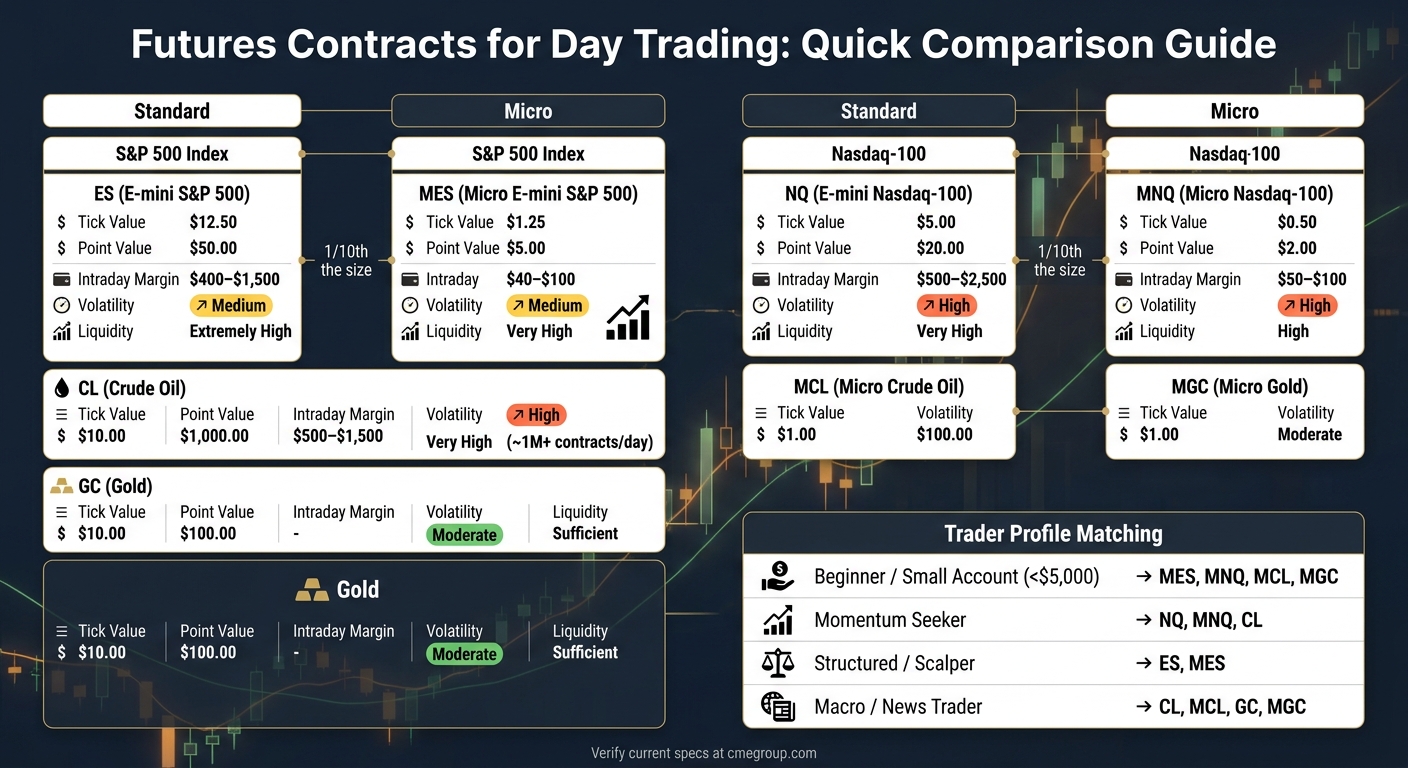
Futures Contracts Comparison: Tick Value, Margin & Volatility at a Glance
Use this matrix to compare speed, cost, and control. The right contract comes down to your account size, risk limit, and how you trade. If you trade momentum, your needs are different from someone waiting on slower macro setups. This table makes the trade-offs easy to spot.
Standard contracts pay better when you size up. Micros give you tighter control.
| Contract | Pros | Cons | Ideal Trader | Micro Fits If… |
|---|---|---|---|---|
| ES | Deep liquidity; tight execution | Choppy mid-day; less explosive than NQ | Scalpers; consistency-focused traders | Account is under $5,000 or you need finer scaling |
| MES | Same index exposure; lower tick risk | Smaller profit per tick | Beginners; traders scaling in and out | You want ES exposure with less dollar risk |
| NQ | Fast momentum; sharp reversals | Snap-backs punish mistakes; not suited for slow, low-frequency trading | Momentum traders; high risk tolerance | A 1-point move ($20) exceeds your risk plan |
| MNQ | Same NQ behavior; smaller sizing | Still volatile | Small accounts that trade momentum | You want NQ exposure with smaller sizing |
| CL | Strong directional moves; news sensitive | Fast spikes; wider stops often needed; higher margin requirements | Macro and news-driven traders | CL’s $10.00 per tick is too aggressive for your risk limits |
| MCL | Same crude setup; lower spike risk per contract | Lower volume than CL | Beginners in crude oil; risk-conscious traders | You want crude exposure with less dollar-per-tick risk |
| GC | Safe-haven flow; reacts to inflation and geopolitical news | Sensitive to USD and rate shifts; lower volume than indices [1][3] | Macro traders; inflation hedgers | You want gold exposure with less capital |
| MGC | Same gold exposure; smaller capital outlay | Less profit per tick than GC | Beginners in metals; small accounts | You want safe-haven exposure with limited capital |
Index futures are still the most liquid. Crude and gold move more off catalysts, so they can feel dead until something hits, then rip hard.
Micros aren’t just practice contracts anymore. They’re a core tool if you care about position sizing, drawdown control, and clean execution.
Session timing matters too:
- ES and NQ usually trade best around the U.S. cash open.
- CL tends to be strongest from 9:30 a.m. to 12:00 p.m. ET.
- Gold is often best during the U.S. morning.
Use micros when you need tighter dollar risk, cleaner scaling, or more room to manage a trade without blowing through your limit. That’s why they make sense for most newer traders and most accounts under $5,000. Next, line those traits up with your account size and trading style.
Which Futures Contract Fits You Best?
Once you know the specs and the tradeoffs, it comes down to two things: account size and how you trade.
If you’re under $5,000, stick with micros. The smaller notional size gives you tighter position control and less risk per trade. That matters a lot when one bad entry can dig a hole fast. Once you’re in the $10,000 to $25,000 range, standard E-minis start to make more sense.
Here’s the fast filter:
| Trader Profile | Recommended Contracts | Best Session (ET) | Key Characteristic |
|---|---|---|---|
| Beginner / Small Account | MES, MNQ, MCL, MGC | 9:30 a.m. – 11:30 a.m. | Low tick risk; precise sizing |
| Momentum Seeker | NQ, MNQ, CL | 9:30 a.m. – 10:30 a.m. | High volatility; large intraday ranges |
| Structured / Scalper | ES, MES | 9:30 a.m. – 11:30 a.m. / 2:00 p.m. – 4:00 p.m. | Deep liquidity; tight spreads |
| Macro / News Trader | CL, MCL, GC, MGC | 8:30 a.m. & 10:30 a.m. | Reactive to OPEC, CPI, and geopolitics |
If you want the safest place to start, MES is the cleanest entry into index futures. It’s easier to size, easier to survive mistakes, and a lot less punishing than jumping straight into NQ or CL.
Best move? Pick one or two contracts and learn how they move. Same product, same session, over and over. That’s how you stop guessing and start seeing the rhythm.
Before you trade, check current CME specs, margin requirements, and trading hours at cmegroup.com.
FAQs
How many micro contracts equal one standard contract?
Micro contracts are 1/10 the size of standard E-mini contracts. In plain English, 10 micro contracts = 1 standard contract for notional exposure.
So if you’re lining things up side by side:
- 10 MES ≈ 1 ES
- 10 MNQ ≈ 1 NQ
That’s the key math. Same market, smaller size, more room to scale in or keep risk tighter.
Should I trade micros even if I can afford standard contracts?
Yes. A lot of experienced traders still use micro contracts even if they can afford standard E-minis.
The big reason is position sizing. Micros let you size with more precision, so you can keep your dollar risk tighter and scale in or out without making huge jumps in exposure. That matters when you’re trying to stay consistent instead of taking on extra heat for no good reason.
Standard contracts give you more exposure. That’s the appeal. But they also demand more capital and a stronger stomach for bigger swings. One contract can move your P&L fast, and not always in a fun way.
Micros are often the better play for:
- Drawdown control
- Better trading discipline
- More consistent execution
- Smoother scaling in and out
Put bluntly, micros give you more control. And for a lot of traders, control beats size.
Which futures contract is best for beginners?
The Micro E-mini S&P 500 (MES) is the go-to futures contract for beginners. For most new traders, it’s the cleanest place to start. You get deep liquidity, tight bid-ask spreads, and price action that tends to behave in a more orderly way. It also tracks the E-mini S&P 500 (ES) at one-tenth the size, so you’re looking at the same market with less dollar risk.
That matters a lot when you’re new. MES has a $1.25 tick value, which gives you live reps without getting smacked by oversized losses. You can work on entries, exits, and trade management while keeping drawdown under better control. Other solid beginner contracts are MNQ and MYM, but MES is usually the better first stop.