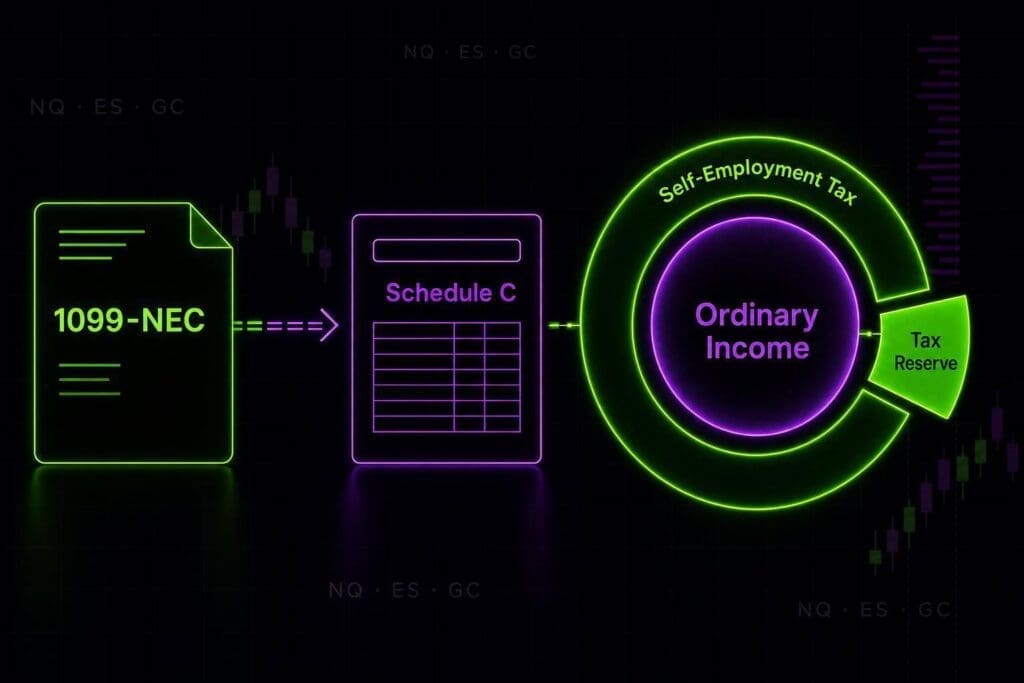
Short version: most prop firm payouts are taxed like contractor income, not like gains from your own futures account. That means ordinary income tax, and often self-employment tax too. If you were expecting Section 1256 treatment and that clean 60/40 split, yeah, that’s usually not how this goes.
I’ll keep this simple. Below, I break down what the article gets right, what the 1099-NEC changes, what it doesn’t change, and the tax numbers you should plan for before the IRS sends you a nasty little reminder.
Introduction
Prop firm payouts are usually taxed as contractor income, not Section 1256 trading gains.[8] That’s the key point. What matters most is how the payout gets reported.
A 1099-NEC is used to report contractor payments of $600 or more during the year.[1][3] That matters because the form changes how the income shows up on your return and what taxes hit it. If you made less than $600 and never got a form, the money is still taxable.[5]
Contractor income usually gets hit with self-employment tax on top of ordinary income tax.[6] That’s the part a lot of traders miss.
The next sections walk through how to report payouts, estimate taxes, deduct expenses, and keep clean records. Then the article gets into what each tax classification changes on your return.
sbb-itb-46ae61d
Are Prop Firm Payouts Taxed as Trading Gains or Contractor Income?
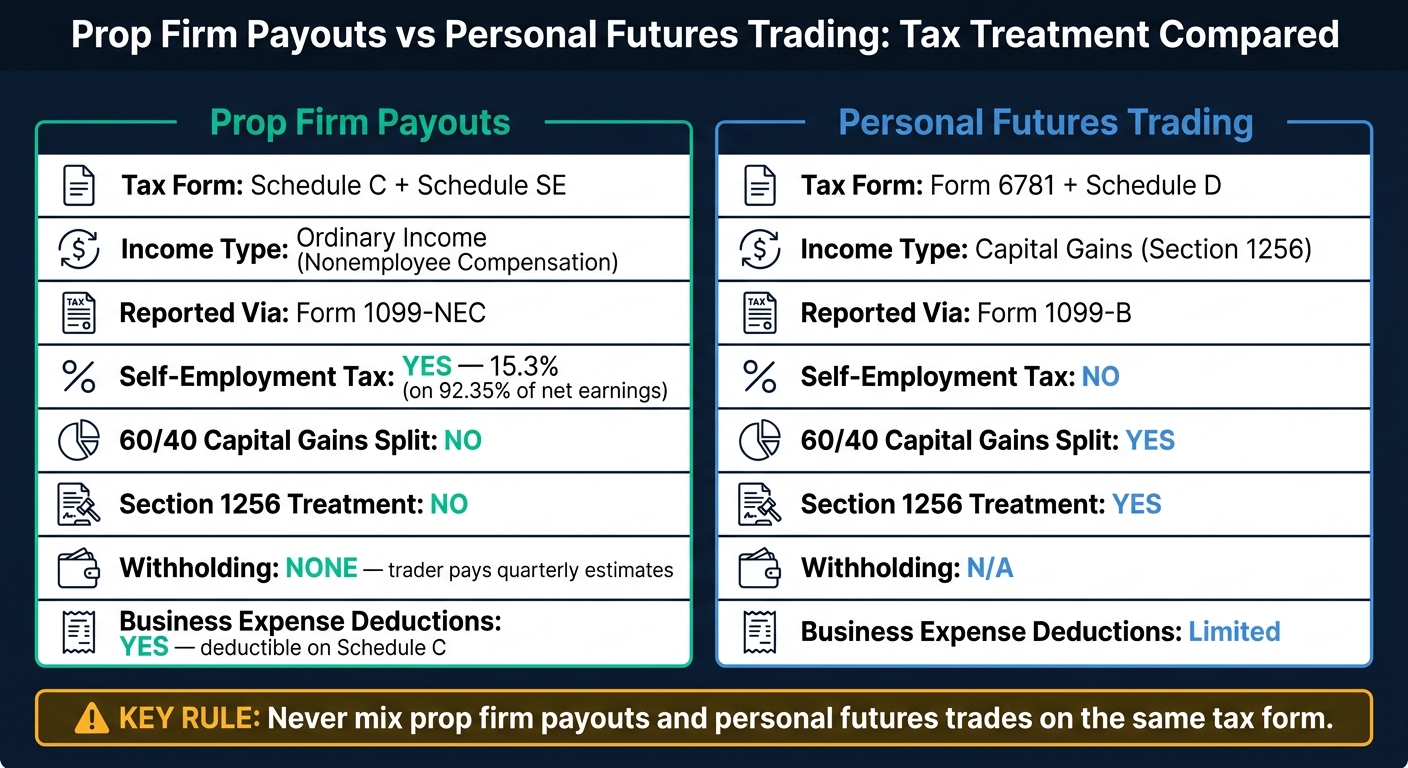
Prop Firm Payouts vs Personal Futures Trading: Tax Treatment Compared
Prop firm payouts are usually taxed as contractor income, not trading gains. The reason is pretty simple: you’re not trading your own futures account. The firm puts up the capital, and the payout is treated as payment for your trading services, not profit from assets you own. The IRS generally views that money as business income.[8]
Why Funded Trader Payouts Are Not the Same as Form 1099-B or Section 1256 Income
Your own futures trading can land under Section 1256 and show up through Form 1099-B, Form 6781, and Schedule D. Prop firm payouts usually don’t work that way because the money is paid to you as compensation for services.[8][6]
That matters. A lot.
Since the payout isn’t based on your own taxable trading gains, it’s generally reported as ordinary business income.[8] So the tax treatment follows business-income rules, not the rules tied to personal trading gains.
What a 1099-NEC Actually Tells You
A 1099-NEC means nonemployee compensation. In plain English, that’s contractor-style tax treatment.[8][3] A firm generally has to issue one once total payments hit $600 or more during the calendar year.[8][5]
That usually points you to Schedule C, with self-employment tax worked out on Schedule SE.[8][9][6]
The next part is where things get more annoying: what changes when a firm sends a 1099-NEC, and what still counts as taxable income when it doesn’t.
1099-NEC vs No 1099 Issued: What Changes and What Does Not
Once you know what a 1099-NEC is, the next part is simple: the form does not decide whether the money is taxable. It only changes how visible that income is to the IRS. The tax treatment stays the same either way.
Income Is Still Taxable Even Below the 1099 Threshold
A prop firm only has to send a 1099-NEC if it paid you $600 or more during the calendar year.[5] If you got less than that, the firm might not send anything. You still owe tax on the full amount you made.[5]
The self-employment tax rule kicks in once your net earnings from self-employment hit $400 or more, even if no form shows up in your mailbox or inbox.[6]
Your own records matter here. Use your payout history from the prop firm, your bank deposits, and your own income log as the main paper trail.[5]
1099-NEC vs No Form Received: What Changes and What Stays the Same
The big difference is IRS visibility. That’s it. Not whether the income counts.
What changes:
| Factor | 1099-NEC Received | No Form Received |
|---|---|---|
| IRS Visibility | IRS gets a copy and can cross-check it against your return | IRS leans on what you report |
| Payer Requirement | Firm paid $600 or more during the year | Firm paid under $600 during the year |
| Primary Record | Form 1099-NEC plus bank records | Personal income log plus bank records |
What stays the same:
- Income is fully taxable either way
- Payouts go on Schedule C and Schedule SE
- Self-employment tax applies if net earnings hit $400 or more
If a 1099-NEC gets filed, the IRS has a copy and can match it against your return. If the numbers don’t line up, that can lead to an IRS notice.[5][2] If no form gets issued, the IRS is leaning much more on your own reporting, which makes clean recordkeeping a bigger deal.[5][9]
Independent Contractor vs Employee Status for Prop Traders
A 1099-NEC usually means contractor treatment, but the form itself doesn’t settle the tax issue. Worker status is what matters. For most funded futures traders, that status is independent contractor, not employee, because the firm usually isn’t telling you how to trade, when to work, or what equipment to use.
With W-2 pay, taxes get pulled out for federal income tax, Social Security, and Medicare before the money hits your account. Prop firm payouts usually don’t work like that. You get the full payout, and you’re the one who has to deal with the tax bill.
How Contractor Status Affects Withholding and Self-Employment Tax
No withholding is the part that trips people up. If you’re a funded trader getting paid as a contractor, you don’t just owe regular income tax. You also owe self-employment (SE) tax, which covers both the employee and employer side of Social Security and Medicare. The combined rate is 15.3%.[6]
That 15.3% doesn’t apply to all of your net income. It applies to 92.35% of your net earnings, not 100%, because the tax calculation backs out the employer side first.[6] So if your net Schedule C income is $50,000, SE tax applies to $46,175.
As of 2026, the Social Security part applies only to the first $184,500 of net earnings. Anything above that still gets hit with the 2.9% Medicare part, but not the Social Security part.[6]
There’s one small break here. You can deduct 50% of your SE tax as an adjustment to income on Form 1040 (Schedule 1). That lowers your adjusted gross income, which cuts down the income tax side of the bill.[6]
Independent Contractor vs Employee: Tax Treatment Compared
Here’s the tax difference in plain English.
| Factor | W-2 Employee | 1099 Independent Contractor |
|---|---|---|
| Tax Form Received | Form W-2 | Form 1099-NEC |
| Withholding | Employer withholds income tax, Social Security, and Medicare | No withholding; trader pays estimated taxes quarterly |
| Social Security and Medicare Treatment | Split 50/50 – 7.65% each side | Contractor pays full 15.3% |
| Tax Filings Required | Form 1040 | Form 1040 + Schedule C + Schedule SE |
| Business Expense Deductions | W-2 employees usually cannot deduct unreimbursed work expenses | Deductible on Schedule C (software, platforms, home office) |
How to Report Prop Firm Income on a Tax Return
Prop firm payouts belong on Schedule C. Your own futures trading does not. Keep those buckets separate.
Reporting Payouts on Schedule C
Report your gross prop firm payouts on Schedule C, then subtract any deductible business costs, like platform fees and data fees, to get your net profit.[5][9] That net profit then flows into your regular income tax calculation and Schedule SE, which is where self-employment tax gets figured.
This matters because prop firm payout income is treated like ordinary income, not futures capital gains.
When Personal Futures Trading Goes on Different Forms
If you also trade your personal futures account, that goes on Form 6781 and Schedule D. Don’t mix it with prop firm payouts. Mixing the two is how you turn a simple tax return into a mess.
Here’s the clean split:
| Feature | Prop Firm Payouts | Personal Futures Trading |
|---|---|---|
| Tax Form | Schedule C + Schedule SE | Form 6781 + Schedule D |
| Income Type | Ordinary Income (Nonemployee Compensation) | Capital Gains (Section 1256) |
| SE Tax | Yes – 15.3% | No |
| 60/40 Rate Split | No | Yes |
A Simple Example Using Real Numbers
Let’s keep the math simple.
If you got $12,500 in payouts from your funded account and had $2,000 in deductible business expenses for platform and data fees, your Schedule C shows $10,500 in net profit.[5]
That’s just:
- $12,500 gross payouts
- Minus $2,000 expenses
- Equals $10,500 net profit
That $10,500 gets hit with ordinary income tax and self-employment tax.[8][6] You can also deduct 50% of the self-employment tax as an above-the-line adjustment, which lowers your adjusted gross income.[6]
That net number is also what feeds your quarterly tax estimate.
Taxes Funded Traders Should Plan for During the Year
Once you know prop firm income lands as contractor income, the next move is simple: set tax money aside during the year. Prop firm payouts usually come with no withholding, so if you don’t hold cash back yourself, the IRS bill can hit hard later [5][6].
Quarterly Estimated Taxes
The IRS wants tax paid as income comes in, not all at once at filing time [4]. If you expect to owe $1,000 or more in federal tax for the year, you’ll usually need to make quarterly estimated payments [4][6]. Miss those deadlines and you can get hit with an underpayment penalty on the unpaid amount [4].
For 2026, the due dates are:
| Payment Period | Federal Due Date |
|---|---|
| January 1 – March 31, 2026 | April 15, 2026 |
| April 1 – May 31, 2026 | June 15, 2026 |
| June 1 – August 31, 2026 | September 15, 2026 |
| September 1 – December 31, 2026 | January 15, 2027 |
The safe harbor rule matters here. Pay at least 90% of your current-year tax or 100% of your prior-year tax. That bumps to 110% if your prior-year AGI was over $150,000 [4][6].
If your prop payouts swing all over the place month to month, use the annualized income installment method on Form 2210. That lets your payments line up more closely with when the income actually showed up [4][10].
How Much to Set Aside from Each Payout
A good rule is to move 25% to 30% of each net payout into a separate tax account right away [5][6]. Do it as soon as the payout lands. Don’t wait until quarter-end and hope the cash is still there.
Use net profit, not gross payouts. That means payouts minus deductible business expenses [5][6]. The self-employment tax rate is 15.3%, but it applies to 92.35% of net earnings, not the full amount [6].
If you also work a W-2 job, there’s one lever that can help: bump up your W-4 withholding at that job. That can cut down part of what you need to send in through quarterly payments [4][5][6].
Keep those tax reserves separate from trading capital. Do not mix them. If it’s sitting in your trading account, it’s way too easy to treat tax money like risk capital.
Business Expenses Prop Traders Can Typically Deduct
Once prop firm payouts get treated as contractor income, deductions are where you cut down taxable profit. On Schedule C, only deduct expenses that are ordinary, necessary, and documented [5]. That’s the whole game here. If you can’t back it up with records, don’t deduct it.
Common Deductible Categories for Funded Traders
The usual write-offs start with direct trading-business costs. Evaluation fees, activation fees, and monthly platform fees paid to prop firms are generally deductible [8].
Beyond that, hardware like monitors, a trading PC, and high-speed routers can also be deductible. Bigger-ticket items might need to be depreciated over time instead of written off all at once [5][6]. Same idea with internet and cell phone bills: you can deduct the business-use share, not the whole bill. Keep a usage log so the percentage you claim doesn’t look made up [5][6].
A home office deduction can work if you use a specific part of your home only for your trading business [6]. The IRS simplified method allows $5 per square foot, up to 300 square feet, with a max deduction of $1,500 [6]. If you use the actual-expense method, keep utility bills, your lease, and square-footage records.
Accountant and tax prep fees tied to the business are fully deductible on Schedule C [5][6]. The same goes for trading courses, books, and professional development that directly relate to futures trading [7][6]. Personal stuff doesn’t count. Don’t try to sneak it in.
Deduction Checklist for Recordkeeping
These are the common buckets most prop traders deal with. The part that matters is the paper trail. A legit expense becomes a defendable deduction only when you’ve got the receipt, statement, or log to prove it. Save everything when you buy it, then keep it sorted by tax year.
| Expense Category | Example for Prop Traders | Documentation to Save |
|---|---|---|
| Platform & Firm Fees | Evaluation fees, activation fees, resets | Firm invoices or account statements |
| Software/SaaS | Platforms, charting tools, journaling apps | Subscription receipts or email confirmations |
| Hardware | Monitors, high-speed routers, trading PC | Store receipts or online order history |
| Professional Fees | CPA fees, tax prep software | Invoices or software purchase receipts |
| Education | Trading courses, mentorships, books | Enrollment receipts or book invoices |
| Connectivity | Business percentage of internet and cell phone | Monthly provider statements with usage log |
| Home Office | Percentage of rent, utilities, insurance | Utility bills, lease agreement, floor plan with measurements |
Use a dedicated business checking account for trading expenses [6][2]. That makes the recordkeeping way less messy, and it gives those deductions a lot more support if anyone ever looks closely.
Records to Keep for Prop Firm Tax Reporting
Once you know how the payout is classified, the next step is simple: prove the numbers. If your records are sloppy, your deductions are weak. These records back up Schedule C reporting, self-employment tax, and quarterly estimates.
Documents to Save All Year
Track every payout with the date, amount, and source. That means ACH, wire, check, or a payment processor. Don’t wait for a year-end form and try to piece it all together later. That’s how mistakes happen.
Match that income log with your expense records. Save invoices and receipts for evaluation fees, account resets, platform subscriptions, data feeds, and other ordinary business costs as soon as you pay them. Best move? Scan or upload receipts right away and keep them in one folder by tax year.
Bank statements from a dedicated business checking account tie the whole thing together. If all trading-related deposits and expenses run through one account, reconciling your books gets a lot easier. The paper trail is cleaner too.
Use those records to match gross payouts, expenses, and any year-end form you receive. Here’s the core stuff to keep:
| Document Type | Purpose for Schedule C | How to Retain |
|---|---|---|
| Payout Confirmations | Verifies gross receipts | Save email confirmations and platform screenshots [5] |
| Evaluation & Reset Fees | Deductible business expense | Keep receipts even for failed attempts [11] |
| Platform & Data Fees | Deductible business expense | Log monthly recurring subscription invoices [11] |
| Bank Statements | Proof of income and payments | Use a dedicated business account for all transfers |
| Form W-9 (copies sent) | Identity and payer record | Keep a copy of every W-9 you submit to a firm [1][2] |
| 1099-NEC (if received) | Income reconciliation | Compare against your personal ledger for accuracy [5] |
Keep personal futures trades in a separate ledger. It keeps your Schedule C records clean and saves a headache later.
Questions to Verify with Your Prop Firm and Accountant
Before year-end, make sure your records line up with whoever sends the tax form. Start with the prop firm. Ask which entity issues the 1099. Some firms send payouts through third-party processors, so the form might come from the payment platform instead of the firm itself [11]. Also ask if they can give you a year-end fee summary so you can reconcile everything without digging through months of emails.
Then talk to your accountant. Bring your income ledger, your expense records, and a clear note showing whether you also traded personal futures accounts during the year. That gives them what they need to split prop payouts from personal trading income and check whether you qualify for the QBI deduction [6]. That deduction won’t lower self-employment tax, but it can cut your income tax bill if you qualify.
Bottom Line: 1099 vs Contractor Income for Prop Firm Traders
For prop firm payouts, the form is the side issue. The tax status is what hits your wallet. A 1099-NEC just reports payments. Independent contractor status is what decides withholding, self-employment tax, and what you can write off. So the real tax question isn’t whether a 1099 shows up. It’s how that payout should be reported.
The $600 threshold only affects whether the payer sends a form. That’s it. If no form arrives, you don’t get a free pass. The income is still taxable, and you still need to report every payout using your own records.
Whether you get a 1099 or not, report prop firm income on Schedule C, figure self-employment tax on Schedule SE, and make quarterly estimated payments if you expect to owe. A good rule of thumb is to set aside about 30% of each payout for income tax plus self-employment tax. That’s why clean payout logs matter more than the form itself.
Track every payout. Keep your records tight. Before year-end, confirm the classification with your accountant.
FAQs
Do all prop firm payouts count as self-employment income?
Usually, yes. In the United States, prop firm payouts are often taxed as self-employment or business income because traders are usually treated as independent contractors, not employees.
That means taxes usually aren’t withheld from your payouts. You’re on the hook for reporting the income, paying regular income tax plus the 15.3% self-employment tax, and, in many cases, sending quarterly estimated tax payments so you don’t get hit with penalties.
Can I deduct failed evaluation and reset fees?
It comes down to whether your trading activity counts as a business expense. If your trading is treated as a business, you’ll usually report income and expenses on Schedule C.
For the fees to be deductible, they need to be ordinary and necessary for that business. Tax treatment changes based on your setup, so check with a qualified accountant to see whether your trading setup supports those deductions.
What if my prop firm never sends me a 1099-NEC?
If your prop firm never sends a 1099-NEC, you still have to report the trading payouts you got. Use your own records: bank deposits, account statements, payout logs, or invoices. No form doesn’t mean no tax bill. That’s not how the IRS sees it.
A 1099-NEC is mostly a payer reporting form. Your job is still the same either way: report the income you made, whether the form shows up or not. If you’re treating those payouts as self-employment or business income, you might also need to pay quarterly estimated taxes.