Crude oil futures are simple on paper and brutal in your P&L if you size them wrong. CL moves at $10 per tick. MCL moves at $1 per tick. That one detail changes everything. If you want the short version, start with Micro WTI, trade during the U.S. morning, and build every position off dollar risk, not margin.
I’m keeping this tight. You’ll get the contract math and sizing, the hours that matter, the news window that can wreck a lazy setup, and the execution habits that keep crude from slapping you around. If you trade futures already, this is the part that matters on screen.
Hedging Event Risk with WTI Crude Oil Futures
sbb-itb-46ae61d
What Are CL and MCL?
CL vs. MCL Crude Oil Futures: Contract Specs & Risk at a Glance
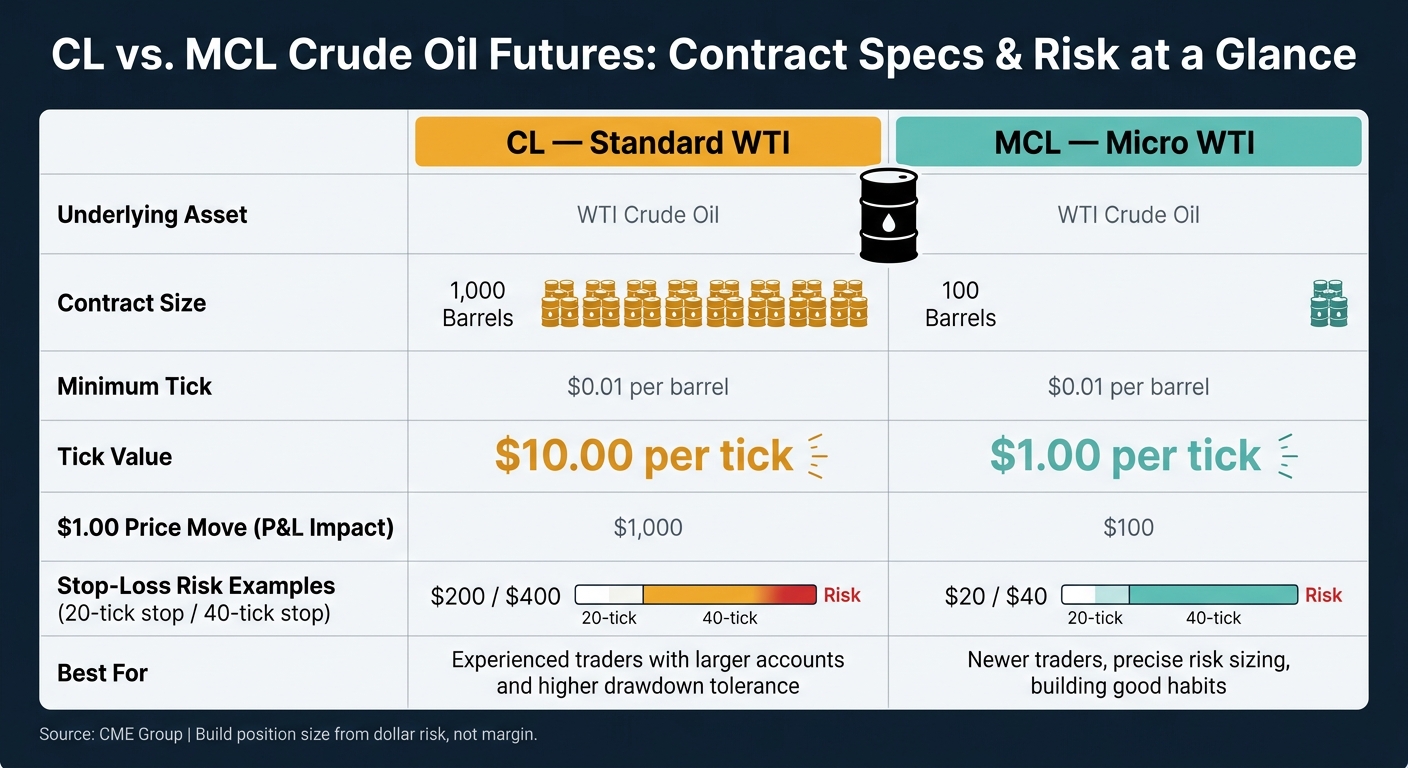
Both contracts track WTI crude oil. The whole deal comes down to size, and size changes your dollar risk. Simple as that.
CL is the standard WTI crude oil futures contract. It represents 1,000 barrels of oil. MCL is the Micro WTI contract, and it represents 100 barrels. That’s one-tenth the size of CL, so each tick is also worth one-tenth as much.
CL vs. MCL Contract Specs
Both contracts move in $0.01 per barrel increments. Since the contract sizes are different, the tick values are different too.
| Spec | CL (Standard WTI) | MCL (Micro WTI) |
|---|---|---|
| Underlying | WTI Crude Oil | WTI Crude Oil |
| Contract Size | 1,000 barrels | 100 barrels |
| Minimum Tick | $0.01/barrel | $0.01/barrel |
| Tick Value | $10.00 | $1.00 |
| $1.00 Move (P&L) | $1,000 | $100 |
Source: CME Group
Tick value matters because it hits three things right away: your stop distance, your position size, and how much you can lose on a trade.
Which Contract Fits Your Risk?
Use CL only if your account size and drawdown limits can handle bigger swings. A move that feels normal on the chart can still smack your P&L hard when each tick is worth $10.00.
Use MCL if you need tighter sizing and better control over risk. It gives you more room to fine-tune exposure before you size up to CL. That’s the main edge. More precision, less blunt-force risk.
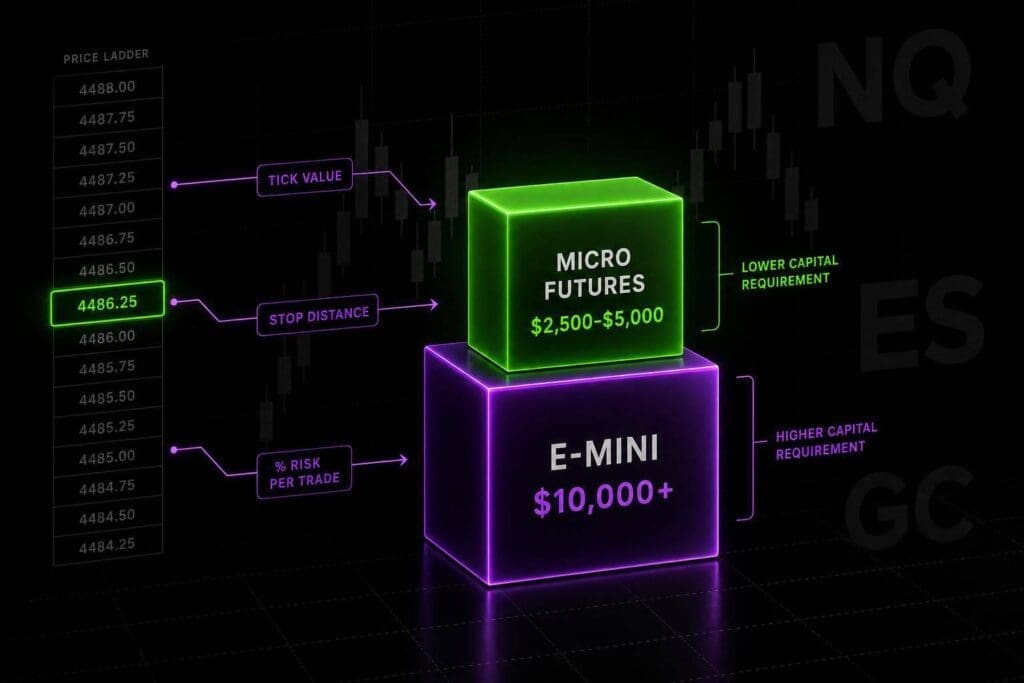
One catch: lower day-trade margins can lure you into oversizing. Don’t build your position off margin. Build it off your dollar risk per trade before you click buy or sell.
Once you’ve picked the right contract size, the next step is figuring out when CL and MCL are most liquid.
When Can You Trade Crude Oil Futures?
CL and MCL trade on CME Globex almost 24/5. That sounds simple, but the session you trade matters a lot. Crude can rip fast, and when liquidity gets thin, slippage gets ugly.
CME Globex Hours and the Daily Maintenance Break
CME Globex runs a weekly session from Sunday 6:00 PM ET to Friday 5:00 PM ET. There’s also a daily pause from 5:00 PM to 6:00 PM ET, Monday through Friday. If you’ve got working orders sitting out there, manage them before the halt.
| Event | Day / Time (Eastern Time) |
|---|---|
| Weekly Market Open | Sunday 6:00 PM ET |
| Daily Maintenance Break | Monday – Friday 5:00 PM – 6:00 PM ET |
| Weekly Market Close | Friday 5:00 PM ET |
Source: CME Group
The Best Trading Windows for CL and MCL
Just because the market is open doesn’t mean it’s a good time to trade. The U.S. morning session is usually the sweet spot for better liquidity, tighter spreads, and cleaner fills. The EIA Weekly Petroleum Status Report is another busy window, so it makes sense to plan trades around that release.
Overnight is a different story. Liquidity gets thinner, spreads get wider, and price can whip around for no good reason. If you’re newer to crude, stick to the U.S. morning session.
Active hours can help with execution. They do not fix bad risk control. Margin and volatility still decide how much heat your trade can take.
Margin, Volatility, and Rollover: What You Need to Know Before You Trade
Margin, volatility, and rollover shape your crude risk before you click buy or sell. That hits hardest when you’re sizing trades, because CL and MCL can turn the same price move into very different P&L.
Margin and Why Crude Feels Bigger Than It Looks
Margin comes in two buckets. Exchange margin is the CME requirement if you hold a position overnight. Day-trade margin is set by your broker and is usually much lower. That lower number can free up capital, but it also tempts people to size way too big.[1]
Here’s the part that trips traders up: margin is a capital requirement, not a risk gauge. Your actual exposure comes from contract size, tick value, and how far crude moves. A cheap intraday margin number doesn’t make the trade safer. It just makes it easier to overdo it.
Do the math before entry. Figure out your position size. Figure out your dollar risk. Then place the trade. In crude, that order matters.
Rollover Basics for Front-Month Crude
CL and MCL both expire on set dates. As expiration gets closer, volume and open interest move into the next month. At the same time, the expiring contract can dry up fast. That’s where fills get worse, slippage picks up, and execution gets messy.
Watch the active contract and roll before liquidity starts thinning out. For exact expiration and last trade dates, check CME Group’s WTI Crude Oil page.
Once rollover is clear, the next step is understanding what actually moves crude.
How Crude Oil Price Movement Actually Behaves
Once you know when to roll, the next thing is understanding why crude can rip or dump so hard.
CL moves faster than equity index futures. A lot faster. It’s pushed mostly by supply shocks, inventory data, and headline risk. When inventory numbers hit, OPEC+ talks shift, or a geopolitical mess pops off, crude can spike in seconds. At that point, your entry, your stop, and how fast you can get orders in matter just as much as the trade idea.
The Main Drivers Behind CL Moves
The big drivers are supply disruptions, inventory data, OPEC+ expectations, and geopolitics.
Supply shocks can slam price with little warning. Think pipeline outages, policy shifts, or geopolitical events that hit oil flow or trader sentiment right away. On the slower side, longer-term demand expectations also change as the energy transition keeps reshaping the market.
Contango, Backwardation, and Why They Matter for Traders
Contango means deferred months cost more than the front month. Backwardation means the front month costs more than deferred months.
That curve matters because it changes your rollover cost and tells you whether holding the front month is working for you or against you. This hits hardest if you carry positions through expiry or keep trading the front month deep into rollover.
Once you understand what pushes crude around, it gets a lot easier to time breakouts, pullbacks, and inventory-driven entries with cleaner execution.
Trading Setups That Work in Crude Oil Futures
Once you know what moves crude, the next job is simple in theory and hard in practice: trade those moves at levels that matter. In CL, the cleanest setups usually show up around key highs and lows, heavy-volume areas, and scheduled news.
Breakout Trades Around Key Levels
Breakouts make the most sense at overnight highs and lows, plus the prior day’s high and low. Those are the levels a lot of traders are watching, so if price pushes through, you want to see actual participation, not a weak poke that fades 30 seconds later. Watch volume first. Then use order flow to confirm that traders are backing the move.[1]
Pullback Trades After a Strong Move
After a hard push up or down, don’t chase the move like a maniac. Wait for price to pull back into a prior breakout area or a volume-profile node. That gives you a cleaner entry and a line in the sand for the trade. Set your invalidation before you enter, then size your contracts based on the stop distance and your dollar risk.[1]
Planning Your Session Around EIA Inventory Reports
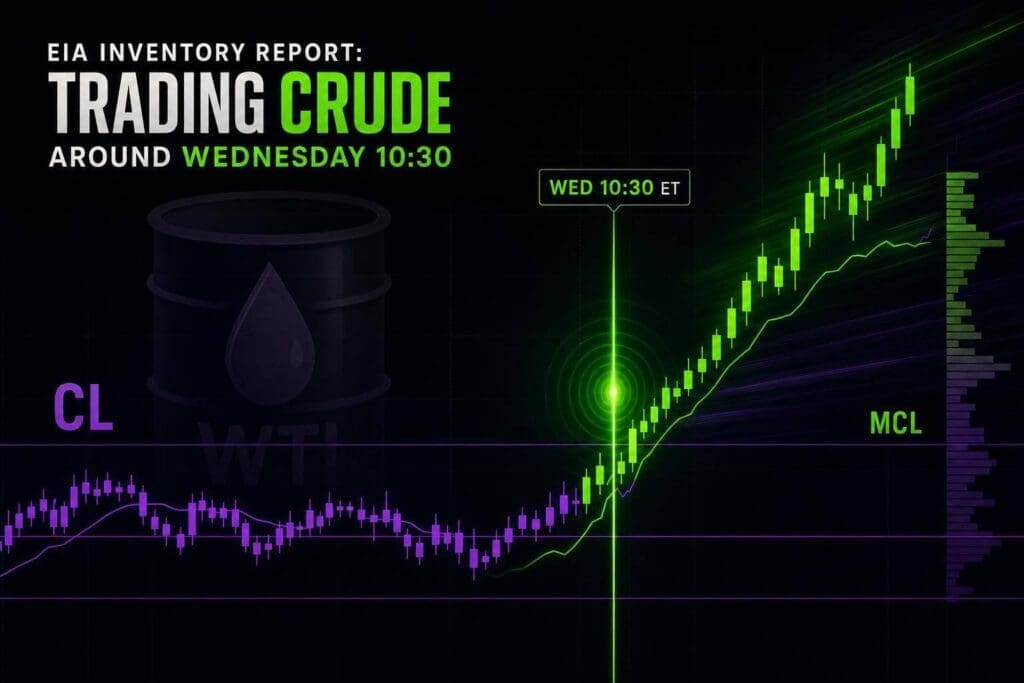
The weekly EIA inventory report can snap CL in either direction fast, so treat that time window as high risk.[1] If you’re trading the reaction, focus on whether price reclaims or loses a key level. Don’t try to guess the number ahead of time. That’s where traders get chopped up.[1]
These setups tend to work best when your platform shows liquidity clearly and lets you get orders in fast.
How to Set Up Your Platform for CL and MCL
Crude pays for clean execution. A slow platform or a messy layout will cost you fills. When CL starts ripping during a volatile session, your tools need to be ready before the move hits. In crude, execution tools aren’t nice extras. They’re part of the trade.
DOM, Bracket Orders, and Fast Order Entry
Once your setup is set, fills come down to execution. NinjaTrader and Sierra Chart both handle DOM workflow well in fast crude sessions. The DOM, or ladder, lets you see resting orders, read how price is moving through levels, and fire limit orders fast without clicking around your chart. If you want more than the basic DOM view, Jigsaw gives you a tighter read on pace and timing.[1]
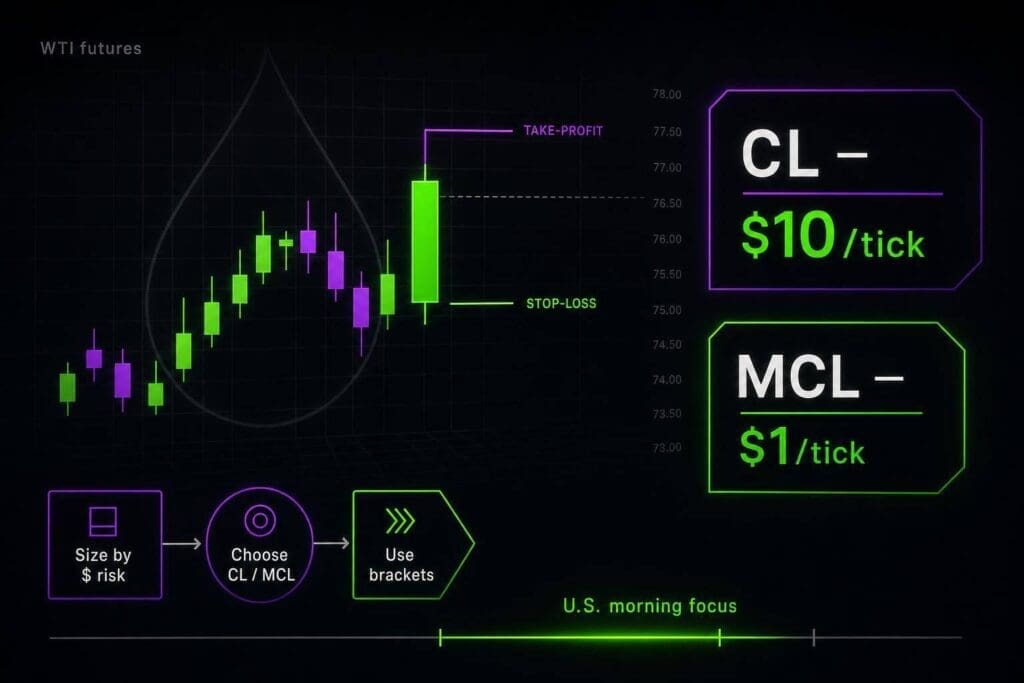
Bracket orders are non-negotiable for crude. The second your entry fills, your stop-loss and profit target should already be in place. That’s how you cut dumb manual errors when the market jumps. Size the bracket to the contract you’re trading: a 10-tick stop is $100 in CL and $10 in MCL.[1] Save those brackets as ATM Strategies so you can flip from your normal setup to a wider-stop template when volatility picks up, instead of messing with settings mid-trade. Set hotkeys for Flatten and Move to Breakeven too. In crude, speed matters.[1]
For data, use a low-latency feed like Rithmic or CQG.[1] If your DOM lags, your read on pace and liquidity is off. That’s a problem.
Chart Layout, Volume Profile, and News Feed
After order entry, your chart should show only what matters. Keep three views on screen: an execution chart, a higher-timeframe context chart, and volume profile vs price action. The context chart, usually hourly or daily, keeps you from shorting into a strong trend just because the lower timeframe looks choppy. Volume profile shows where business got done, and those high-volume nodes give you clean reference areas for breakout targets and pullback entries.[1]
If you want a deeper look at order flow, Bookmap adds a heatmap so you can see where big resting limit orders are sitting in crude.[1] That helps when you’re trying to spot where liquidity is stacked before you get in. Also keep an economic calendar open, especially for the Wednesday 10:30 a.m. ET EIA release.[1]
| Tool | Best Use in Crude Oil | When It Matters Most |
|---|---|---|
| DOM (Ladder) | Timing entries and reading market pace | Fast-moving sessions, EIA reactions |
| Bracket Orders | Pre-setting stop-loss and profit target | Every trade, especially around news |
| Volume Profile | Finding high-volume nodes for targets | Breakout and pullback setups |
| Context Chart | Seeing key structure and trend direction | Session planning, before entry |
| Economic Calendar | Tracking EIA report times | Wednesday mornings, 10:30 a.m. ET [1] |
How to Manage Risk When Trading Crude Oil Futures
A clean platform setup helps you get in without fumbling. Risk management is what stops one bad CL trade from wrecking the account.
Crude oil moves HARD. One oversized position in CL can do serious damage in a single trade. Before you click buy or sell, you should know your risk in dollars, not just ticks.
Position Size, Stop Placement, and Dollar Risk
The math is simple once it clicks.
Every tick in CL is worth $10. Every tick in MCL is worth $1. That means a 20-tick stop on one CL contract puts $200 at risk. The same 20-tick stop on one MCL contract puts $20 at risk.[1]
That’s the right way to think about it. Start with the dollar amount you’re willing to lose, then work backward. Don’t start with margin and hope the stop makes sense after the fact. Pick your max loss for the trade, convert that into ticks for the contract you’re trading, and use a futures trading profit calculator and drawdown calculator before you place the order.[1]
If the chart says the trade needs a wider stop than your risk plan allows, you’ve got two clean choices:
- Size down to MCL
- Skip the trade
That’s it. Don’t force a setup to fit a bad size.
Stop placement should come from market structure and crude’s normal volatility, not some random number that feels okay. If your stop is too tight, normal noise can knock you out before the trade even has a chance to work.[1] If the proper structural stop is too wide for your risk cap, cut size. Don’t squeeze the stop just to stay in CL.
| Contract | Tick Value | 20-Tick Stop Risk | 40-Tick Stop Risk |
|---|---|---|---|
| CL (Standard) | $10.00 | $200 | $400 |
| MCL (Micro) | $1.00 | $20 | $40 |
Common Crude Mistakes That Blow Up Traders
Oversizing CL is one of the fastest ways to break your own risk rules. Low day-trade margins can make size look cheap, but that’s a trap. Margin is not your risk plan.[1] Your size should match your pre-set loss limit, not whatever the platform says you can hold.
Trading EIA without a plan is another mess waiting to happen. Inventory releases can hit fast, move hard, and produce slippage. Decide before the number drops whether you’re trading it or staying out.[1] Making that call mid-spike is how traders get smoked.
Stops that are too tight get clipped all the time in crude. This market has normal noise that’s bigger than what many traders want to tolerate.[1] If CL needs more room than your plan allows, move to MCL and give the trade proper space instead of jamming a tiny stop onto CL.
Slippage during fast conditions is real, and pretending otherwise is dumb. During EIA releases or sharp breakouts, your stop might not fill at the exact price you set. Build that into your dollar-risk plan from the start.[1] A good data feed like Rithmic or CQG can help keep pricing clean, but it won’t make slippage disappear.[1]
Where to Start With Crude Oil Futures
After risk control, contract choice and execution discipline are the next things that matter.
Start with MCL. It’s the cleaner place to build good habits: solid entries, bracket-order discipline, and control during news sessions before you size up.
Once the contract size lines up with your risk, look at cost next. Check total trading cost, not just margin, before you add size. Margin can look cheap and still cost you more where it counts.
Move to CL only when you can size every trade by dollar risk, place stops based on structure, and stay flat when news risk gets too high.
Next Steps for Prop Traders
If you’re trading a funded account, tool choice matters just as much as contract choice. Get your broker, platform, and data feed set up first. Add journaling after your execution is stable.
Also, check your firm’s rules before you use copy or automation tools.
FAQs
How much money do I need to start trading MCL?
The amount you need to trade Micro WTI (MCL) futures comes down to two things: where you’re trading and what type of account you’re using.
If you’re trading a personal account, you need enough to cover your broker’s minimum deposit and the intraday margin for MCL. That number isn’t fixed. One broker might let you in with a small deposit, while another wants more room in the account.
If you’re trading through a prop firm evaluation, the setup is different. You’re not funding the position the same way you would in a personal brokerage account. Instead, some firms charge a one-time activation fee to open the funded account after you pass. A common number is around $130.
So don’t overcomplicate it:
- Personal account: minimum deposit + MCL intraday margin
- Funded account: often a one-time activation fee of about $130
That’s the core difference. One is margin-based. The other is fee-based.
What stop size is realistic for crude oil futures?
There’s no one-size-fits-all stop for crude oil futures. The right stop comes down to your risk plan, current volatility, and how you trade.
Crude oil moves fast. A stop needs to be wide enough to handle normal noise, not so tight that a routine swing knocks you out early. Set it around your account risk, your margin, and the contract’s tick-value math.
When should I avoid trading CL or MCL?
Avoid trading CL and Micro WTI (MCL) if you can’t handle gap risk or sudden liquidity shifts. The big rule is simple: don’t hold positions through the weekend.
Flatten everything by the end of the Friday CME/Globex session at 5:00 p.m. ET. Don’t carry crude into a weekend gap.