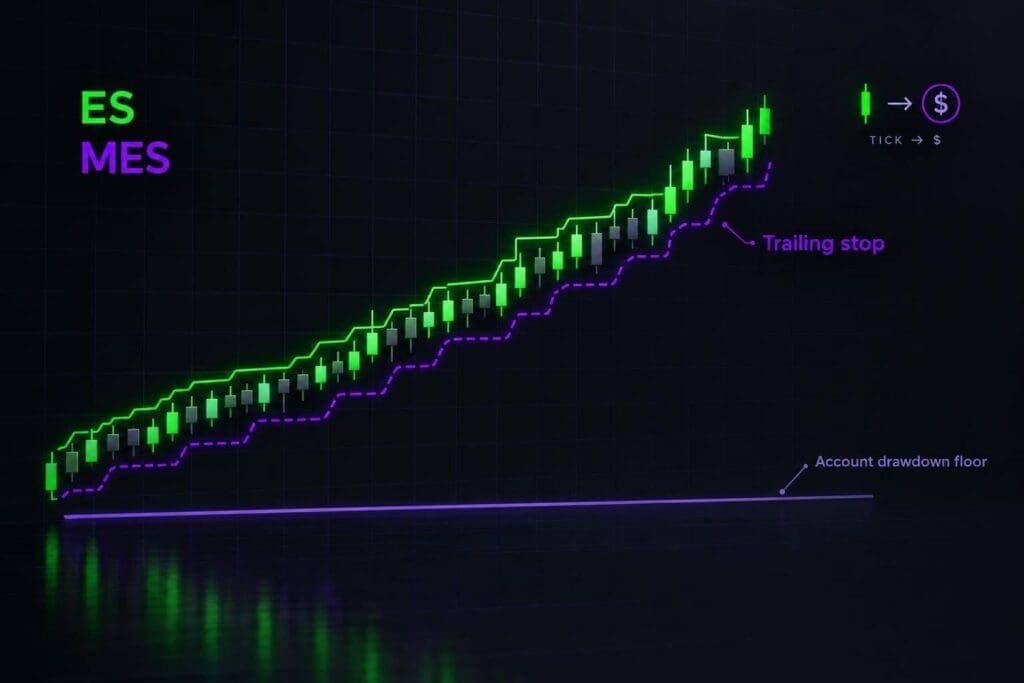
A trailing stop manages your position, not your account’s trailing drawdown. I’d keep that distinction front and center before setting any automatic exit. A 10-point trail on one ES contract puts $500 at risk before fees and slippage; the same distance on MES is $50. Neither figure is a guaranteed loss cap.
Here, I’ll break down the tick math, how stops follow favorable price moves, and which platform settings you need to check. You’ll also see why a stop trigger isn’t a promised fill price. <u>Size the trade against your remaining account room</u>, not just the distance on your chart. A stop won’t save an oversized position from a drawdown breach.
Bookmap Special Order Types: OCO, Brackets, & Trailing Stops
sbb-itb-46ae61d
How a Futures Trailing Stop Works
A fixed stop stays at the price you set unless you move it. A trailing stop adjusts automatically as price moves in your favor. It can protect open profit, but it doesn’t guarantee profit or your fill price.
The details come down to your platform’s settings: when the trail activates, which price it tracks, how often it updates, and how it handles orders. Check those rules before trading live. See the official NinjaTrader Auto Trail documentation.
Long Stops Move Up; Short Stops Move Down
For a long position, the stop trails a fixed distance below the highest price reached after activation. New highs move the stop up according to the platform’s update rules.
For a short position, the stop trails a fixed distance above the lowest price reached after activation. New lows move the stop down according to those same rules.
The trailing rule works the same way in both directions. Only the side of the market changes.
Next, convert that trail distance into dollar risk on ES and MES.
Calculate Trailing Stop Risk on ES and MES
ES vs. MES Trailing Stops: Dollar Risk and Price Movement
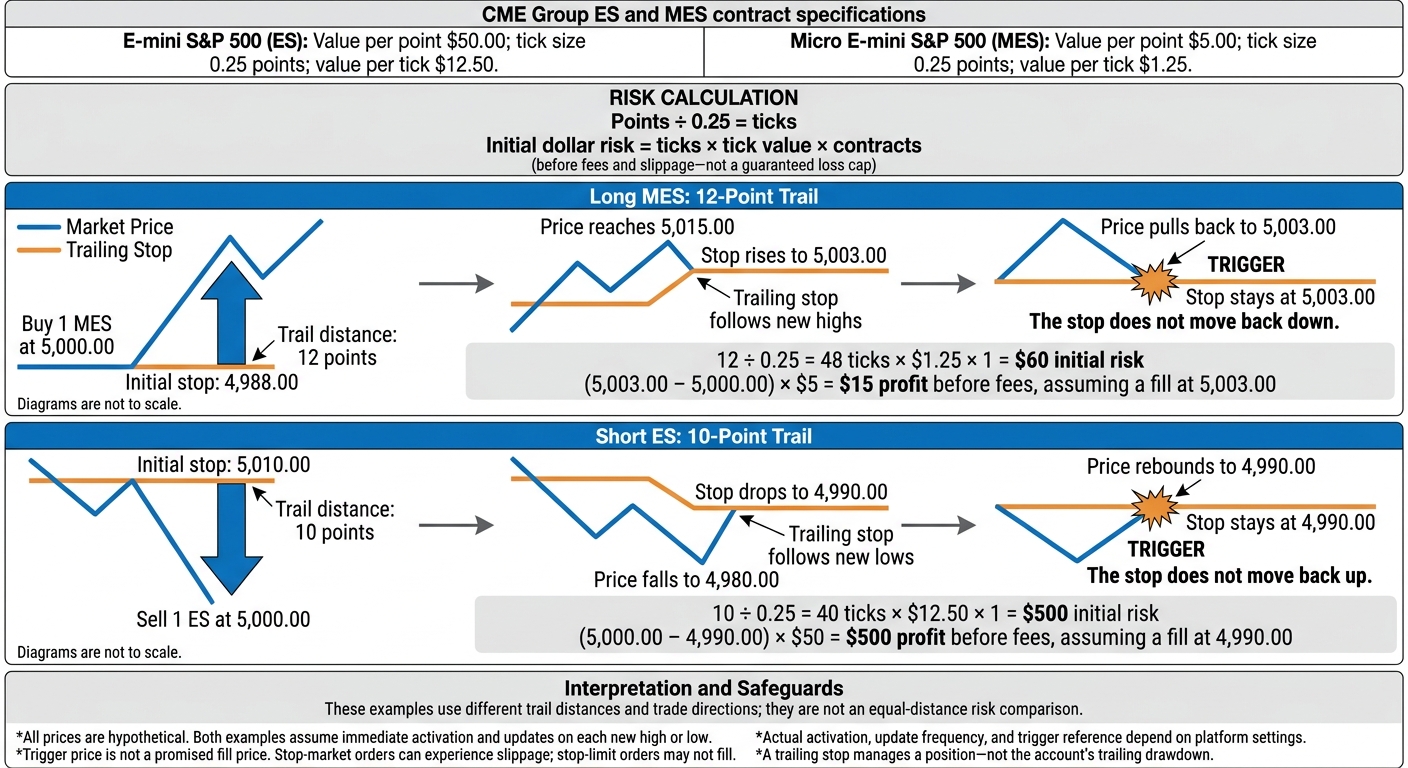
Convert your trail distance into dollars using the contract specs below, sourced from CME Group’s ES contract specifications and MES contract specifications.
| Contract | Value per point | Tick size | Value per tick |
|---|---|---|---|
| E-mini S&P 500 (ES) | $50.00 | 0.25 points | $12.50 |
| Micro E-mini S&P 500 (MES) | $5.00 | 0.25 points | $1.25 |
First, convert points to ticks: points ÷ 0.25 = ticks. Then calculate initial dollar risk = ticks × tick value × contracts. That’s your risk before fees and slippage.
Check the values and size your position before entry with DamnPropFirms’ ES contract guide, MES contract guide, and Position Size Calculator.
All prices below are hypothetical. Both examples assume immediate activation and updates on each new high or low.
Long MES Example: A 12-Point Trail
Buy 1 MES at 5,000.00 with a 12-point trail: 12 ÷ 0.25 = 48 ticks × $1.25 × 1 = $60 in initial risk. The initial stop is 4,988.00. If price reaches 5,015.00, the stop rises to 5,003.00. It stays there during a pullback unless price makes another high. If price reverses to 5,003.00, the stop triggers; profit before fees is (5,003.00 − 5,000.00) × $5 = $15, assuming a fill at that price.
Short ES Example: A 10-Point Trail
Sell 1 ES at 5,000.00 with a 10-point trail: 10 ÷ 0.25 = 40 ticks × $12.50 × 1 = $500 in initial risk. The initial stop is 5,010.00. If price falls to 4,980.00, the stop drops to 4,990.00 and stays there during a rebound – it does not move back up. If price rebounds to 4,990.00, the stop triggers; profit before fees is (5,000.00 − 4,990.00) × $50 = $500, assuming a fill at that price.
Choose and Set Your Trailing Distance
Use the ES and MES dollar examples above to pick a trail that fits your setup and account limit. Base it on recent volatility and price structure, not a random number. Tighten it only after price fails to extend the move. A tight trail can stop you out on normal price fluctuations. A loose trail gives the trade more room but increases loss exposure and profit giveback. [1][3]
Convert the distance to ticks and dollars, then size your trade with the Position Size Calculator. If the risk is too high, cut contracts. [3]
Leave room for fees and slippage, too. Total planned risk must stay within your remaining account limit, including those costs. That’s a planning estimate, not a guaranteed maximum loss. [3]
Check Platform Settings Before Going Live
Check whether your trail uses ticks or points, when it activates, how often it updates, and which price triggers it: Last, Bid, or Ask. For NinjaTrader, read its Auto Trail documentation alongside DamnPropFirms’ NinjaTrader platform guide. [3][5]
Test the full order in sim first, including activation, updates, and partial fills. Then check the platform documentation for live disconnect behavior: does the stop stay active, and do trailing updates continue? Sim testing alone won’t confirm what happens during a live disconnect. [3][4]
When price touches your stop, the trigger price and execution price can still differ.
What Happens When the Stop Triggers
Once your stop has trailed behind price, it triggers when price comes back and hits it.
Your platform may use the last trade, bid, or ask as the trigger. When that reference price hits your stop, a stop-market order becomes a market order and fills at the next available price.[3]
Why the Fill Price Can Differ From the Stop Price
Slippage is the gap between your stop’s trigger price and your actual fill. Fast markets, thin liquidity, or sharp moves can leave you with a fill away from the trigger price.[2]
A stop-limit caps the execution price, but it may not fill in a fast market.[3]
The stop controls your trade exit. It doesn’t change your account-level trailing drawdown.
Trailing Stop vs. Trailing Drawdown
A trailing stop exits one trade. A trailing drawdown limits account loss as equity rises. Same word, different rule.
| Feature | Trailing stop | Trailing drawdown |
|---|---|---|
| Scope | One position | Entire account |
| Purpose | Limit trade loss or protect profit | Enforce an account loss limit |
| Movement | Moves with favorable price | Rises with account equity |
| Trigger | Price reaches the stop | Monitored account value reaches the drawdown limit |
| Result | Position exits | Account reaches the drawdown limit |
Your stop controls the trade, not the account’s drawdown floor. Slippage can push a stop fill past that floor, even with a stop in place.
Before you trade, check which account value the rule monitors. Then compare your planned trade risk with the room left above the drawdown limit as part of your risk management essentials. Leave room for execution costs and slippage. That whole buffer isn’t yours to risk.
Check Damn Prop Firms’ glossary or rules page for the exact drawdown definition.
Manage Trade Risk and Account Limits Separately
After sizing the ES and MES examples above, check these before entry:
- Set the trail distance first. Use volatility and structure, such as ATR, recent swing highs/lows, or EMA 21, to guide it.[6]
- Calculate dollar exposure. Convert the trail distance to dollars, then add commissions, fees, and slippage.[3]
- Check the platform setup. Test the order in demo and confirm it fits your account rules.[3]
- Check account room separately. Compare planned risk with your remaining drawdown and daily loss room. If the buffer is too small, cut size or skip the trade.[3]
Keep trade risk and account limits separate. The stop manages the trade; the drawdown and daily loss checks protect the account.
A trailing stop exits the trade; it doesn’t cap your final loss. Once triggered, it becomes a market order, so your fill can differ from the stop price.[2][3]
FAQs
When should I activate my trailing stop?
Activate your trailing stop after the trade moves in your favor, usually once the market confirms the direction you expected. Your strategy sets the timing. The goal is to help lock in gains and limit losses.
A trailing stop isn’t an account-level trailing drawdown. It follows favorable price movement at a set distance for one position. Check your platform or broker settings to make sure the stop updates in real time.
How should I adjust my trail as volatility changes?
Adjust your trailing stop distance as volatility changes. Use a wider trail in higher volatility to give normal market noise more room without stopping you out. In lower volatility, tighten the trail to protect gains more aggressively.
A trailing stop follows favorable price movement at a set tick distance. Monitor market conditions and adjust that distance manually to keep your risk management in line with your strategy.
How much drawdown buffer should I leave for slippage?
Leave room for slippage in your drawdown buffer. Your stop-loss can fill at a different price than its trigger, especially during high volatility or low liquidity. If that fill pushes your balance below the trailing drawdown threshold, you can breach the account limit even with a stop in place. Check your firm’s drawdown rules so you know how execution differences affect your account.