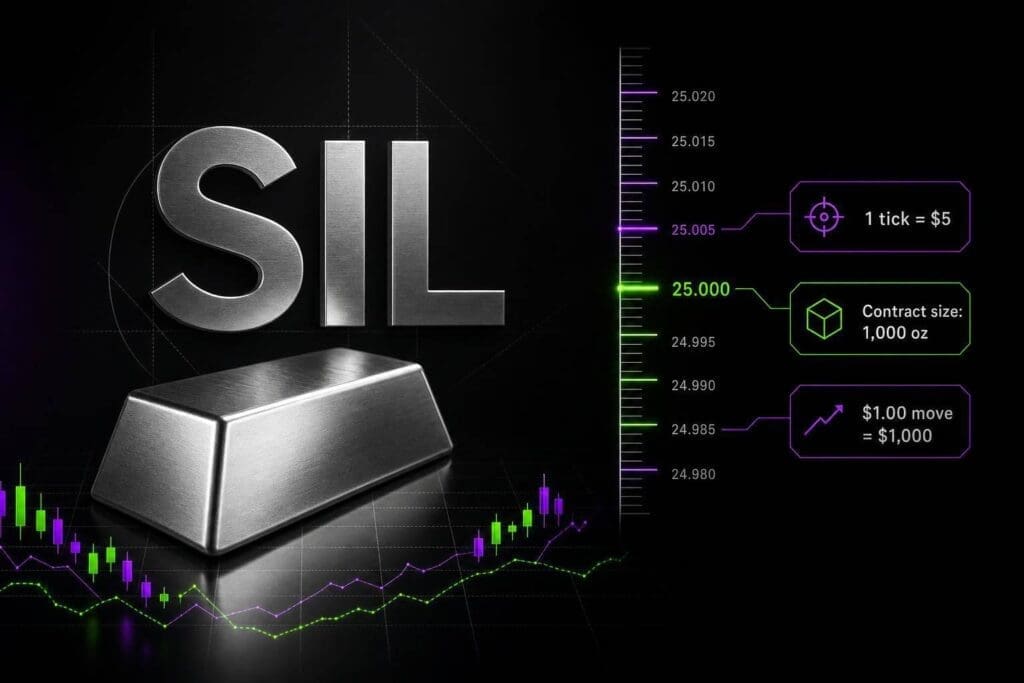
SIL moves in $0.005-per-ounce ticks, and each tick is worth $5 per contract. That’s the whole deal in one line. If you trade Micro Silver, your P&L changes in $5 steps on a 1,000-ounce contract, and a $1.00 move in silver equals $1,000.
I’ll keep this tight: the math, the contract specs, the session times, and the expiration details that matter when you’re sizing trades. If you’re trading SIL in a prop account, this is the stuff you need before you click buy or sell. No fluff. Just the numbers and what they mean for your risk.
E-Micro Gold Futures and Silver 1000oz Futures
sbb-itb-46ae61d
Introduction
SIL is CME Group’s Micro Silver futures contract on COMEX [1]. It covers 1,000 troy ounces of 0.999 fine silver, which makes it the smaller, lower-notional version of the standard 5,000-ounce silver contract [2][3].
The numbers that matter right away are simple: the minimum price increment is $0.005 per troy ounce, and each tick is worth $5.00 per contract [1][2]. If you trade this contract, those two specs shape your risk fast.
Below, we’ll get into contract size, tick value, trading hours, contract months, and what those specs mean for best futures prop firms and their risk rules. First up: the core SIL specs.
SIL Contract Specs at a Glance
Core SIL Specs
SIL is a COMEX silver contract. Here’s the quick snapshot you need before getting into the P&L math below.
| Field | Detail |
|---|---|
| Symbol | SIL |
| Exchange | COMEX (CME Group) |
| Contract Size | 1,000 troy ounces |
| Price Quotation | U.S. dollars and cents per troy ounce |
| Minimum Price Fluctuation | $0.005 per troy ounce |
| Tick Value | $5.00 per contract |
| Point Value | $1,000.00 per contract |
| Settlement | Physical delivery through warrants |
| Trading Hours | Sun–Fri, 6:00 PM – 5:00 PM ET (1-hour daily break) |
Source: CME Group contract specifications [1][2][3]
The Numbers That Matter Most for Traders
If you’re sizing a SIL trade, three numbers do the heavy lifting: tick size, tick value, and point value.
That’s what tells you how a move in silver turns into dollars in your account. A one-tick move is $5. A full 1.00 move in price is $1,000 per contract. Simple math, but you need it nailed down before you place size.
Next, the article breaks down how those specs turn into tick-by-tick dollar movement.
SIL Tick Value and Price Movement Math
How Much Is 1 SIL Tick Worth?
1 SIL tick is $5.00 per contract: $0.005 × 1,000 ounces [1][2].
That means your P&L moves in $5.00 steps on each contract. Up 1 tick, you make $5.00. Down 1 tick, you lose $5.00.
What 10 Ticks, $0.10, and 1.00 Points Mean in Dollars
| Price Move | Ticks | Dollar Value (1 Contract) |
|---|---|---|
| $0.005 (1 tick) | 1 | $5.00 |
| $0.05 (10 ticks) | 10 | $50.00 |
| $0.10 (20 ticks) | 20 | $100.00 |
| $1.00 (1 point) | 200 | $1,000.00 |
A 1.00-point move is 200 ticks, which comes out to $1,000.00 per contract [1][2]. So if you’re using a 20-tick stop, you’re putting $100.00 at risk on one contract.
That’s the part a lot of traders need to nail down fast. SIL doesn’t mess around. A few extra ticks on bad entry timing can turn into a bigger hit than you planned.
Position Sizing Examples for Prop Traders
Use a futures trading profit calculator or the dollar math to line up your SIL size with your stop and daily loss limit. Risk per contract = stop distance in ticks × $5.00.
| Stop Size | Risk per 1 Contract |
|---|---|
| 8 ticks ($0.04) | $40.00 |
| 20 ticks ($0.10) | $100.00 |
| 40 ticks ($0.20) | $200.00 |
Plain math. If your daily loss limit is tight, contract count adds up fast. Two contracts with a 20-tick stop is $200.00 at risk. Three contracts with a 40-tick stop is $600.00. That’s why SIL position sizing has to start with the stop, not with what you feel like trading.
After the math, the next thing that matters is contract months and expiration, because that decides how long you can hold that risk.
SIL Contract Months, Expiration, and Last Trading Day
Which Months Are Listed?
Once you’ve got tick value and position sizing down, the next risk issue is simple: how long can you stay in the contract without walking into expiration trouble?
SIL lists the standard silver cycle months: January, March, May, July, September, October, November, and December. On top of that, it also lists nearby monthly expiries within a 23-month window [2].
The front-month contract is usually the first one traders watch because that’s where liquidity tends to be best [3].
When Does SIL Stop Trading?
Trading ends on the third-to-last business day of the contract month [2]. SIL is physically settled, so if you’re still holding an open position into expiration, you can end up with delivery obligations for 1,000 troy ounces of .999 fine silver [1][2].
Most active traders roll before First Notice Day. That’s the clean move if you want to avoid delivery risk and the usual drop-off in liquidity as expiration gets close [2][3].
SIL Trading Hours and Exchange Details
CME Globex and COMEX Session Times

SIL trades electronically on CME Globex under COMEX, and the market is open almost 23 hours a day from Sunday evening through Friday afternoon [2][3].
| Time Zone | Session Open (Sunday) | Session Close (Friday) | Daily Maintenance Break |
|---|---|---|---|
| Eastern Time (ET) | 6:00 p.m. | 5:00 p.m. | 5:00 p.m. – 6:00 p.m. |
| Central Time (CT) | 5:00 p.m. | 4:00 p.m. | 4:00 p.m. – 5:00 p.m. |
Why Session Timing Matters for Prop Traders
Not all hours trade the same. SIL can get thin outside the busier windows, and that usually means wider spreads and more slippage. If you’re trading with a tight drawdown cap, that stuff hits fast [2].
The busiest periods are usually the London-New York overlap and the COMEX open at 8:20 a.m. ET [2]. That’s where you’ll usually get cleaner movement and less friction getting in and out.
Once you know when SIL actually moves, the next step is simple: figure out whether the smaller contract size makes more sense for your account than standard silver.
How SIL Compares to Standard Silver Futures
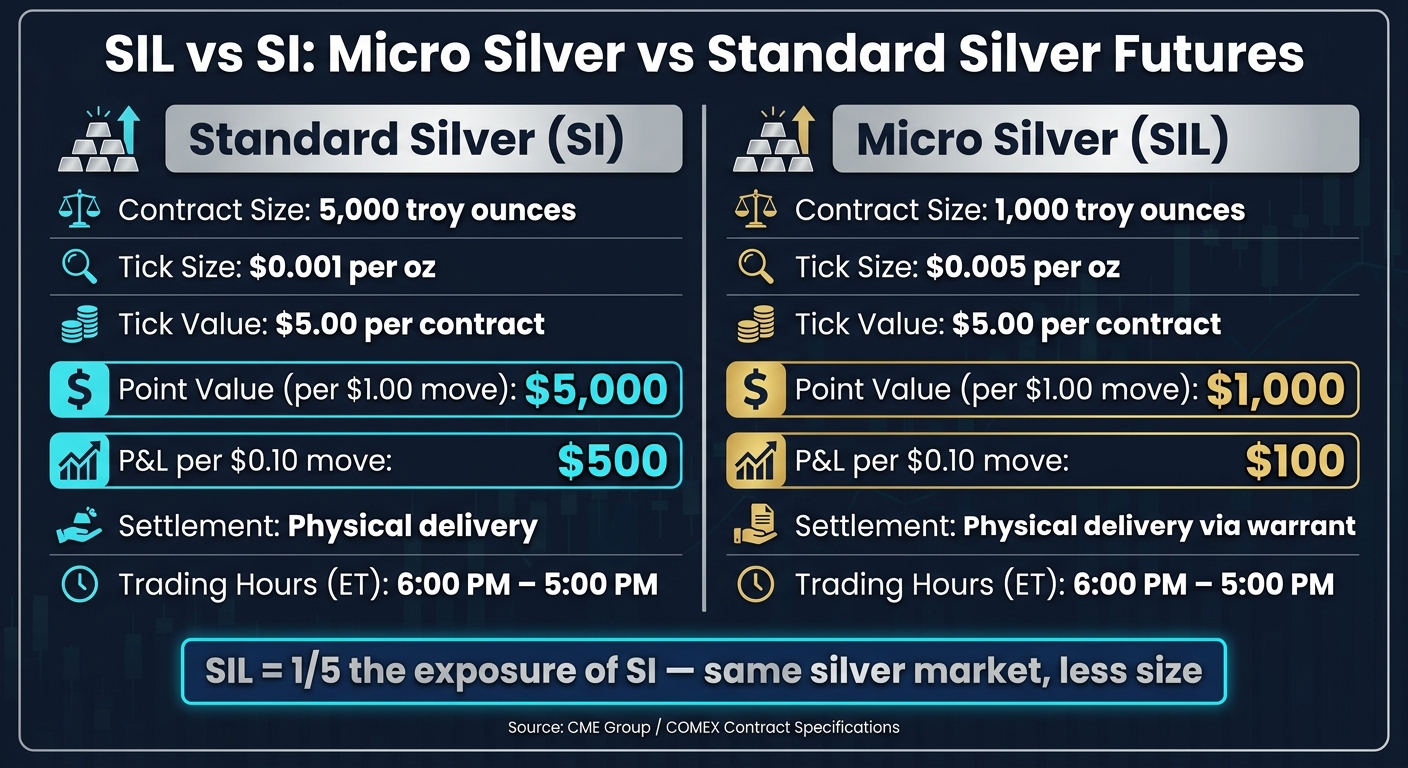
SIL vs SI Silver Futures: Contract Specs Comparison
SIL is 1,000 troy ounces per contract. SI is 5,000 troy ounces, so SIL gives you one-fifth the exposure. Same silver market. Less size. That’s the whole appeal for prop traders trying to stay inside tight risk rules.
SIL vs. Standard Silver Specs Table
The fastest way to see it is side by side:
| Specification | Standard Silver (SI) | Micro Silver (SIL) |
|---|---|---|
| Contract Size | 5,000 troy ounces | 1,000 troy ounces |
| Tick Size | $0.001 per oz | $0.005 per oz |
| Point Value (per $1.00 move) | $5,000 | $1,000 |
| P&L per $0.10 move | $500 | $100 |
| Settlement | Physical delivery | Physical delivery via warrant |
| Trading Hours (ET) | 6:00 p.m. – 5:00 p.m. | 6:00 p.m. – 5:00 p.m. |
A full $1.00 move in silver means $5,000 on SI versus $1,000 on SIL [2].
Why Traders Choose SIL Over the Full Contract
The smaller size gives you more room to work with. If silver moves $0.10, one SI contract swings $500, while one SIL contract swings $100 [2]. That’s a big deal when you’re setting stops around a daily loss limit or trying not to get clipped by normal noise. You can also use a consistency calculator to ensure your trade sizes align with firm-specific payout rules.
SIL also makes scaling a lot cleaner, especially when using a futures contract size converter to manage risk. You can add or cut size in 1,000-ounce increments instead of being forced into 5,000-ounce blocks. That makes partial exits easier, and it gives you tighter control over position size [3].
Next, use those contract specs to set stops and keep drawdown under control in a prop account.
Using SIL Specs to Manage Risk in a Futures Prop Firm Account
Once you’ve got the contract specs locked in, the next job is simple: turn SIL’s $5 per tick into actual trade risk. That’s how you keep your sizing in line with how prop firms work regarding loss limits.
Stop Placement and Daily Loss Control
Start with the daily loss limit. Then do the math from there.
If your prop firm account has a $500 daily loss limit and you’re trading 1 SIL contract, the farthest your stop can be is 100 ticks because $500 ÷ $5 = 100 ticks.
If you trade 2 contracts, that same $500 cap only gives you a 50-tick stop, since $500 ÷ (2 × $5) = 50 ticks.
Here’s the clean conversion from stop size to dollar risk:
| Stop Distance | 1 Contract | 2 Contracts | 5 Contracts |
|---|---|---|---|
| 10 ticks | $50 | $100 | $250 |
| 20 ticks ($0.10 move) | $100 | $200 | $500 |
| 50 ticks ($0.25 move) | $250 | $500 | $1,250 |
| 100 ticks ($0.50 move) | $500 | $1,000 | $2,500 |
A 20-tick stop on 5 contracts eats the entire $500 daily loss limit. No room for slippage. No second shot.
SIL’s 1,000-ounce contract size is one-fifth the size of the standard SI contract [2][3]. That smaller contract makes gap risk easier to handle when you’re trading under a prop firm loss cap.
Bottom Line on SIL Tick Value
Once you think in ticks, SIL gets a lot easier to handle inside futures prop firm rules. The whole contract boils down to one number: $5 per tick [1][2]. That’s small enough to make stop placement cleaner, and adding size one contract at a time keeps your risk defined instead of dumping a big chunk on the table.
Do the tick math before every entry. For prop traders, SIL makes the most sense when your contract count, stop distance, and account limits all line up [2][3].
FAQs
How do I calculate SIL trade risk fast?
Multiply the tick count by the dollar amount per tick. In Micro Silver (SIL), 1 tick = $5.00.
That means:
- 10 ticks = $50.00
- 1-point move = 200 ticks = $1,000.00
Those numbers are fixed, so use them when you size your position and set your stop-loss around your account’s drawdown limit. Before you place a trade, check the current contract specs.
When should I roll a SIL contract?
Roll a SIL contract before first notice day if you want to avoid physical delivery.
The move is simple: close your current contract, then open the next contract month before that date. Futures expire on fixed schedules, so don’t wing it. Check the official CME Group calendar every time for the exact expiration date and first notice day.
Is SIL better than SI for smaller accounts?
Yes. Micro Silver (SIL) is usually the better fit for smaller accounts than the standard Silver (SI) contract.
The main reason is size. SIL tracks 1,000 troy ounces, while SI tracks 5,000 troy ounces. That makes SIL much easier to handle if your account isn’t big.
Smaller contract size usually means:
- Lower margin requirements
- Better control over risk
- More room to size positions without getting boxed in
With a smaller account, that matters. You don’t want one contract eating up too much buying power or making every tick feel too heavy.