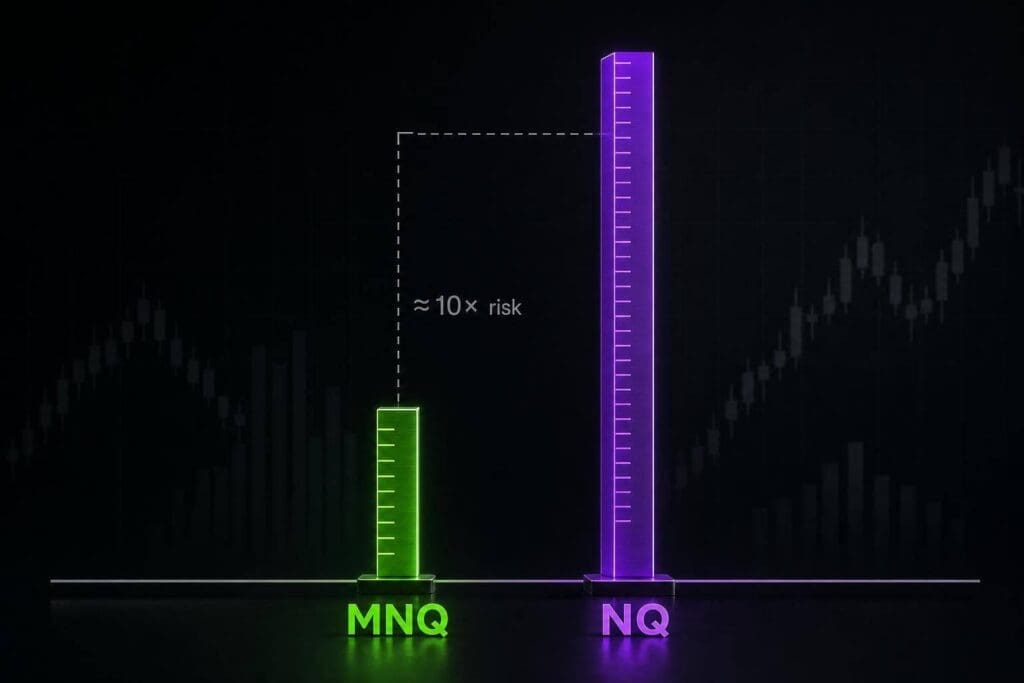
MNQ is the default pick for most funded traders. If your drawdown room is tight, NQ hits too hard, too fast. The chart is the same. The math isn’t. I’m going to boil this down to the only part that matters on a funded account: how many dollars each stop costs you, how fast you burn through a daily loss limit, and when NQ stops being dumb and starts making sense.
The short version is simple. NQ is 10x MNQ in dollar exposure. So if your position sizing still needs fine control, stick with MNQ. If one full NQ stop fits cleanly inside your risk cap and you don’t need micro sizing, then NQ is fine. That’s the whole call. You can use a futures risk management planner to calculate these costs before you enter a trade.
MNQ vs NQ: Dollar Risk Comparison for Funded Futures Traders
Introduction
MNQ is usually the smarter fit if you’re trading a funded account with Tradeify with a small drawdown buffer or you’re still tightening up discipline. It gives you finer sizing and puts less stress on your drawdown. One NQ contract equals 10 MNQ contracts [1], so every stop, every loss, and every sizing call on NQ hits with 10x the dollar weight.
NQ makes more sense when you have a bigger buffer and cleaner execution. The next sections break down how MNQ and NQ differ on tick value, notional exposure, volatility, drawdown pressure, and scaling. Next, compare the contract specs that drive the risk difference.
sbb-itb-46ae61d
What Is the Real Difference Between MNQ and NQ?
Both contracts track the Nasdaq-100. Same chart. Same price moves. The only thing that changes is the money attached to each point.
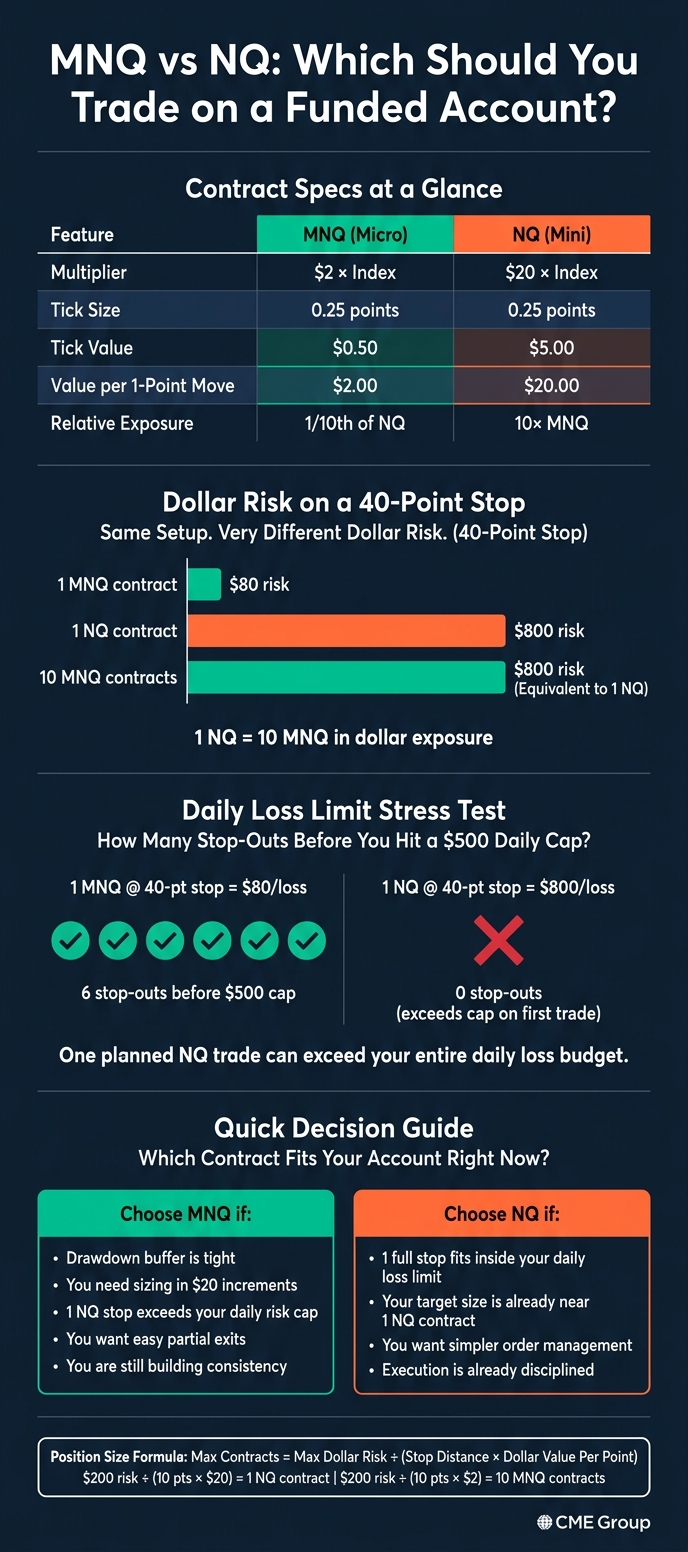
MNQ vs NQ Contract Specs Side by Side
| Feature | E-mini Nasdaq-100 (NQ) | Micro E-mini Nasdaq-100 (MNQ) |
|---|---|---|
| Symbol | NQ | MNQ |
| Multiplier | $20 × Index | $2 × Index |
| Minimum Tick | 0.25 points | 0.25 points |
| Tick Value | $5.00 | $0.50 |
| Value per 1-Point Move | $20.00 | $2.00 |
| Relative Exposure | 10× MNQ | 1/10th NQ |
| Exchange | CME Group | CME Group |
Both contracts move in 0.25-point ticks, but the payout per tick is nowhere near the same. NQ pays $5.00 per tick. MNQ pays $0.50. That 10-to-1 gap changes everything that matters: stop size in dollars, heat per trade, and how fast you can dig a hole.
The setup can look identical on the chart and still hit your account very differently.
Why 1 NQ Contract Equals 10 MNQ Contracts
NQ uses a $20 multiplier, while MNQ uses a $2 multiplier. That means 1 NQ contract equals 10 MNQ contracts in dollar exposure [1].
Here’s the plain-English version:
- A 100-point move in 1 NQ = $2,000
- A 100-point move in 1 MNQ = $200
Same market. Same move. Not the same hit to your account.
That matters a lot if you’re trading with drawdown limits. One trade on NQ can chew through a big chunk of room fast, while MNQ gives you more control over position size and dollar risk.
How Much Dollar Risk Does the Same Setup Create on MNQ vs NQ?
Once you turn points into dollars, the gap is obvious.
The Risk Formula Funded Futures Traders Should Use
Use this:
Risk per trade = stop distance × point value × contracts.
Your stop distance comes from the setup. Contracts are the part you control as you scale your funded account.
Slippage can push your actual loss above your planned risk. That hurts a lot more when each contract carries more dollar weight. MNQ keeps that hit smaller in dollar terms [1].
Example: A 40-Point Stop on MNQ vs NQ
Say the setup needs a 40-point stop. Same chart. Same stop. Very different dollar risk [1]:
| Position | Contract | Point Value | Dollar Risk |
|---|---|---|---|
| 1 contract | MNQ | $2.00 | $80 |
| 1 contract | NQ | $20.00 | $800 |
| 10 contracts | MNQ | $2.00 | $800 |
That’s the whole point. One NQ contract puts the same $800 at risk as 10 MNQ contracts. If your account has a tight drawdown buffer, NQ can chew through it fast.
Example: A 10-Point Stop and Smaller Risk Increments
Cut the stop to 10 points and the gap still smacks you in the face. 1 MNQ risks $20. 1 NQ risks $200. That $180 difference matters when you’re trying to size trades with any precision near a drawdown limit.
MNQ moves risk in $20 steps. NQ moves it in $200 steps.
So if your plan says you should risk $100 on the trade, MNQ can do that with 5 contracts. NQ can’t. It skips right past $100 and lands at $200 [1].
| Position | Contract | Dollar Risk (10-Point Stop) |
|---|---|---|
| 1 MNQ | Micro | $20 |
| 5 MNQ | Micro | $100 |
| 10 MNQ | Micro | $200 |
| 1 NQ | Standard | $200 |
That tighter sizing is why MNQ usually fits funded-account buffers better than NQ. When your room for error is small, those smaller risk steps matter.
Why MNQ Usually Puts Less Pressure on a Funded Account
MNQ’s edge is simple: better sizing control. It lets you match your contract size to the drawdown room you still have left, which is critical when navigating an Alpha Futures prop firm consistency rule or similar payout restriction. That matters a lot once you stop talking in general terms and look at one thing that hits traders in the face fast: how many losses your daily limit can take.
Trading with a Small Buffer vs a Large Buffer
If your buffer is small, MNQ gives you tighter risk steps and cleaner position sizing. NQ needs a lot more room just to handle normal Nasdaq movement without putting your account on a leash.
How Many Full Stop-Losses Fit Inside a Daily Loss Budget?
Think of the daily loss limit as a brick wall. Once you hit it, you’re done. So the only math that matters is how many losing trades that cap can absorb before the day is cooked.
Take a hypothetical $500 daily loss cap with a 40-point stop.
On 1 MNQ, that stop costs $80, so the account can take six full stop-outs before hitting the cap. On 1 NQ, that same 40-point stop costs $800, which blows past the daily limit on the first loss.
| Scenario | Contract | Dollar Risk (40-pt Stop) | Stop-Outs Before $500 Cap |
|---|---|---|---|
| 1 contract | MNQ | $80 | 6 |
| 1 contract | NQ | $800 | 0 (exceeds cap) |
That’s the whole problem on a tight account. One clean, planned NQ trade can still torch the day’s risk budget. MNQ keeps each loss smaller, so you get room for more than one setup without slamming into the limit right away.
Slippage, Fast Markets, and When Realized Loss Exceeds Planned Risk
A stop is the plan. The fill is reality.
When Nasdaq starts moving hard, slippage can turn a planned loss into a bigger actual loss. That hurts more on NQ because every ugly fill carries more dollar damage per contract. With MNQ, the hit is smaller, which makes scaling a lot cleaner and a lot less stressful.
Is MNQ Better for Scaling and Position Sizing on a Funded Account?
Once your risk per trade is set, the next step is simple: how cleanly can you scale in and out?
MNQ usually wins on funded accounts because it gives you tighter control over dollar risk. That’s the whole point here. Earlier, we looked at what each contract costs based on stop size. Now we’re looking at how easy it is to build a position and take it off without turning trade management into a mess.
Where MNQ Has the Edge
MNQ lets you size in smaller steps. You can trade 2, 3, or 5 contracts and get closer to the amount of risk your account can actually handle. That makes a difference on funded accounts, where the buffer often feels thin.
It also makes scaling out a lot cleaner. If you’re long 5 MNQ contracts and price hits your first target, you can dump 3 and leave 2 on. Clean. Simple. With one NQ contract, it’s basically all or nothing unless you’re already trading more than one mini.
That kind of flexibility matters most when your drawdown buffer is still tight.
Where NQ Has the Edge
NQ starts to make more sense when your target size is already close to one full NQ contract. At that point, juggling 10 MNQ contracts can become a pain.
You’ve got more orders to manage, more fills to watch, and more chances to screw something up when the market starts moving fast. One contract is just easier to handle. Less clutter. Less friction.
When your size is already near one mini, simplicity starts to matter more than fine-tuned sizing.
MNQ vs NQ: Granularity, Flexibility, Complexity, and Drawdown Sensitivity
| Feature | MNQ | NQ |
|---|---|---|
| Granularity | High – 1/10th the size of NQ | Low – standard unit |
| Partial exits | Easy – close any number of contracts | Requires multiple NQ contracts |
| Order management | More contracts to track | Simpler, fewer orders |
| Drawdown sensitivity | Lower – smaller risk per stop | Higher – larger dollar swings per tick |
| Better fit | Small buffers, consistency building | Traders already sized near one full mini |
One catch: don’t let micros trick you into oversizing.
MNQ only changes the contract size. Your total exposure still comes from quantity. Stack on too many micros just because margin feels lighter, and you can end up with NQ-level exposure anyway, except now you’re managing a pile of contracts on top of it.
That’s why the next step is matching contract size to your current buffer and how often you trade.
Which Contract Fits Your Funded Account Right Now?
Once you stack up stop size, drawdown pressure, and scaling funded accounts, this gets pretty simple: the right contract depends on how much buffer you have left and how tight you need your sizing to be.
After comparing contract risk, daily loss impact, and scaling, use this rule set to pick the contract.
Choose MNQ If…
MNQ fits better when your remaining drawdown buffer is tight or you need finer risk control to stay inside your daily loss limit. If 1 NQ blows past your risk cap, use MNQ.
Micros also make more sense when you need trade size to match your risk cap more closely. That extra granularity is often what keeps funded traders inside the rules.
Choose NQ If…
NQ makes more sense when one stop fits cleanly inside your daily loss limit, and your execution is already steady enough that you don’t need micro sizing just to stay disciplined. At that point, 10 MNQ can just mean more order clutter without giving you better risk control. Then check size with the formula below.
The Position-Size Formula to Run Before Every Trade
Use this before every trade:
Maximum Contracts = Max Dollar Risk Per Trade ÷ (Stop Distance in Points × Dollar Value Per Point)
For NQ, the dollar value per point is $20. For MNQ, it’s $2 [1]. Round down to whole contracts. You can also use a futures contract size converter to quickly toggle between these units.
A couple quick examples:
- At $200 max risk and a 10-point stop, NQ = 1 contract and MNQ = 10
- At $150 max risk and a 10-point stop, NQ no longer fits and MNQ = 7
Run this formula before every entry. Then compare the result against your daily loss limit and remaining drawdown. If one stop eats up too much of either, cut size or use MNQ. Run the numbers before the open.
Bottom Line: MNQ or NQ for Funded Traders?
MNQ is the default pick for most funded traders because the dollar swings are smaller, and that makes sizing a lot easier when you’re stuck with tight loss limits. That’s the whole reason the gap matters so much: NQ only makes sense when your stop size and your buffer actually fit together.
Use NQ only when one full stop sits comfortably inside your risk plan and you don’t need micro sizing. That’s the line. If one normal stop on NQ puts too much pressure on your daily loss limit or trailing drawdown, it’s the wrong tool.
Contract choice also changes your trading costs, so don’t just look at risk. Check the all-in cost before you size up. Start with MNQ, size every trade, and move to NQ only when your drawdown room and execution are there.
FAQs
How do I know when to switch from MNQ to NQ?
Switch from MNQ to NQ only when your account can handle the bigger tick value and margin hit without putting your firm’s drawdown limits in danger.
Use MNQ to build discipline and get your position sizing under control. Move to NQ only when your risk per trade and stop size still work with the larger contract’s bigger swings and heavier dollar impact.
Can trading too many MNQ contracts create the same risk as NQ?
Yes. If you size up enough Micro E-mini Nasdaq-100 (MNQ) contracts, you can take on the same risk as one E-mini Nasdaq-100 (NQ) contract.
Here’s the simple math:
- MNQ is 1/10 the size of NQ
- 10 MNQ = 1 NQ in notional exposure
- 10 MNQ = 1 NQ in dollar risk per tick
So if you trade 10 MNQ, the drawdown pressure can hit just as hard as 1 NQ. Same deal with your daily loss limit. The smaller contract doesn’t save you if you stack enough of them.
Should beginners on funded accounts start with MNQ?
Yes, generally. On funded accounts, MNQ gives you smaller size and lower dollar risk per trade than NQ.
That matters. A lot.
It gives you finer position sizing, which makes it easier to stay inside tight drawdown rules and daily loss limits. You also get more room to manage risk without every small move smacking your account too hard.
For most traders, that makes MNQ easier to handle on funded accounts. It’s a cleaner way to build consistency and discipline while working with a buffer that doesn’t feel so tight.