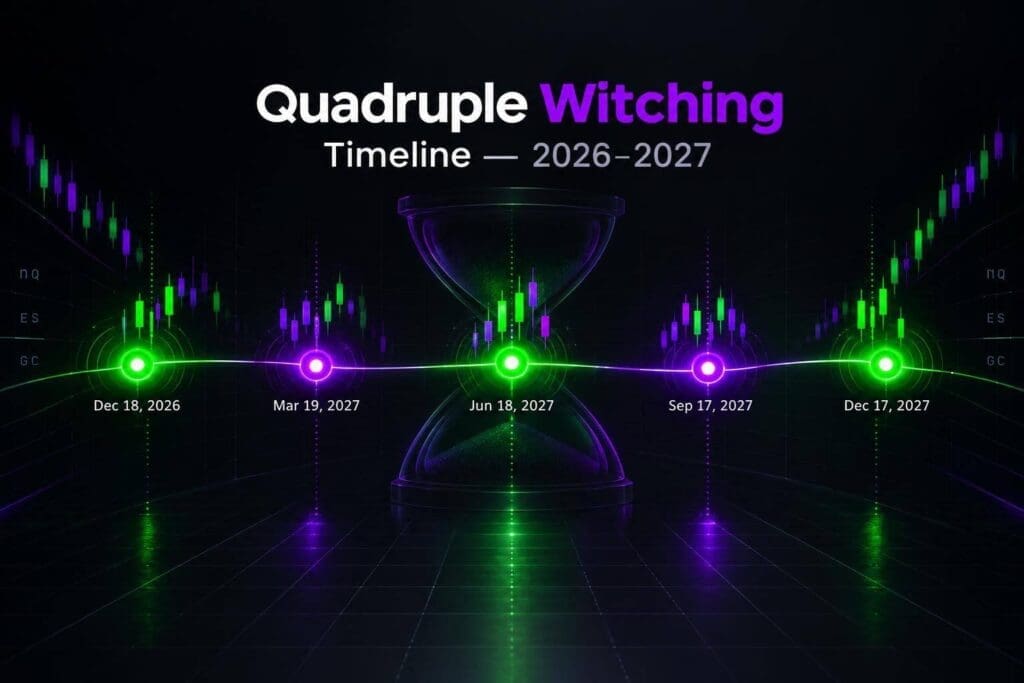
December 18 is the only witching date left in 2026. For 2027, the scheduled third Fridays are March 19, June 18, September 17, and December 17. But I wouldn’t treat those dates as automatic exit deadlines: <u>June’s Juneteenth holiday affects the expiration schedule in both years</u>.
Here’s what I want you to take away: expiration and rollover aren’t the same thing. Your contract’s last-trading time, the liquidity shift, and your TradeDay prop account’s cutoff matter more than the calendar label. I’ll break down what to check before switching contracts, so you don’t leave an old-month position or resting order behind. On ES, just 10 ticks of adverse slippage costs $125 per contract before fees. Get the month and deadline right first.
Expiration and Settlement of Futures
sbb-itb-46ae61d
2026 and 2027 Witching Calendar
Use this calendar to plan your contract switch. CME equity-index roll timing is a liquidity convention, not a hard deadline. The table shows the quarterly schedule and the contract month traders watch. See CME’s equity-index roll calendar. [1]
For futures prop traders, the headline Friday isn’t the whole story. You need to track when liquidity shifts, when to roll, and when settlement takes place.
| Year | Quarter | Contract month | Scheduled third Friday | Roll date | Adjustment note |
|---|---|---|---|---|---|
| 2026 | Q1 | March (H) | March 20, 2026 | March 12, 2026 | Standard |
| 2026 | Q2 | June (M) | June 19, 2026 | June 11, 2026 | Juneteenth holiday |
| 2026 | Q3 | September (U) | September 18, 2026 | September 10, 2026 | Standard |
| 2026 | Q4 | December (Z) | December 18, 2026 | December 10, 2026 | Standard |
| 2027 | Q1 | March (H) | March 19, 2027 | March 11, 2027 | Standard |
| 2027 | Q2 | June (M) | June 18, 2027 | June 10, 2027 | Juneteenth observed |
| 2027 | Q3 | September (U) | September 17, 2027 | September 9, 2027 | Standard |
| 2027 | Q4 | December (Z) | December 17, 2027 | December 9, 2027 | Standard |
Contract switching can change spreads, slippage, and fill quality. Use these dates for planning, then confirm your contract’s actual last-trading day and final settlement in the CME specifications. [1]
June Expirations and Juneteenth
June 19, 2026, falls on Juneteenth, so CME equity-index expirations may move to Thursday, June 18, 2026. In 2027, Juneteenth is observed on Friday, June 18. Check your contract’s adjusted last-trading day before entering or holding positions.
For E-mini S&P 500 (ES) and E-mini Nasdaq-100 (NQ), check the ES specifications and NQ specifications alongside the CME holiday notices. Record the last trading date, termination time, and final settlement separately for your prop account. [1]
Quadruple Witching vs. Triple Witching
Quadruple witching is the quarterly expiration of stock-index futures, stock-index options, stock options, and single-stock futures. In today’s U.S. market, triple witching is the better term because listed single-stock futures are largely gone.
Sharing an expiration date doesn’t mean these contracts share a trading deadline or settlement time. Index futures and options can settle on different clocks. Plan your exit around the contract specs, not the calendar label.
For traders at the best futures prop firms, the contract’s last trading time sets the expiration deadline. Check your futures prop firm reviews for exit cutoffs before holding through expiration [1]. Then check the exact CME expiration and final settlement time for the contract you hold.
CME Equity-Index Futures Expiration and Settlement
The witching date is a reference point. Your contract sets the actual trading cutoff. ES, NQ, MES, and MNQ expire quarterly and settle in cash through the Special Opening Quotation (SOQ).[1][2][3][4]
Last Trading Times and Final Settlement
On a normal quarterly expiration, these contracts stop trading Friday morning, before the cash equity close.[1][2][3][4] Don’t plan your exit around the closing bell.
The SOQ uses the opening prices of the index components. That means final settlement can differ from the live index print, which matters for both your exit timing and settlement risk.[1][2][3][4]
| Contract | Final settlement |
|---|---|
| ES – E-mini S&P 500 [1] | Cash settlement based on the S&P 500 SOQ |
| NQ – E-mini Nasdaq-100 [2] | Cash settlement based on the Nasdaq-100 SOQ |
| MES – Micro E-mini S&P 500 [3] | Cash settlement based on the S&P 500 SOQ |
| MNQ – Micro E-mini Nasdaq-100 [4] | Cash settlement based on the Nasdaq-100 SOQ |
Holiday shifts change the deadline, not just the date. Check the CME holiday calendar for holiday-shifted expirations. The scheduled third Friday isn’t always the last trading day. If the cutoff moves, move your exit or rollover plan with it.
Sources: [1] CME ES specifications; [2] CME NQ specifications; [3] CME MES specifications; [4] CME MNQ specifications.
Expiration vs. Rollover
Once you know the cutoff, decide whether to exit or roll. Expiration ends a contract; rollover moves your exposure to the next month.
| Term | What it means | What you need to do |
|---|---|---|
| Expiration | The formal end of the contract’s life. | Exit before your account’s cutoff or follow the applicable settlement rules. |
| Rollover | Moving exposure from one contract month to another. | Close your current contract position and open the next contract to stay in the market. |
CME treats the Monday before the third Friday as the customary roll window. But don’t switch on the calendar alone. Check liquidity and contract specs, plus the holiday schedule for June 2026.
Choosing the Right Contract in Your Prop Account
Compare volume, open interest, and DOM depth in the expiring and next-quarter contracts. Choose the month with stronger trading activity and enough depth for your order size. “Roll day” alone isn’t a reason to switch.
In NinjaTrader or Tradovate, check the contract month before sending an order. A continuous chart is for analysis only; it isn’t the tradable contract. Changing the month on your chart won’t move an open position. Check positions and working orders in the old month separately.
Your prop firm may enforce an earlier cutoff than CME. Verify that deadline, then confirm the contract month in your platform. Make that choice before witching week, when liquidity can shift fast.
Trading the wrong month can affect volume, spreads, slippage, and drawdown risk right away.
Preparing Your Prop Account for Witching Week
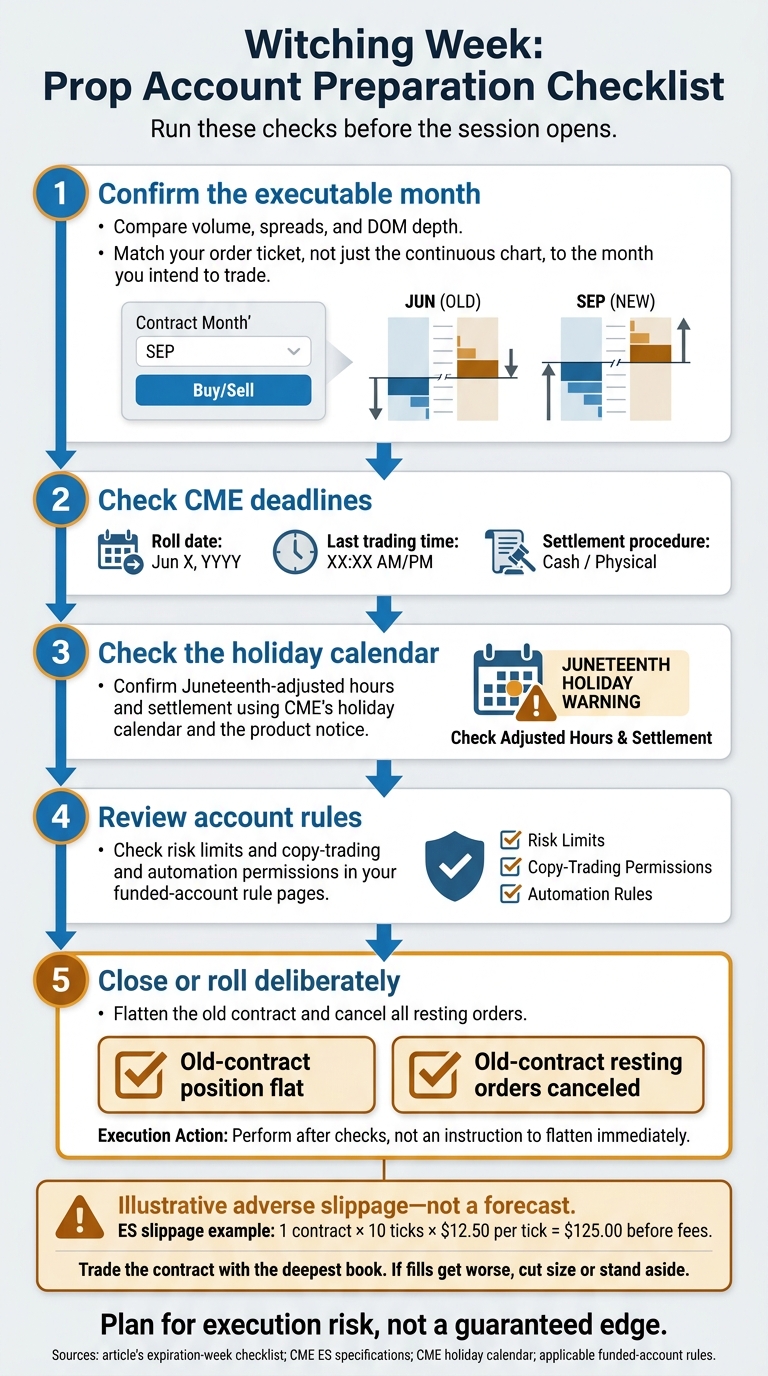
Witching Week: Prop Account Preparation Checklist
Once you decide whether to roll or hold, get your account ready for the execution window.
Plan for execution risk, not a guaranteed edge. Sync your broker, platform, and data feed. Verify copy-trading platforms and automation permissions, too. [1] The checks below help reduce execution errors during the roll window.
| Factor | Possible benefit | Risk |
|---|---|---|
| Liquidity | More depth in the active contract | Witching-week volume often comes from roll flow, not better fills |
| Volatility | More movement can create setups | Sudden spikes can hit stops or drawdown limits |
| Slippage | Deep books can help execution | Fast order flow can still leave you with poor fills |
| Contract selection | Access to the active contract’s liquidity | Check the tradable month on your ticket before sending orders |
| Settlement exposure | A defined exit window | Final settlement can differ from the last traded price |
Volume, Slippage, and Drawdown Risk
On one E-mini S&P 500 (ES) contract, 10 ticks of adverse slippage is $125.00 before fees, based on the $12.50 tick value. [1]
Trade the contract with the deepest book. If fills get worse, cut size or stand aside. Use your Position Size Calculator to protect your drawdown room.
Expiration-Week Checklist
Run these checks before the session opens.
- Confirm the executable month: Compare volume, spreads, and DOM depth. Match your order ticket, not just the continuous chart, to the month you intend to trade.
- Check CME deadlines: Record your contract’s roll date, last trading time, and settlement procedure.
- Check the holiday calendar: Confirm Juneteenth-adjusted hours and settlement using CME’s holiday calendar and the product notice. [1]
- Review account rules: Check risk limits and copy-trading and automation permissions in your funded-account rule pages. [1]
- Close or roll deliberately: Flatten the old contract and cancel all resting orders.
FAQs
How do I confirm June’s holiday-adjusted expiration?
Check the contract specifications on your broker’s website or the exchange’s official website. Trading details and holiday schedules can change. Confirm the expiration in the exchange’s official documentation or your broker’s platform guide before placing a trade.
What happens if I miss my prop firm’s rollover cutoff?
As futures contracts expire and stop trading, the firm or clearinghouse can automatically liquidate your positions. Missing the deadline to switch to the current, liquid contract can also violate your firm’s rules.
Check your firm’s help center for rollover deadlines and its forced-liquidation policy so you don’t face account penalties or have trades closed without warning.
Should I reduce position size during witching week?
Your risk plan should drive position size during quadruple witching. There’s no single rule that says you must trade smaller. Volume and volatility can increase as traders roll over or close out expiring index futures and options.
Before placing a trade, check your account balance, risk tolerance, and remaining drawdown room. Size the position to stay within those limits, with room for sharp market moves.