Interest rate futures aren’t interchangeable bets on rates. ZN, ZB, ZF, and ZT give you Treasury price exposure; SR3 prices short-term SOFR. I’ll show you how to read their quotes, turn moves into dollar risk, and size positions without confusing cheap margin with a small loss.
The math matters: 12 ticks against two ZN contracts costs $375 before fees. SR3 uses different math: a 0.25-percentage-point increase in its implied rate costs a long position $625 per contract. Same market theme. Different exposure.
My starting point is simple: <u>check dollar risk before contract count</u>. Then check DV01, remaining drawdown room, and exit deadlines. Buying power isn’t a risk budget.
Interest Rate Futures: Exposure, Tick Values, and Dollar Risk
10-Year T-Note futures fell after hawkish Fed signals. 1/28/26
sbb-itb-46ae61d
How Interest Rate Futures Work
Treasury futures move with Treasury yields. SR3 prices the expected compounded SOFR for the next three-month reference quarter.
Tick Value, Face Value, and DV01
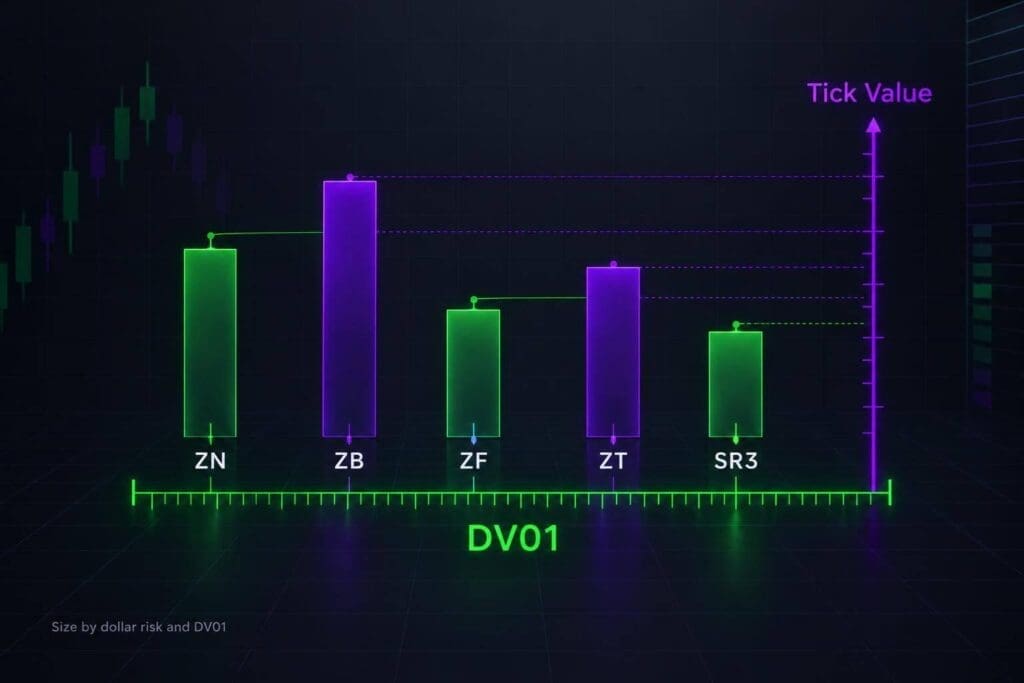
Face value sets the contract size. Tick value translates price changes into dollars. DV01 tells you how much the contract’s dollar value changes for a 1-basis-point rate move. The same number of contracts can carry very different risk.
Low day-trade margin doesn’t reduce the contract’s actual risk.
ZN is the clearest place to see how a yield move translates into dollars.
ZN: 10-Year Treasury Note Futures
ZN tracks the 10-year Treasury sector, not a single cash note. Its price generally rises when yields fall. It’s a deliverable contract, meaning the short can deliver any eligible Treasury note that meets CME rules.
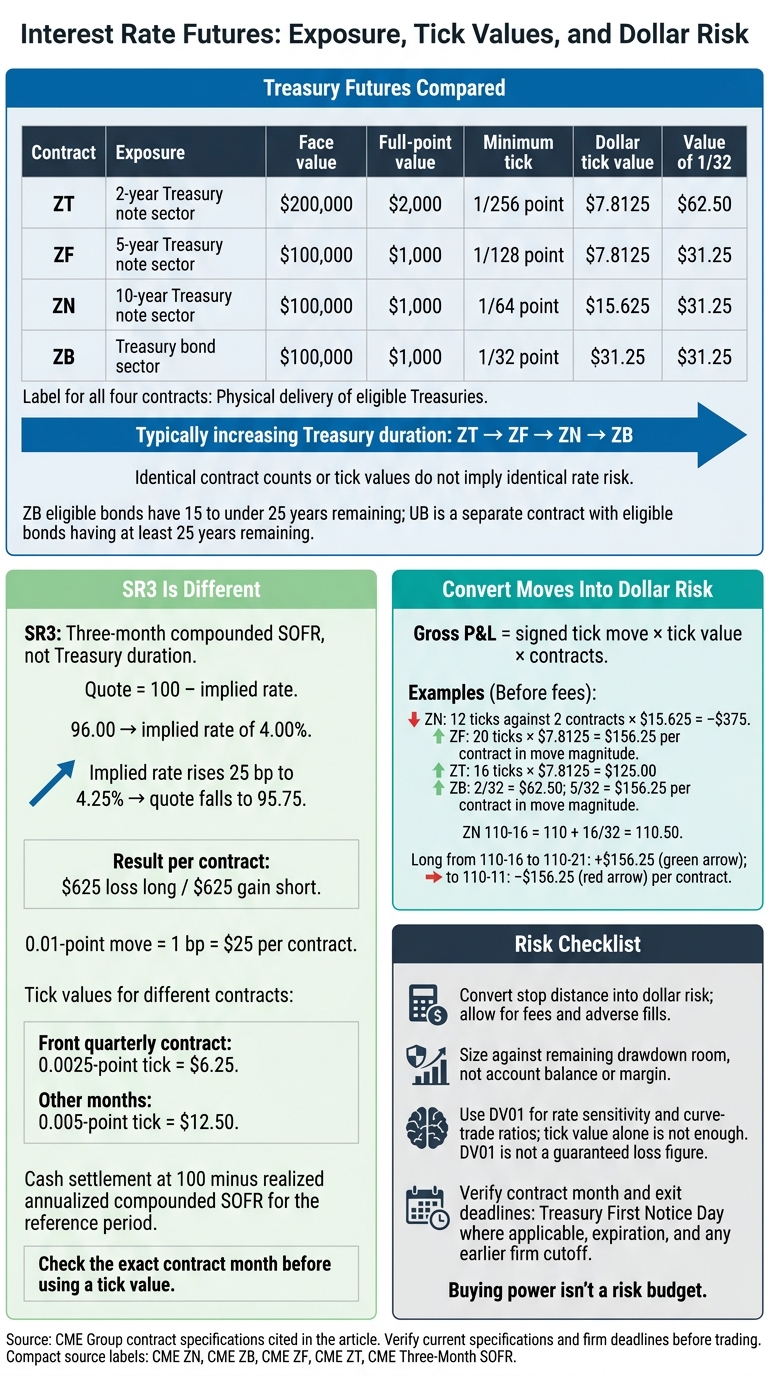
Each contract has a $100,000 face value and a $1,000 full-point value. The minimum tick is 1/2 of 1/32, or 1/64 of a point, worth $15.625, per CME Group’s ZN contract specifications.1
Reading ZN Quotes and Calculating P&L
Each 32nd is worth $31.25 per contract. Half a 32nd is $15.625.
110-16 = 110 + 16/32 = 110.50. One long contract bought at 110-16 and sold at 110-21 makes 5/32, or $156.25; sold at 110-11, it loses $156.25.
ZB uses the same quote framework for a longer-duration Treasury contract with greater rate sensitivity.
ZB: Treasury Bond Futures and Rate Sensitivity
ZB has a $100,000 face value and trades in points and 32nds. Its minimum tick is 1/32 point, worth $31.25 per contract.2 ZB is more rate-sensitive than ZN because its longer duration makes price moves larger for a given change in yield.
CME specifies physical delivery from an eligible Treasury bond basket with 15 to under 25 years remaining to maturity. UB is a different contract, with a separate eligible-bond basket: bonds with at least 25 years remaining.23
Converting ZB Price Moves Into Dollar Risk
Start with the quote, then turn the price move into dollars.
Each 1/32 = $31.25 per contract; a 2/32 move = $62.50, and a 5/32 move = $156.25.
Convert your stop distance from ticks to dollars per contract. Then size the trade so your max loss stays within your remaining drawdown.
ZF: 5-Year Treasury Note Futures
ZF trades in 1/128-point ticks worth $7.8125 per contract. CME’s 5-Year Treasury Note futures have a $100,000 face value and quote prices in points and 32nds.4
One point is worth $1,000. One 32nd is worth $31.25. ZF divides each 32nd into four ticks at $7.8125 each.
ZF gives you exposure to the five-year Treasury sector. Its rate sensitivity typically falls between ZT and ZN/ZB, making it a middle ground between ZT and ZN.
A 20-tick move equals $156.25 per contract before costs, or 5/32 of a point.
Next is ZT, with shorter duration and smaller dollar swings.
ZT: 2-Year Treasury Note Futures
ZT has the shortest duration of the Treasury note contracts in this group. Its face value is $200,000, and a full point is worth $2,000. The minimum tick is 1/256 of a point, or $7.8125. One 32nd is worth $62.50.5
A 16-tick move equals $125.00 per contract, or 2/32 of a point, before costs.
ZT sits at the front end of the Treasury curve, where Federal Reserve policy expectations and near-term data releases drive pricing. Its shorter duration means a lower DV01 than ZF or ZN, so the same yield move has a smaller effect on P&L.
Using DV01 to Set Curve-Trade Contract Ratios
For ZT–ZF or ZT–ZN curve trades, size each leg by DV01, not contract count or tick value. That keeps the trade near duration neutral. Round your contract counts, then recalculate the combined DV01. Even a DV01-neutral entry can drift as spreads move.
SR3 shifts the focus from Treasury duration to short-rate pricing.
SR3: Understanding the 100-Minus-SOFR Quote
After ZT, SR3 moves from Treasury duration to the front end of the rate curve. The quote is 100 minus the implied rate. Read it as a rate first, then convert basis points (bp) into dollars before sizing your trade.6
96.00 means 4.00%. A 25-bp rise in the implied rate cuts SR3 to 95.75 – a $625 loss long or $625 gain short, per contract.6
Rates up, price down. Each basis point translates into a fixed dollar move.
SR3 Tick Sizes and Dollar P&L
A 0.01-point move equals $25 per contract, or $25 per bp. The front quarterly contract trades in 0.0025-point ticks ($6.25). Other months trade in 0.005-point ticks ($12.50). Check your expiration before converting ticks into dollar risk.6
SR3 Reference Quarters and Cash Settlement
CME lists March, June, September, and December quarterly contracts, plus serial months. The reference quarter starts on the third Wednesday of the contract month and ends the day before the third Wednesday three months later. Trading stops on the business day before that ending Wednesday.6
Before the quarter starts, SR3 reflects expected overnight rates. During the quarter, it combines realized SOFR with expected rates for the remaining days. Part of the rate is already fixed; the rest is still an expectation. The contract settles in cash at 100 minus realized annualized compounded SOFR for that period.6
Comparing ZN, ZB, ZF, ZT, and SR3
Use this table to compare what each contract tracks, how it settles, and its relative sensitivity to rates.
| Ticker | Primary exposure | Relative rate sensitivity | Settlement |
|---|---|---|---|
| ZN | 10-year Treasury note sector | Typically higher duration than ZF/ZT; lower than ZB | Deliverable Treasury notes |
| ZB | 30-year Treasury bond sector | Typically highest Treasury duration in this group | Deliverable Treasury bonds |
| ZF | 5-year Treasury note sector | Typically between ZT and ZN | Deliverable Treasury notes |
| ZT | 2-year Treasury note sector | Typically lowest Treasury duration in this group | Deliverable Treasury notes |
| SR3 | Three-month compounded SOFR | Short-rate exposure, not Treasury duration | Cash settlement |
ZN and ZB generally carry more duration risk than ZF and ZT. SR3 tracks short rates and settles in cash. Don’t treat it as a Treasury proxy.
Check CME Group’s contract pages for exact specs: ZN, ZB, ZF, ZT, and SR3.
Next, size each contract by its dollar sensitivity.
Sizing Interest Rate Futures Positions
Before choosing your contract count, use the tick value to turn your stop distance into dollar risk.
Gross P&L = signed tick move × tick value × contracts, so a 12-tick move against 2 ZN contracts equals -$375.00 before fees. 1
Subtract commissions and exchange fees separately. Budget for slippage when planning a trade. When you calculate realized P&L from your fills, slippage is already part of the price difference. DV01 is a sensitivity guide, not a guaranteed loss figure.
Sizing Against Remaining Drawdown Room
Size against your remaining drawdown room, not your total balance. Before entering or adding to a position, check how much drawdown budget you have left. Leave room for fees, adverse fills, and existing positions. Then use a position size calculator to turn your stop distance and tick value into a contract count.
Size correlated legs as one risk bucket. CME specs define contract risk, not your account’s risk limits. After setting your size, check trading hours and rollover before holding the trade.
Trading Hours and Settlement Schedules
Know the contract’s listed months and exit deadlines before you trade. Missing a cutoff can leave you facing unwanted delivery or an account-rule violation. Treasury futures list March, June, September, and December; SR3 lists additional months. Check exact dates on CME’s product calendars after sizing your trade, so a forced exit doesn’t derail your risk plan.
| Contracts | Listed months | Settlement | Key expiration milestones |
|---|---|---|---|
| ZN, ZB, ZF, ZT | March, June, September, December | Physical delivery of eligible Treasuries | Roll or close before First Notice Day or your firm’s earlier cutoff. |
| SR3 | Quarterly and serial months | Cash settlement | Follow your firm’s earlier liquidation deadline; it may fall before CME’s last trading day. |
Contract Months, Notice Dates, and Rollover
For deliverable Treasury contracts, the cutoff matters more than the quote. First Notice Day marks a deadline you can’t ignore because of delivery risk. Size your contract risk, then check expiration deadlines before placing the trade. If your firm sets an earlier cutoff, follow it. Once those dates are clear, read the quote carefully before entering.
Interest Rate Futures Quote-Reading Checklist
Before you send an interest-rate futures order, run through these checks.
Match the contract month and year across your chart, order ticket, and broker platform. If your platform, broker/FCM, or data feed shows conflicting details, resolve the mismatch using CME’s contract details before trading. [1]
Verify the quote convention. Use CME’s current contract specifications to confirm the minimum tick and dollar tick value for the exact contract month or spread you’re trading. [1]
Check your total dollar risk. Once you’ve sized the trade, make sure the order matches your calculated risk, including commissions and exchange fees. [1]
Check your exit deadline before the session closes. Verify First Notice Day where applicable, the expiration date, and any earlier firm cutoff. Check session hours and holiday changes against CME’s trading-hours calendar. [1]
Give the ticket one last check. Before submitting, recheck the contract month, quantity, direction, and account permissions. Verify overnight-holding restrictions and any copier or automation rules. [1]
Bottom Line: Match Exposure to Position Size
Match your position size to the exposure you’re trading. ZN, ZB, ZF, and ZT are Treasury-duration trades. SR3 is a short-rate trade.
Tick value turns price moves into dollars. DV01 measures sensitivity to a 1-basis-point rate move. Use DV01 to measure rate risk, not tick value alone.
Size the position against your remaining drawdown room, not your account balance. Convert the quote into dollar risk before you enter. Low day-trade margin gives you buying power. It doesn’t control your risk.
FAQs
How do I find a Treasury futures contract’s current DV01?
The provided search results don’t show how to calculate or find a Treasury futures contract’s current DV01 (Dollar Value of a 01). For contract specifications, sensitivities, and technical data, check CME Group’s official product documentation.
Why can ZT and SR3 react differently to a Fed rate decision?
ZT and SR3 track different interest rate exposures. ZT (2-Year Treasury note) futures reflect expectations for future rates, plus the Treasury market’s broader reaction to growth and inflation outlooks.
SR3 (Three-Month SOFR) futures are tied to the Secured Overnight Financing Rate. They’re more sensitive to the Fed’s immediate target range for overnight borrowing costs and often respond more precisely to the size of a rate move.
How does rolling a futures position affect my risk?
Rolling means closing an expiring futures contract while opening a later contract month to keep your market exposure. The price gap between those contracts creates rollover risk.
In contango, the next contract costs more, so keeping the same position size may cost more. In backwardation, the roll may work in your favor. Factor both the price gap and transaction costs into your overall risk and capital exposure.