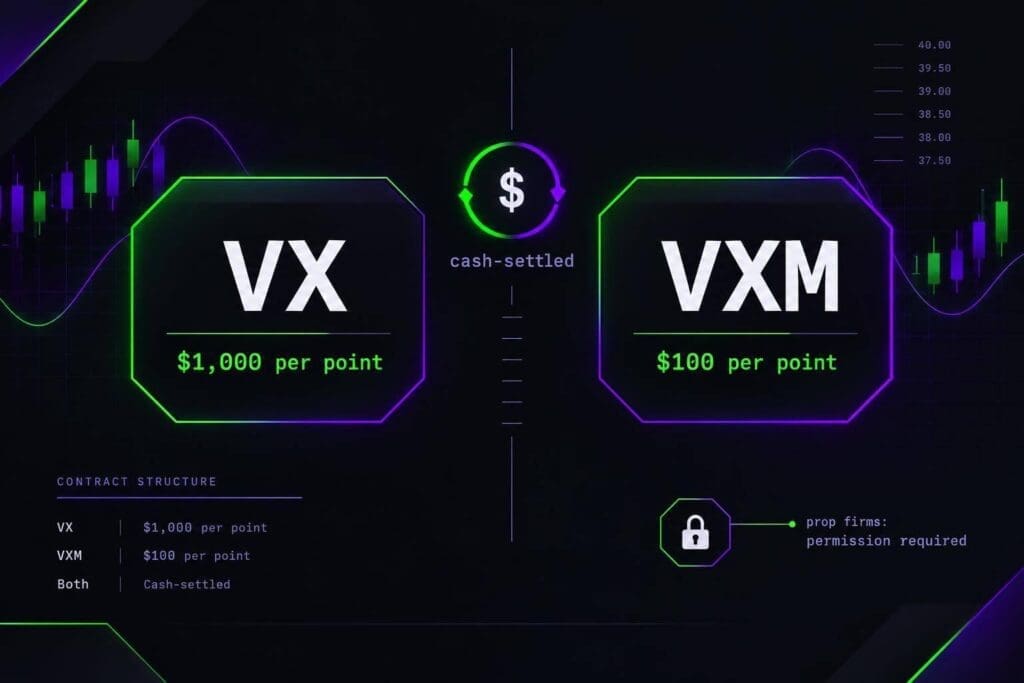
VX puts $1,000 on the line for every 1.00-point move; VXM puts $100 on the line. But neither belongs in your prop account unless the firm explicitly allows it. I’d check that permission before spending time on a trade setup. A ticker on your platform isn’t approval.
Here’s what I’ll break down: contract exposure, P/L math, expiration, and why futures prices don’t match spot VIX. VXM gives you 90% less dollar exposure per contract, not a safer volatility market. Your spread, stop distance, and remaining drawdown still matter. Check the contract. Check the rules. <u>Then size the trade.</u>
How to Calculate Profit or Loss on Futures Contracts
sbb-itb-46ae61d
What VIX Futures Track vs. Spot VIX
Spot VIX measures expected volatility over the next 30 days, based on S&P 500 Index (SPX) option prices. It’s a calculated index, not something you can buy or sell directly [2][4][5].
VX and VXM reflect the market’s expected VIX level at expiration. That’s why either contract can trade above or below spot VIX.
The gap matters when you size your VX and VXM positions using a futures risk management planner: each contract moves in fixed dollar increments.
VX and Mini VIX (VXM) Contract Specifications
VX vs. VXM: VIX Futures Contract Exposure
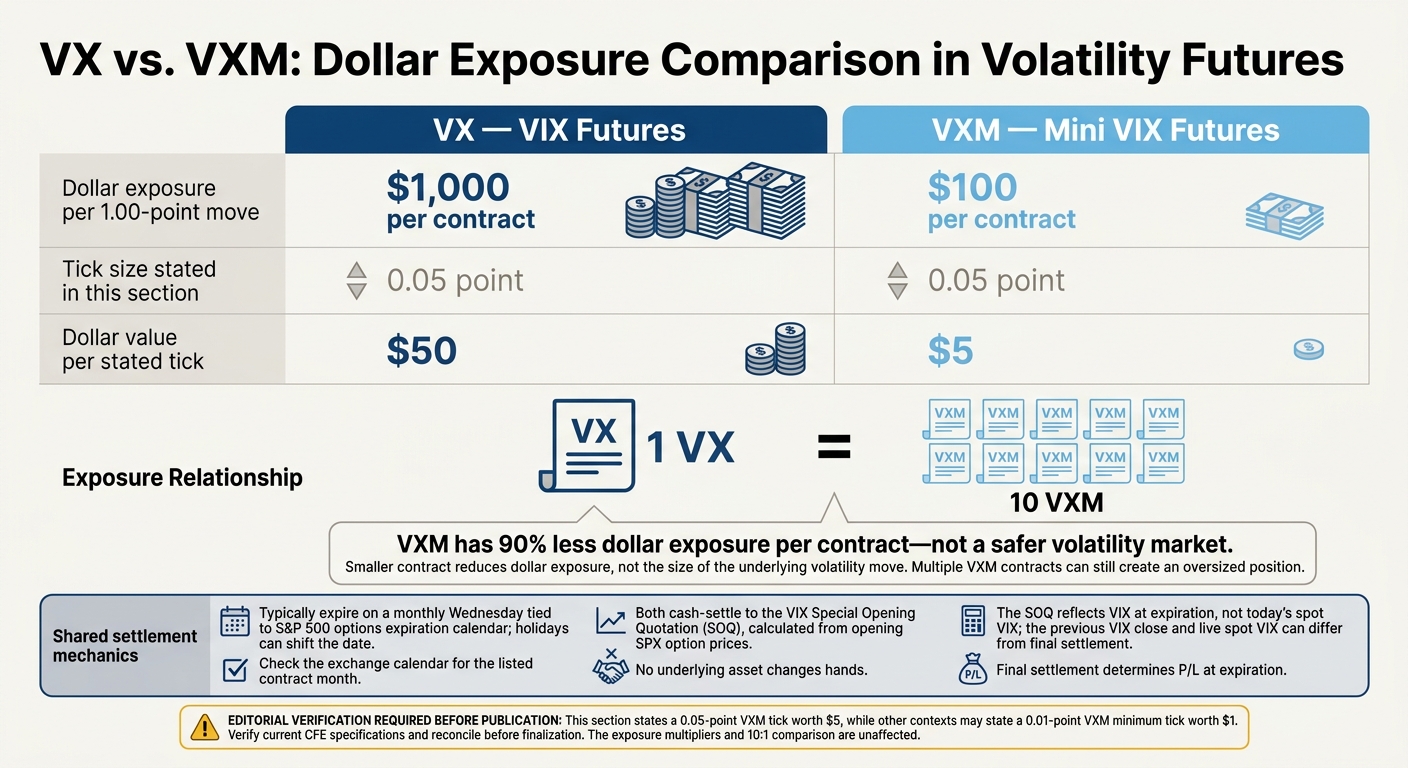
VX and VXM differ in dollar exposure, but both trade in 0.05-point ticks. VX controls $1,000 per point, making each tick worth $50. VXM controls $100 per point, making each tick worth $5.
The smaller contract cuts your dollars at risk per point. It doesn’t shrink the volatility move. Ten VXM contracts carry the same dollar exposure per point as one VX contract. You can still oversize.
VIX Futures Expiration and Cash Settlement
VX and VXM typically expire on a monthly Wednesday tied to the S&P 500 options expiration calendar. Holidays can shift that date, so check the exchange calendar for your listed contract month.
Both contracts cash-settle to the VIX Special Opening Quotation (SOQ), calculated from opening SPX option prices. No underlying asset changes hands.
The SOQ reflects VIX at expiration, not today’s spot VIX. Both the previous VIX close and live spot VIX can differ from the final settlement price. That settlement value determines your P/L at expiration.
Calculating VIX Futures Profit and Loss
Long P/L = (exit − entry) × multiplier × contracts. Short P/L = (entry − exit) × multiplier × contracts.
A VX long from 20.00 to 20.50 gains $500; a VXM long gains $50. A move to 19.50 creates the same loss. Shorts work in reverse.[1]
Each minimum tick changes P/L by $50 for VX (0.05 point) or $1 for VXM (0.01 point).[1]
Notional value isn’t margin. At 20.00, notional value is $20,000 for VX and $2,000 for VXM. Neither amount is your required margin or maximum possible loss.[1]
Size your position from your stop distance. Subtract commissions and applicable fees from gross P/L. Subtract slippage only if your fills don’t already reflect it, or you’ll count it twice.[1]
That covers single-contract P/L. VX prices also differ by expiration month because of the futures curve.
Why VIX Futures Prices Differ by Expiration
Each expiration prices a different settlement date. That’s why near-month and deferred contracts can trade at different levels.
During a volatility spike, deferred months can lag spot because traders expect the stress to fade before those contracts expire.[3]
Contango and Backwardation Examples
These illustrative prices compare months within the same contract type: VX with VX, or VXM with VXM.
Curve shape Near-month price Deferred price Typical interpretation Contango 18.00 20.00 Upward-sloping: later expirations price in more volatility and risk premium. Backwardation 20.00 18.00 Downward-sloping: near-term stress prices above later months.
Neither curve guarantees a forecast. Contango doesn’t promise VIX will rise to 20.00. Backwardation doesn’t promise it will fall to 18.00. Both reflect current expectations and risk premiums, and those can change.
Your next check is whether your best futures prop firms allow VX or VXM.
Prop Firm Permission for VX and VXM
Once you understand how VX and VXM are priced, check whether your prop firm allows you to trade them. Permission varies by firm. A contract showing up on your platform, or an order being accepted, doesn’t mean it’s allowed. Trading a restricted contract can violate the firm’s rules.
CME support doesn’t mean CFE access. VX and VXM trade on the Cboe Futures Exchange (CFE), not a CME Group exchange. Check the firm’s official supported-instruments list (for example, TradeDay’s supported assets).
How to Confirm VX or VXM Is Allowed
Look for VX and VXM separately on the firm’s official list. Also check evaluation and funded accounts separately. Permission can change between account stages.
Confirm position limits, permitted trading hours, news-trading rules, and strategy restrictions, including automation. Check that the firm provides CFE market data; a CME data bundle might not include it. Verify commissions, exchange fees, and routing fees, too.
If the rules aren’t clear, get written confirmation naming VX or VXM and your account type before placing an order. Save the reply and the relevant rules page.
Once you’ve confirmed permission, check the firm’s risk rules before trading.
VIX Futures Risk Checks for Prop Traders
Once you confirm VX or VXM is allowed, check the trade against your loss limits and risk management plan. A 1.00-point move against you costs $1,000 per VX or $100 per VXM. Calculate planned risk as stop distance × multiplier × contracts. [1]
Size against your remaining loss limit, not your account balance. Your planned loss must fit within both the remaining max loss limit and any remaining daily loss allowance. For a recap, see the drawdown concepts in our glossary. [1]
Check the bid-ask spread and order-book depth for the contract month you’re trading. Stops can slip, leaving your actual loss higher than planned. [1]
Verify current CFE session hours, daily breaks, and the contract’s last trading cutoff in Eastern Time. Use whichever comes first: that cutoff or the firm’s required flat time. [1]
Before Trading: Check Contract Details and Firm Approval
Before you place an order, check the exact contract month and current CFE specs. Confirm your data feed covers Cboe futures, then add up commissions, exchange fees, and routing charges.[1]
Check the futures prop firm’s official supported-instruments list for explicit VX or VXM approval for your account type. Seeing a ticker on your platform doesn’t mean you’re allowed to trade it. If the rules aren’t clear, get written confirmation from support first. No official approval, no trade.[1]
FAQs
Which tick size should I use for VXM?
The tick size for Mini VIX (VXM) futures is 0.05 index points. Before you set up your trading platform, check the official VXM contract specifications to confirm that tick size is still current.
Can a stop-loss keep me within prop firm drawdown limits?
A stop-loss helps control risk, but it doesn’t guarantee you’ll stay within a prop firm’s drawdown limits. Market gaps, slippage, and fast price moves can push your fill past your planned exit price.
You’re still responsible for your account balance. Set your risk controls to match your firm’s drawdown rules, and check its official help documentation to confirm those rules.
Should I close VIX futures before expiration?
Close VIX futures positions before expiration as a general rule. These contracts are cash-settled. If you hold through expiration, you receive a final cash settlement based on the VIX index, not physical delivery.
Many futures prop firms also require you to close trades by the end of Friday’s session to limit weekend risk. Check your firm’s rules for holding positions through expiration or over the weekend. Requirements vary by firm.