Tradovate is not zero-commission anymore. Your bill comes from three things: the plan, the market data, and the per-contract trading cost. That’s the only math that matters. If you trade light, the Free plan usually wins. If you trade a lot, the $99/month plan can cut your total. And if you’re using futures prop firms, data can turn into the part that hurts most, with pro rates running around $124 per exchange per month in some cases.
I’m keeping this tight. Below is the plain-English version of what moves your monthly cost, where the break-even sits, and where people get nicked by data fees.
Introduction
What you pay each month comes down to three buckets: plan, commissions, and market data. Stack those together, and you get the real number. On top of that, every trade includes pass-through exchange, clearing, and NFA fees [1][6]. If you trade through a prop firm, data fees can hit just as hard as commissions [4].
Market data is its own monthly charge. There’s no proration. If you subscribe halfway through the month, you still pay for the whole month. It also renews on the 1st [2].
Contract size changes the math fast. ES costs more per contract than MES, so the break-even point on any paid plan moves around based on your monthly volume [1][3].
Start with the plans. Then look at commissions and data. That’s where the actual cost shows up.
sbb-itb-46ae61d
Table of Contents
- What Fees Do You Actually Pay With Tradovate?
- Tradovate Plans: What Each One Includes and Costs
- Tradovate Commission Rates Per Contract
- Tradovate Market Data Fees
- Monthly Cost Estimates for Different Trader Types
- Which Tradovate Plan Fits Your Situation?
- Bottom Line
Start with the fee buckets, then move to plans, commissions, and data to build your monthly total.
First: what you actually pay.
What Fees Do You Actually Pay With Tradovate?
Tradovate costs land in three buckets: plans, commissions, and data.
The 3 Fee Buckets That Matter
Bucket 1 – Platform plan. Tradovate has three tiers: Free, Monthly, and Lifetime. These plans cut your per-side commission. They do not remove trading costs [1][3].
Bucket 2 – Per-contract commissions and transaction fees. You pay this every time you enter or exit a trade. That number includes Tradovate’s commission plus mandatory exchange, clearing, and NFA fees [1][4].
Bucket 3 – Market data subscriptions. Live data is billed monthly, and Tradovate doesn’t prorate it [2].
| Fee Category | What It Covers | How Often |
|---|---|---|
| Tradovate commission | Tradovate’s execution fee, which changes by plan | Per side |
| Exchange + Clearing + NFA | Mandatory exchange, clearing, and NFA fees | Per side |
| Market Data | Live price quotes from the exchanges | Monthly |
| Platform Plan | Optional subscription that lowers the commission rate | Monthly or one-time |
Why Contract Size and Trading Style Change the Math
This is where the math starts to matter.
The biggest split shows up when you compare standard contracts with micros. On the Free plan, an ES round-turn costs $2.58, while MES costs $0.78. On the $99/month plan, those drop to $1.98 for ES and $0.58 for MES. So you’re saving $0.60 per ES round-turn and $0.20 per MES round-turn [1].
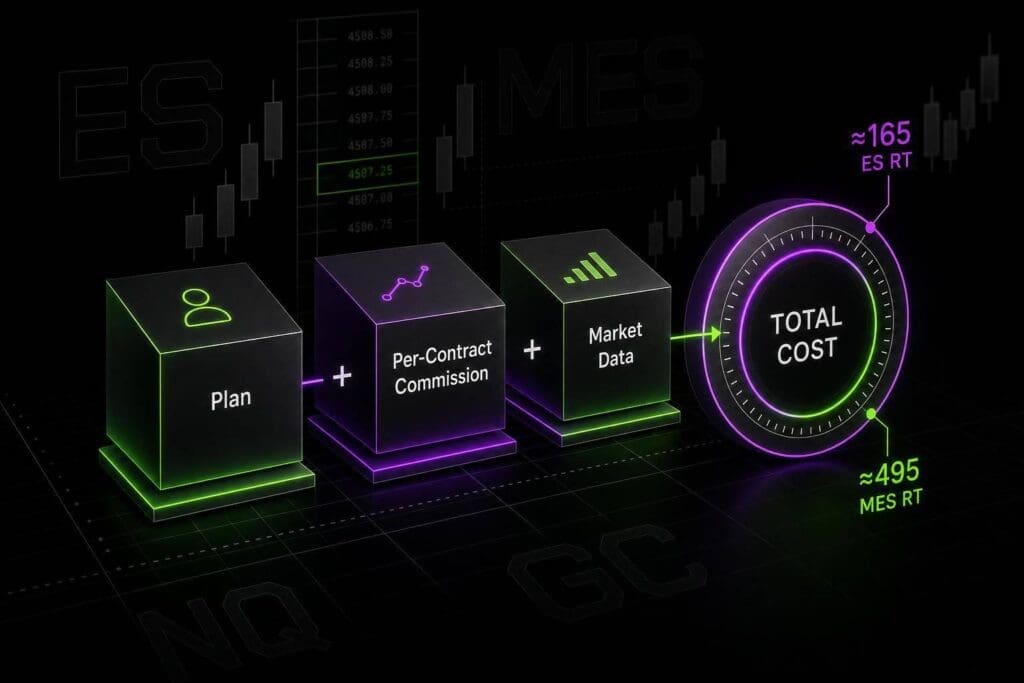
That sounds small until you stack trades. To break even on the Monthly plan, you need about 165 ES round-turns or 495 MES round-turns per month [1]. If you’re doing around 20 round-turns a day, the Monthly plan can pay for itself just from the lower commission rate [1].
Data can hit even harder than commissions. As of March 2026, CME Group started reclassifying funded prop firm traders as "Professional," and that can move data fees from about $12/month to around $124/month per exchange [4].
So yeah, plan choice matters. But contract size, trade frequency, and your data status can swing your total cost way more than most traders expect.
Next, compare Tradovate’s plan tiers, which change commission rates but not exchange data fees.
Tradovate Plans: What Each One Includes and Costs
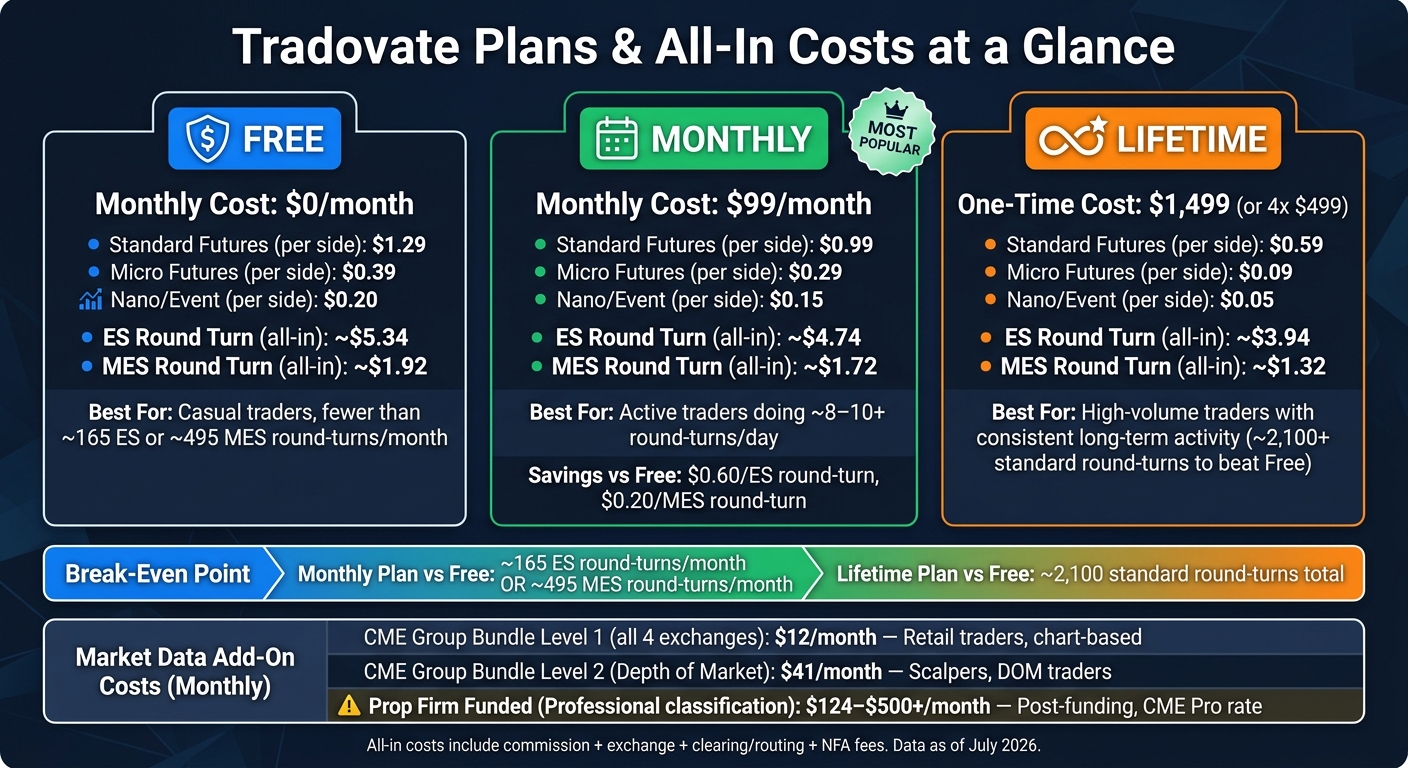
Tradovate Plans & All-In Costs: Which Plan Saves You More?
Tradovate keeps this part pretty simple. The platform access doesn’t change much from plan to plan. What changes is your commission rate. That’s it.
So when you’re picking a tier, don’t overthink the platform side. The only thing that matters is whether the lower commission rate saves you enough to cover the plan cost based on how much you trade.
Free, Monthly, and Lifetime Plan Pricing
The Free plan costs $0/month. The Monthly plan costs $99/month. The Lifetime plan is a $1,499 one-time payment, or 4 installments of $499 each [1][4].
All three tiers come with the same core platform tools. You’re paying for lower commissions, not extra platform features.
How Each Plan Affects Your Trading Costs
Here are Tradovate’s per-side commissions [1][3][4]:
| Plan | Cost | Standard Futures | Micro Futures | Nano/Event |
|---|---|---|---|---|
| Free | $0/month | $1.29 | $0.39 | $0.20 |
| Monthly | $99/month | $0.99 | $0.29 | $0.15 |
| Lifetime | $1,499 one-time | $0.59 | $0.09 | $0.05 |
This is where the math starts to matter. If you trade light, the Free plan is usually fine. If you trade a lot of contracts every month, the lower per-side rate on Monthly or Lifetime can chip away at your total cost fast.
What Plans Do Not Cover
The plan fee does not cover everything. Exchange, clearing, and NFA fees still apply on every trade no matter which tier you pick [1][2][3].
On top of the commission rate, clearing and routing charges usually add another $0.19 to $0.25 per contract [4]. So don’t look at the headline commission and assume that’s your all-in cost. It isn’t.
Tradovate Commission Rates Per Contract
The next cost driver is the per-contract rate. ES costs more than MES, and that gap starts to bite once your trade count goes up.
Rates for Standard, Micro, and Nano Contracts
Per-side commissions change by contract type and plan [1]. Standard futures like ES and NQ cost more per side than micros like MES and MNQ.
Round-turn cost is just both sides of the trade, so you double the per-side number. Here’s the clean view for standard and micro contracts [1]:
| Plan | Standard Round Turn | Micro Round Turn |
|---|---|---|
| Free | $2.58 | $0.78 |
| Monthly | $1.98 | $0.58 |
| Lifetime | $1.18 | $0.18 |
That looks cheap at first glance. It isn’t the full bill.
Exchange, Clearing, and NFA Fees on Every Trade
Base commission is only one part of what you pay. Exchange, clearing, routing, and NFA fees are what push the total higher. Those charges hit every trade no matter which plan you’re on, and no plan gets rid of them [1][2][6].
Exchange fees are about $1.18 per side for E-mini contracts like ES and about $0.37 per side for micro contracts like MES [5]. Clearing and routing fees usually add around $0.19 to $0.25 per contract [4]. The NFA fee applies to every contract side [1][6].
All-in cost per side = commission + exchange + clearing/routing + NFA.
That’s the number you should care about. Not the headline commission.
ES vs MES All-In Cost Examples by Plan
The table below shows approximate all-in costs per side as of July 2026 [1][5][4]:
| Contract | Plan | Commission | Est. Exchange Fee | Est. pass-through fees | All-In Per Side | Round Turn |
|---|---|---|---|---|---|---|
| ES | Free | $1.29 | $1.18 | ~$0.20 | ~$2.67 | ~$5.34 |
| ES | Monthly | $0.99 | $1.18 | ~$0.20 | ~$2.37 | ~$4.74 |
| ES | Lifetime | $0.59 | $1.18 | ~$0.20 | ~$1.97 | ~$3.94 |
| MES | Free | $0.39 | $0.37 | ~$0.20 | ~$0.96 | ~$1.92 |
| MES | Monthly | $0.29 | $0.37 | ~$0.20 | ~$0.86 | ~$1.72 |
| MES | Lifetime | $0.09 | $0.37 | ~$0.20 | ~$0.66 | ~$1.32 |
If you’re running a high-frequency MES setup, this stacks up fast across dozens of entries and exits in one day. That’s why plan choice and contract choice hit your monthly P&L in a very direct way.
Commissions aren’t the whole story either. Market data can add to your monthly cost even faster.
Tradovate Market Data Fees
Lower commissions don’t help if you picked the wrong data tier. Market data is a separate monthly bill, and on funded prop accounts it can get uncomfortably close to what you pay in commissions.
Live Data vs Delayed Data: Which Do You Need?
Tradovate requires live data if you want to place trades and use real-time charts or DOM ladders. Delayed data is basically view-only unless you pay for the $12.95/month Extended Simulation Membership [2].
So first, you need live data. After that, it’s a simple call: Level 1 or Level 2.
CME Level 1 and Level 2 Bundle Pricing
Tradovate offers two main data depths: Level 1 (Top of Book) and Level 2 (Depth of Market). Level 1 shows the best bid and ask. Level 2 shows the full order book depth, which matters if you trade off the DOM and care about order flow and queue depth [2].
The CME Group Bundle covers all four U.S. futures exchanges in one subscription: CME, CBOT, COMEX, and NYMEX [2].
| Data Package | Level 1 (Top of Book) | Level 2 (Depth of Market) |
|---|---|---|
| CME Group Bundle (all 4 exchanges) | $12/month | $41/month |
| Individual Exchange (e.g., CME only) | $4/month | $16/month |
| EUREX | – | $26/month |
If you’re mostly chart-based or holding trades longer, the $12/month bundle is enough. If you’re scalping off the DOM, just budget for the $41/month Level 2 bundle. That’s the cost of seeing the book you actually trade from.
For funded traders, though, the bigger issue isn’t the retail bundle price. It’s your classification.
Professional Data Rates and Prop Firm Considerations
CME now classifies funded prop traders as Professional, and that’s where the bill can get ugly. The full-bundle cost can move from about $12/month to roughly $124/month per exchange [4]. If you’re trading all four U.S. futures exchanges as a professional, data fees alone can go past $500/month [4].
Funded Tradovate accounts currently include free Level 1 CME Group and EUREX data while the account stays funded [2]. Prop firm evaluation accounts also usually include Level 1 CME data by default [2]. The pain point tends to start after funding, when CME flips you into the Professional bucket. Check that before you commit, and if you need firm-specific context, use our Best Futures Prop Firms rankings page rather than guessing.
| Trader Type | Estimated Monthly Data Cost | Recommended Level |
|---|---|---|
| Casual retail trader | $0–$12 | Level 1 Bundle |
| Active retail scalper | $41 | Level 2 Bundle |
| Prop firm (evaluation) | $0 (usually included) | Level 1 |
| Prop firm (funded, professional) | $124–$500+ | Level 1 or Level 2 |
Monthly Cost Estimates for Different Trader Types
Use these examples to get a rough read on your monthly bill. The numbers make the plan choice pretty clear once you line them up.
Occasional ES or MES Trader
If you trade 10 MES round-turns per month on the Free plan, you’re looking at $7.80 in commissions. Exchange, clearing, and NFA fees add about $5.00, and the CME Group Level 1 bundle adds $12/month. That puts you at roughly $24.80 all-in [1][2].
At that pace, the Free plan is the cheap move. The Monthly plan doesn’t break even until about 495 MES round-turns [1][3]. So if you’re only taking a handful of trades, paying for the monthly subscription just burns money.
Active ES Scalper or High-Volume Trader
Once volume picks up, the math flips.
At 200 ES round-turns, the Monthly plan comes in at about $636. That’s made up of the $99 plan, $41 Level 2 data, $396 commissions, and about $100 in fees. The Free plan lands around $657, so the Monthly plan saves about $21 [1][2][3].
That’s not a huge gap, but it shows where the crossover starts. If you’re active enough, the lower per-trade commission can cover the monthly charge and then some.
Retail Tradovate Account vs Prop Firm Setup
This part trips people up.
With a retail account, you pay the plan, data, and exchange fees yourself. Funded prop accounts often include Level 1 CME data, so don’t pay for it twice [2]. That’s an easy way to waste money for no reason.
After funding, data costs can jump hard if you’re put on professional pricing. Instead of about $12/month, you could be paying roughly $124/month per exchange. Across all four CME exchanges, that can push your total above $500/month if the firm doesn’t cover those fees [4].
Commission schedules can be different too, which means retail Tradovate pricing may not apply on the prop side [5].
Those differences are what decide which plan still makes sense once your setup changes.
Which Tradovate Plan Fits Your Situation?
Now that the fee buckets are clear, match the plan to how much you trade each month. Use the all-in costs above and pick the tier that costs you the least at your volume [1][5].
Best Fit for Casual Traders
If you only take a handful of MES or ES round-turns each week, stick with Free. Simple as that. The $99/month plan doesn’t earn its keep until your volume gets high enough to pay back that fixed monthly cost [1][3].
Best Fit for Active Traders and Scalpers
If you’re doing about 8 to 10 round-turns per day, the $99/month plan starts to pencil out. At that pace, the lower per-trade cost usually covers the monthly fee. So this isn’t a feature call. It’s a math call [1].
In prop setups, only compare the tier you’ll actually pay for. Check out our futures prop firm reviews to see how different firms handle these costs. The Lifetime plan at $1,499 is only worth a look if your volume stays high for a long stretch. Roughly speaking, it takes about 2,100 standard round-turns before it beats Free [1].
How to Think About the Break-Even Point
Break-even is simple:
monthly fee ÷ per-round-turn savings
If your monthly volume gets past that number, the Monthly plan is cheaper. If it doesn’t, Free wins.
Once you’ve got the plan sorted, the next cost to check is market data.
Bottom Line
Tradovate’s headline commission doesn’t tell you the full story. What matters is your total monthly cost: subscription fee, per-side commissions, exchange and clearing fees, NFA fees, plus market data [1][3]. So don’t get stuck on the plan name by itself. Add up commissions and data first.
Go with Free if your volume is low. Move to Monthly when the per-contract savings are more than the $99/month fee [1][3]. After that, check data pricing, because that can swing the math fast.
If CME tags you as a Professional, data can run about $124 per exchange each month [4]. That’s not a small detail. Check how futures prop firms work and whether they pay for that before you sign up [2].
Pick the plan that gives you the lowest monthly total based on your trade volume and your data status.
FAQs
What is my real monthly Tradovate cost?
Your real monthly Tradovate cost comes from three buckets:
- your account plan
- your market data subscription
- mandatory pass-through fees
The Free plan skips a monthly platform fee, but you pay higher per-side commissions. The $99 Monthly and Lifetime plans cut those commission rates.
Then there’s data. Standard retail market data runs about $12 to $41 per month. If you’re tagged as a professional user, the bill jumps hard: $124+ per exchange.
On top of that, every trade gets hit with pass-through charges like exchange fees, clearing fees, and NFA fees. Those aren’t optional, and they add up fast if you trade often.
When does the $99 plan beat Free?
The $99/month plan only makes sense when your trade count is high enough that the lower per-side commissions pay back the monthly fee.
The break-even point is about 495 micro round-turns or 165 E-mini round-turns per month. Under that, the Free plan is usually the cheaper move since you’re not stuck paying a fixed monthly bill.
Will funded traders pay professional data fees?
Usually, no. On funded accounts, the prop firm will often cover the Level I CME Group data tied to that account, so you typically don’t pay those professional data fees yourself.
If you want Level II or other exchange data, you can add those through Tradovate. One thing you shouldn’t do: buy Top of Book CME Group data for a prop firm account on your own. In most cases, the firm already has that covered, and paying twice is just dumb.
Still, check your firm’s exact data setup before you click anything. Coverage can vary.