
Meetups win for focused trade reviews. Discord wins for daily prep and access. I’d choose based on the habit you need to fix, not the crowd size or winning screenshots.
This breakdown compares both formats on feedback, distractions, accountability, and time spent. For futures prop traders, the test is simple: does the group help you follow your plan without leaning on someone else’s entries?
More chat doesn’t mean better trading. If your daily loss limit is $500, five bullish voices don’t turn it into $750. That’s a 50% increase, not confirmation.
My rule: <u>judge the process, not the platform</u>. Look for honest loss reviews, written commitments, and follow-up. Skip groups that sell confidence instead of explaining risk.
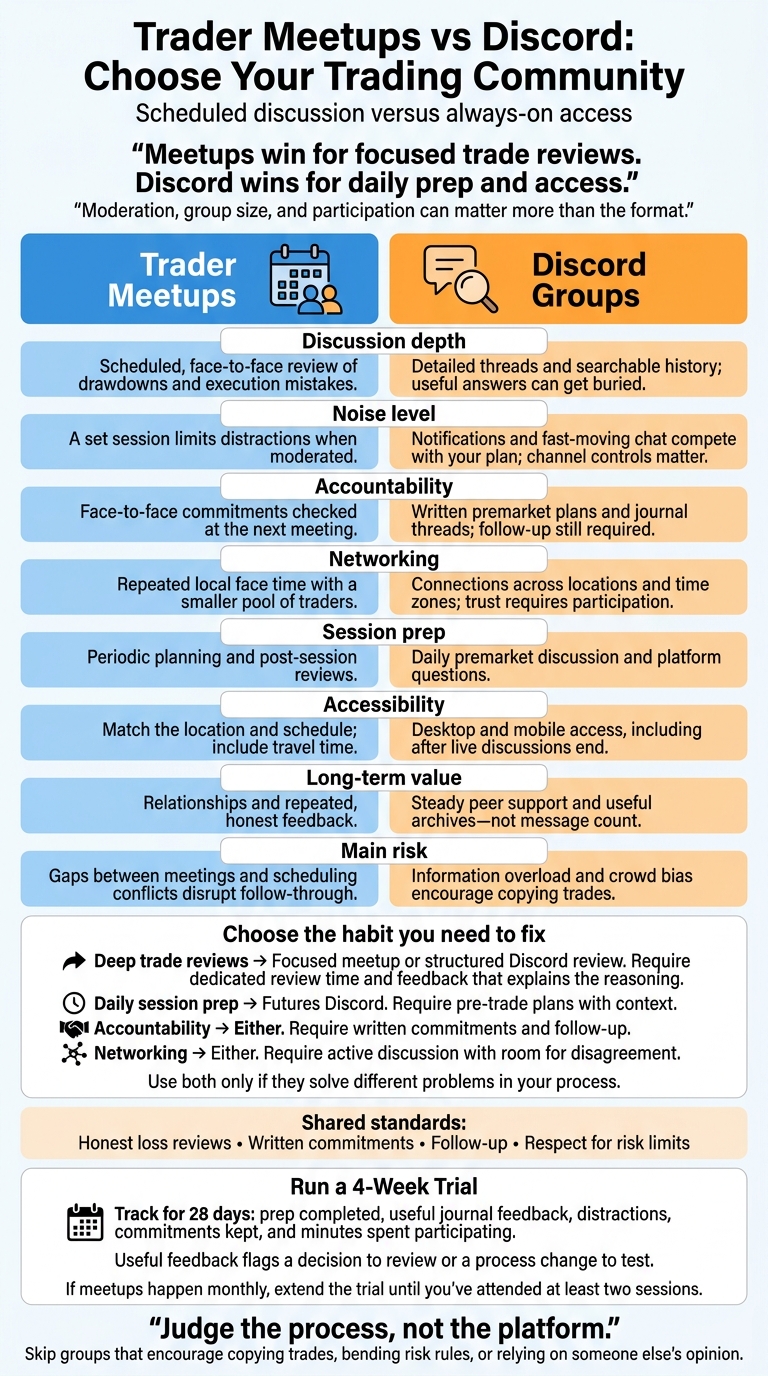
Trader Meetups vs Discord: Choose Your Trading Community
Trader Meetups vs Discord Groups at a Glance
The main split is scheduled discussion versus always-on access. Here’s how each format serves futures prop traders.
8 Differences for Futures Prop Traders
| Factor | Trader Meetups | Discord Groups |
|---|---|---|
| Discussion depth | Scheduled, face-to-face conversations leave room to review drawdowns and execution mistakes. | Threads and searchable history let traders work through detailed reviews, but useful answers can get buried. |
| Noise level | A set session limits distractions if a moderator keeps people on topic. | Notifications and fast-moving chat compete with your trading plan. Channel controls matter. |
| Accountability | Face-to-face commitments give peers something specific to check at the next meeting. | Premarket posts and journal threads leave a written record, but traders still need to follow up. |
| Networking | Local connections mean repeated face time with a smaller pool of traders. | You can connect across locations and time zones, but building trust takes participation. |
| Session prep | Better suited to periodic planning and post-session reviews than daily coordination. | Dedicated channels and live voice rooms support daily premarket discussion and platform questions. |
| Accessibility | You need to match the event’s location and schedule, then account for travel time. | Desktop and mobile access let you read messages after the live discussion ends. |
| Long-term value | Comes mostly from relationships and repeated, honest feedback. | Comes from steady peer support and useful archives, not a higher message count. |
| Main risk | Gaps between meetings and scheduling conflicts can break follow-through. | Information overload and crowd bias can pull you into copying trades without understanding why. |
Look for experienced traders who answer questions, allow disagreement, and review losing days, not just winning screenshots. Moderation, group size, and participation can matter more than the format.
Count the full cost of getting that feedback. Meetups take transportation, parking, tickets, and time away. Discord can mean a subscription plus the attention you spend filtering chat. Before joining, sit in on a few sessions. Check whether traders explain their decisions and follow up on earlier commitments.
sbb-itb-46ae61d
Trader Meetups: Strengths and Limits
Compared with Discord, meetups trade speed for deeper review and better follow-through. A meetup earns its place on your calendar only if you leave with one change to make. Scheduled, in-person review gives you room to do that. Just don’t mistake confidence for skill.[2][4]
| Meetup Feature | Potential Benefit | Limitation |
|---|---|---|
| Discussion time | Focused review of setups, journals, and execution mistakes. | Depth depends on the organizer and available time. |
| Local continuity | Repeat attendance builds trust and local relationships. | Small groups can limit outside perspectives. |
| Scheduling | A fixed appointment sets aside time for review. | Travel and personal conflicts can disrupt attendance. |
The real test is how the room reviews a losing day, not how well everyone talks markets.
Detailed Reviews and Personal Commitments
Time to talk without interruptions helps peers separate a weak setup from poor execution. Before acting on feedback, check whether the idea fits your trading plan.[2]
Put the change in writing. Record the sizing change or stop rule in your journal, then revisit it at the next meeting.[1] Hold mentors to the same standard: clear reasoning and a willingness to examine losses.[6]
Travel, Scheduling, and Attendance
Count transportation, venue fees, and all your time away from screens, not just the meeting itself. Missed meetings break continuity. A small local group might trade a different session or style, and an occasional meetup won’t help you during live trading hours.[2][4]
Before you return, ask for a written agenda covering trade reviews, risk per trade, and drawdown management. A good organizer keeps those decisions in focus and checks earlier commitments. Without that structure and a reliable core of attendees, the meeting can drift into market predictions or a social hang. That’s fine for networking, but less useful for fixing execution.[3][6]
Discord usually wins on access: you can connect right away instead of waiting for the next in-person review.
Discord Groups: Strengths and Limits
Meetups give traders time for deeper conversations. Discord keeps the discussion moving day to day.
Daily access alone doesn’t make a server useful. Judge its structure, not its chat volume. Separate channels for premarket plans, trade journals, and risk-limit reviews make feedback easier to find. Without clear rules and moderation, fast chat just means more noise.
| Discord Feature | Potential Benefit | Limitation |
|---|---|---|
| Text channels | Keep premarket plans, journal entries, and psychology discussions organized. | Advice quality varies, and busy channels bury questions. |
| Voice rooms | Support live trade commentary and immediate follow-up questions. | Scheduled calls might clash with your trading session. |
| Screen sharing | Shows chart context, order flow, and execution decisions. | Watching someone trade can tempt you to copy entries without knowing their risk plan. |
| Searchable history | Keeps past plans and reviews available for study. | Deleted posts leave gaps in the record. |
| Notifications | Flag relevant updates without constant checking. | Too many pings can trigger FOMO-driven decisions. |
Access gets you into the conversation. A well-run server gives you something to review afterward.
Daily Discussion and Remote Networking
Text channels let you post a premarket plan and review it later, regardless of time zone. Look for dedicated spaces for preparation, journals, psychology, and session reviews, rather than one endless general chat.
Written plans also give other traders something concrete to check. Did you stick to your risk cap? Did you make the change you committed to in your journal?
Voice and screen sharing help when traders explain why a setup fits their plan, where it becomes invalid, and how they control risk. The chart shows the trade; the explanation shows the process. If calls don’t fit your routine, written recaps can do more for you than a packed voice room.
Notification Noise and Groupthink
The same opinion repeated by five people isn’t five independent confirmations. Winning screenshots don’t show the losses behind them, either. And by the time an alert reaches you, the setup might already be gone. Someone else’s confidence is no reason to break your risk cap.
During active trading, mute everything except one channel you need, or mute the entire server. Look for moderators who remove spam, enforce channel rules, and challenge trade signals posted without reasoning or risk parameters, similar to the standards found in top-tier futures prop firm communities.
Before paying, watch the server for a week and read recent losing-session threads. Check for journals that include losses, entry and exit context, and follow-up, not just victory screenshots.
Session Prep and Accountability in Both Formats
Meetups put prep and review in one room. Discord keeps a daily written record. The accountability scorecard stays the same: prep, execution, review, and follow-up.
A green trade doesn’t excuse a rule break. For evaluation and funded traders, score plan adherence, not single-trade P&L.
| Routine | Meetup Approach | Discord Approach | Track |
|---|---|---|---|
| Premarket preparation | Review written plans and question the reasoning behind levels. | Post your plan in a dedicated channel before trading. | Plan adherence |
| Execution boundaries | Agree on trading hours, risk caps, and stop-trading triggers. | Record those limits, then mute distracting discussion. | Risk adherence |
| Post-session review | Bring journal entries. Start with losses and mistakes. | Keep screenshots and feedback in one journal thread. | Journal completion |
| Weekly commitments | Set one measurable change and a review date. | Pin the commitment and report progress in the weekly thread. | Weekly follow-through |
Premarket Plans and Trading Boundaries
Before trading, write down your market, key levels and the reasoning behind them, eligible setups, trading window, maximum size, per-trade risk, daily risk budget, and what invalidates the idea.
Check your account’s current constraints separately. A group checklist doesn’t replace your account rules. Don’t size up just because someone else sounds confident.
Trade Journals and Weekly Follow-Up
Log decision timestamps, planned versus actual risk, entry reasoning, exits, losing trades, and execution mistakes. During review, flag overtrading, revenge trading, sizing changes, and account-rule violations. Don’t limit the discussion to trades that lost money.
Judge each decision using the information available at the time, not what the chart showed afterward.
Track plan adherence by trade and by week. Then set one measurable fix for the next five sessions. Meetups check it in person; Discord checks it in writing.
A 30-Minute Review Agenda
Spend 5 minutes on preparation, 15 on journaled decisions, 5 on risk discipline, and 5 on next commitments. In Discord, keep the discussion in separate channels: #premarket-plans, #live-discussion, #trade-journals, #psychology, and #weekly-reviews.
How to Judge Long-Term Group Value
After prep and accountability, check whether the group still helps you make better trading decisions a week later.
Count better decisions, not chat volume or screenshots. Feedback matters when it changes how you trade and the lesson sticks after the session ends.
| Criterion | Meetup Evidence | Discord Evidence |
|---|---|---|
| Continuity | Regular attendees pick up earlier conversations between events. | Persistent channels keep discussions available between sessions. |
| Constructive feedback | Peers revisit trade reasoning and check which lessons hold up over time. | Journal discussions show whether earlier feedback helps in later sessions. |
| Follow-through | Members revisit changes and check whether they worked. | Dated threads show whether process changes stuck and helped. |
| Reusable archive | Notes and recaps make past lessons easy to use again. | Searchable threads preserve reasoning, not just alerts.[5] |
| Total time and financial cost | Count travel, fees, and prep time. | Count subscription fees, interruptions, and notification noise.[2][5] |
Group Standards, Trust, and Total Cost
Look for regular participation, clear conduct rules, room for disagreement, and disclosure of promotional incentives. Review two weeks of Discord history and find a losing session. Did members examine mistakes, or did moderators disappear or shut down questions? At meetups, check whether tough questions get the same respect as success stories.[1][6]
A free Discord group still costs attention. A free meetup still takes travel time. Neither earns a spot in your schedule if it crowds out your own prep.
Run a 4-Week Trial
For 28 days, track prep completed, useful journal feedback, distractions, commitments kept, and minutes spent participating. Only count feedback that flags a decision you can review or a process change you can test. Compare posts that explain why with posts that just announce an entry.[5]
At the end of the trial, check whether the group helps you trade without relying on it. Does the feedback stick after the session? Does it support repeatable decisions and follow-through within your funded-account drawdown constraints? If meetups happen monthly, extend the trial until you’ve attended at least two sessions.[3]
Leave groups that reward copied alerts, hype, or dependence on one personality, even if the chat never stops.[5][6]
Conclusion: Choose Meetups, Discord, or Both
Pick the format that addresses your weakest trading habit: deeper review or daily prep and access.
Match your need to the conditions below.
| Primary Need | Format to Consider | Required Conditions |
|---|---|---|
| Deep trade reviews | Focused meetup or structured Discord review | Dedicated review time and feedback that explains the reasoning |
| Daily session prep | Futures Discord | Pre-trade plans with context |
| Accountability | Either | Written commitments and follow-up |
| Networking | Discord or local meetup | Active discussion with room for disagreement |
Use both only if they solve different problems in your process. Skip any format that nudges you toward copying trades, bending your risk rules, or relying on someone else’s opinion.
Test One Community for 4 Weeks
The DGT Discord at Damn Prop Firms is one option. Hold it to the same checklist: useful feedback, honest loss reviews, and process over signals.
Pick one community and put a 4-week review date on your calendar. Check whether you complete your plans, stick to your risk limits, and think more clearly. Other members’ winning-trade posts aren’t your scorecard.
FAQs
Should I join a trading group before developing my own strategy?
A trading group can help you build your strategy through education and discussion. Focus on learning, not copying signals. For futures prop traders, well-moderated Discord groups offer daily session prep and regular support. But chat noise and herd mentality can pull you off your plan.
In-person meetups work better for deeper strategy discussions, accountability, and long-term relationships. They’re not the place for real-time trading help or platform support. Match the group to the support you need.
How can I verify a trading mentor’s credibility?
Look for a repeatable process: premarket prep, session recaps, and honest talk about losses. Meetups give you deeper feedback, room for follow-up questions, and stronger relationships. Accountability comes naturally, but it’s less consistent between meetings.
Discord groups give you faster, always-on access. Without strong moderation, organized channels, and actual session prep, though, they turn into noise and distractions. Either format can serve you long term; choose based on how much structure or flexibility you need.
What account details should I hide when sharing trade journals?
The guidance doesn’t say which account details you should hide when sharing trade journals.