Futures margin is just the cash gate to open or hold a contract. It is not your trade risk. That’s the part too many traders screw up. You can open an ES with a tiny intraday margin and still get smoked by a normal move if your account is too thin.
I’ll keep this simple: margin gets you in, tick value tells you how fast you bleed, and notional value shows how big the position actually is. If you trade ES, NQ, MES, MNQ, CL, or GC, this is the part you need to have straight before sizing anything.
Margin
sbb-itb-46ae61d
What Are Futures Margin Requirements?
Futures margin is the cash you put up to open or hold a futures contract. It is not the full notional value of the trade. That’s where leverage comes from.
Once you get that part, the next step is figuring out who actually sets the number you need to post.
Margin Is a Performance Bond, Not a Loan
In futures, you’re not borrowing money. You put up a good-faith deposit, also called a performance bond, to show you can cover losses if the trade goes against you [2][1]. The clearinghouse stands on the other side of every trade, and margin helps keep the whole system from turning into a mess if one participant blows up [2].
Who Sets Futures Margin Requirements?
Three groups shape the final margin requirement.
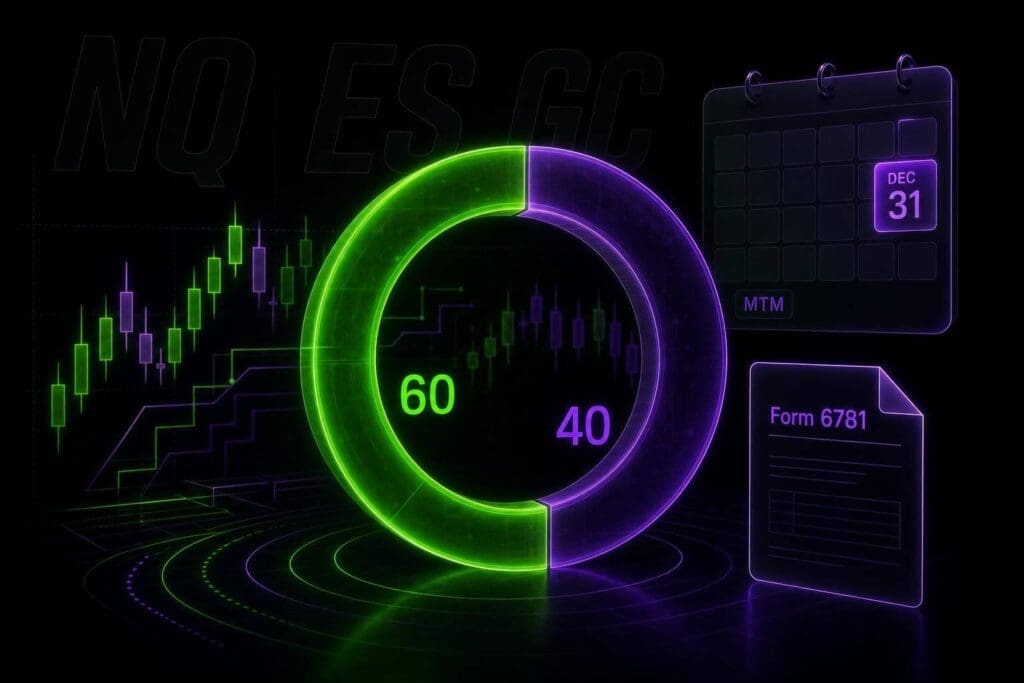
CME Group sets the baseline initial and maintenance margin for contracts like ES, NQ, CL, and GC. Those exchange minimums are fixed for positions you hold past the session close [2][5].
Then you’ve got the FCM or clearing firm. They hold customer funds in segregated accounts and make sure margin rules are enforced under CFTC and NFA oversight [2][7].
On top of that, brokers can set their own house margins. They might cut intraday margin for active day traders, or jack it up when volatility gets ugly [2][6].
| Entity | Role | Effect on Your Account |
|---|---|---|
| Exchange (CME Group) | Sets initial and maintenance margin | Defines the minimum capital required to hold overnight |
| FCM / Clearing Firm | Enforces exchange rules, holds funds | Ensures the account meets regulatory and exchange minimums |
| Broker | Sets intraday / house margin | Can discount for day trading or raise during volatility |
The posted margin number is only half the story. You also need to know how much exposure that margin is controlling.
Why Notional Value Matters
Notional value is your total dollar exposure. The math is simple: contract multiplier × market price. If ES has a $50 multiplier and the S&P 500 is near 6,000, one contract controls about $300,000 in market exposure, even if the intraday margin is only $500 [2][4].
That’s the part newer traders often miss. A low day-trading margin doesn’t make the contract safer. It just lowers the cash needed to get in. Margin tells you the entry cost. Notional value tells you the size of the beast. If you ignore one of them, position sizing gets stupid fast.
Initial Margin vs. Maintenance Margin: What’s the Difference?
Initial margin gets you into a futures trade. Maintenance margin keeps you in it. The part that matters is the gap between the two, because that’s the buffer you have before a normal move turns into a margin issue.
Initial Margin
Initial margin is the account equity needed for your order to be accepted by the order engine. The exchange sets it, and it can change when volatility picks up. It’s also the minimum required to hold the position overnight [2][5].
Maintenance Margin
Maintenance margin is the minimum account equity you must keep while the position is open. If your equity drops below that level, the broker can issue a margin call and liquidate the trade if you don’t add funds fast enough [1][2].
A one-contract example makes the difference pretty clear.
A Simple Example Using One ES or NQ Contract
Say ES is trading near 6,000. The exchange initial margin is about $15,900 per contract, and maintenance margin is about $14,400. You open one contract with $16,000 in account equity.
ES drops 30 points. At $50 per point, that’s a $1,500 loss. Your equity falls to $14,500, which is still above maintenance.
Then ES drops another 5 points. That’s another $250 loss. Now your equity is $14,250, which is below the $14,400 maintenance level. At that point, the broker can issue a margin call or start liquidating the position before the loss gets worse. So yes, you met initial margin at entry, but you still ran into trouble in the same session.
| Margin Type | Consequence If Breached |
|---|---|
| Initial Margin | Order rejected |
| Maintenance Margin | Margin call; possible liquidation |
That gap matters even more when day-trading margin and overnight margin split apart.
How Intraday Margin and Overnight Margin Work
That exchange number is the overnight baseline. Brokers can offer a much lower rate if you open and close the trade in the same session.
Intraday / Day-Trading Margin
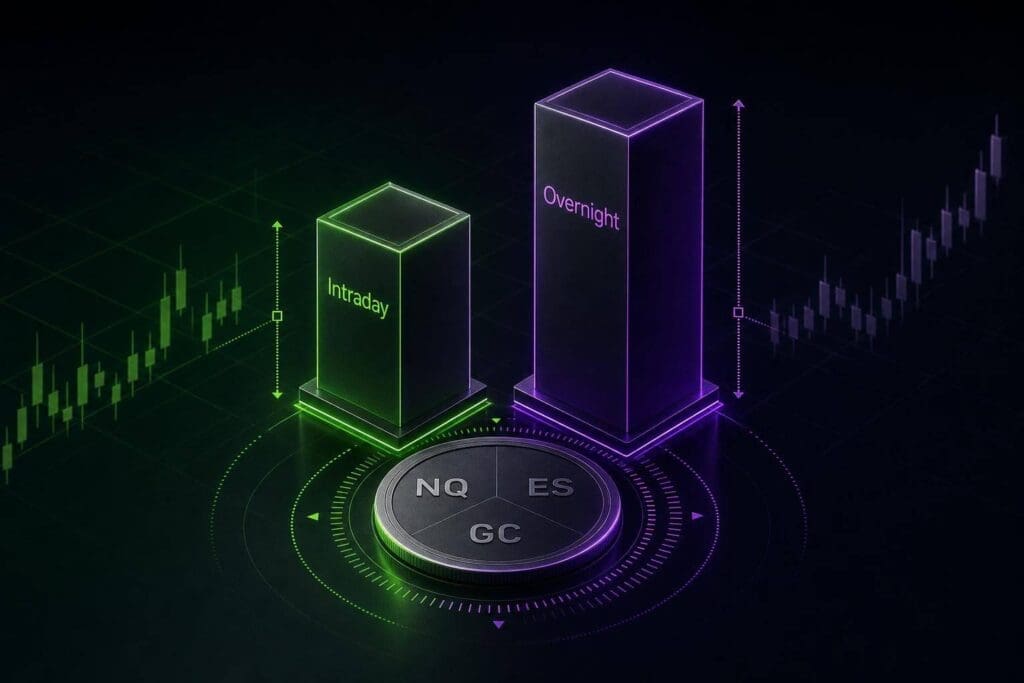
Intraday margin is a broker-set discount for same-session trades. On ES, some brokers drop intraday margin to $400–$500 per contract, while the exchange overnight number is often above $12,000 [2]. On MES, intraday margin can fall to $40–$50 [2].
That sounds cheap. It isn’t. It’s just more leverage.
Low intraday margin does not change the risk of the contract itself. A $500 ES intraday margin still controls about $300,000 in exposure [4]. If ES moves 10 points against you, that’s a $500 loss. Your full margin deposit is gone [2].
And once you hold past the session close, that cheap intraday rate is done.
Overnight Margin
Overnight margin is the exchange-set amount you need to hold a position past the close. This number comes from the exchange – CME, NYMEX, ICE – not your broker [2][5]. The whole point is to cover gap risk: price moving hard while the market is shut or when liquidity gets thin between sessions [3].
| Intraday Margin | Overnight Margin | |
|---|---|---|
| Who sets it | Broker | Exchange (CME, NYMEX, etc.) |
| What it covers | Day-trading leverage | Session-to-session gap risk |
| ES example | ~$400–$500 [2] | >$12,000 [2] |
| MES example | ~$40–$50 [2] | ~$1,200+ [2] |
That gap gets very real at the session close.
What Happens If You Hold Past the Session Cutoff?
If your account equity doesn’t cover the full overnight margin by the 5:00 PM ET cutoff, your broker can flatten the position. They may also hit you with a fee [2].
Simple rule: if you don’t have overnight margin, get out before the cutoff.
Margin Requirements for ES, NQ, MES, MNQ, CL, and GC
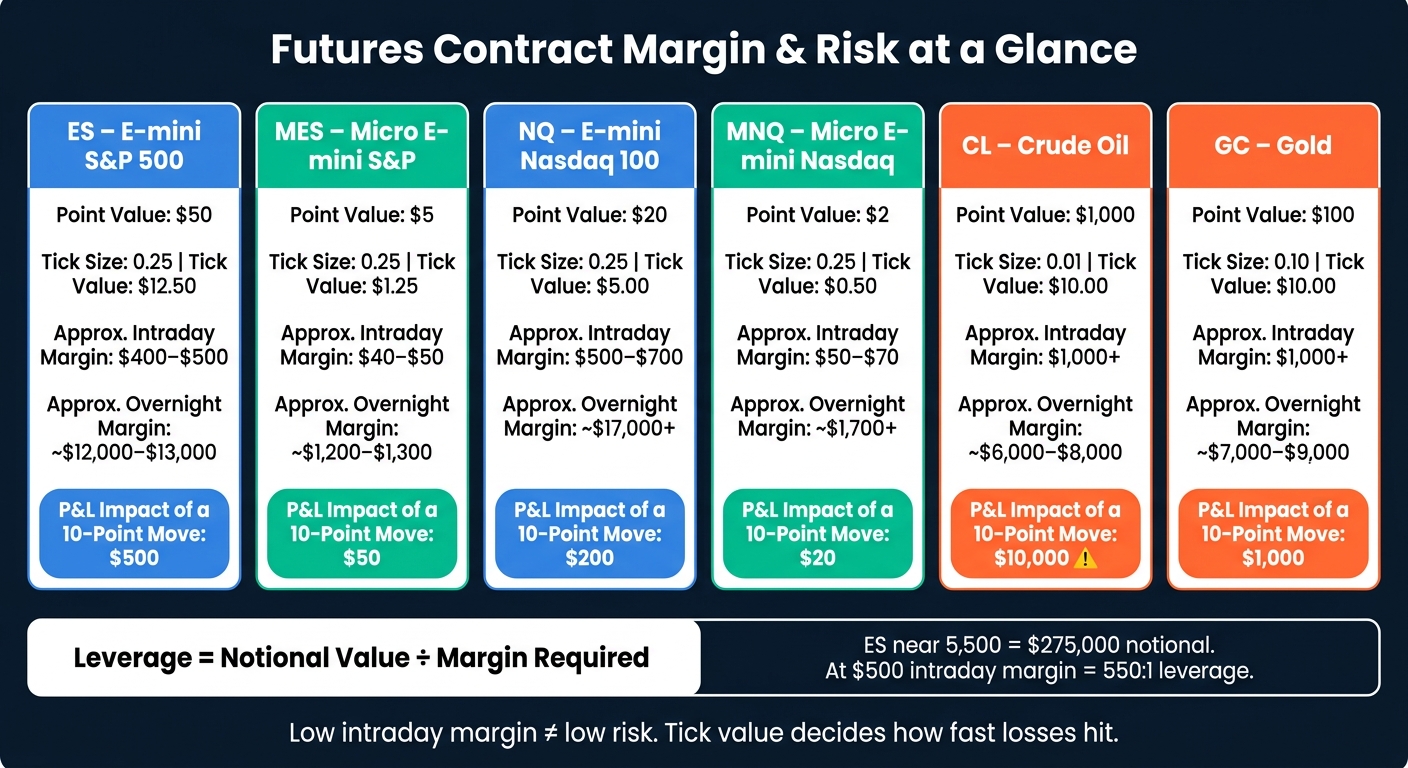
Futures Margin Requirements: ES, NQ, MES, MNQ, CL & GC Compared
These contract specs turn margin into actual dollar risk for the futures prop traders trade most.
Contract Size, Tick Value, and Leverage Compared
Each contract’s multiplier tells you how much money moves with each point. That’s what turns a margin number into actual exposure. Before you size a trade, map the contract specs to the dollars you can lose.
| Contract | Symbol | Point Value | Tick Size | Tick Value | Approx. Intraday Margin | Approx. Overnight Margin |
|---|---|---|---|---|---|---|
| E-mini S&P 500 | ES | $50 | 0.25 | $12.50 | $400–$500 | ~$12,000–$13,000 |
| E-mini Nasdaq 100 | NQ | $20 | 0.25 | $5.00 | $500–$700 | ~$17,000+ |
| Micro E-mini S&P | MES | $5 | 0.25 | $1.25 | $40–$50 | ~$1,200–$1,300 |
| Micro E-mini Nasdaq | MNQ | $2 | 0.25 | $0.50 | $50–$70 | ~$1,700+ |
| Crude Oil | CL | $1,000 | 0.01 | $10.00 | $1,000+ | ~$6,000–$8,000 |
| Gold | GC | $100 | 0.10 | $10.00 | $1,000+ | ~$7,000–$9,000 |
ES and NQ give you a lot of exposure for not much cash up front. That’s why tick value matters more than the entry margin.
ES vs. MES and NQ vs. MNQ
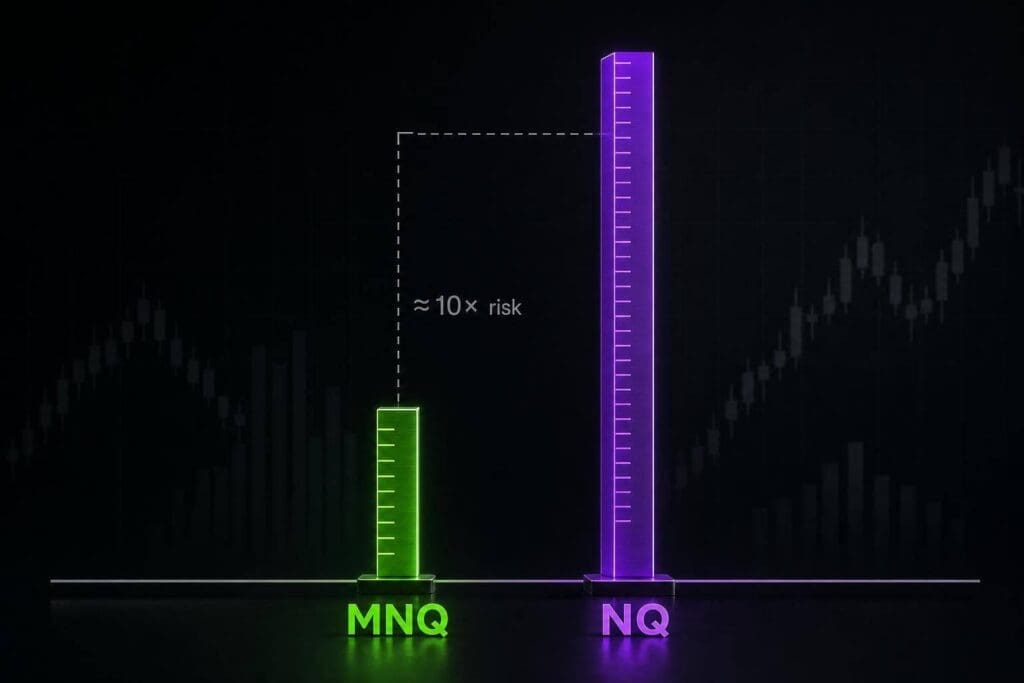
This is where sizing stops being theory and starts being useful. Micros cut dollar risk to one-tenth of the minis. MES ticks at $1.25 versus $12.50 on ES. MNQ ticks at $0.50 versus $5.00 on NQ. Same market. Same move. Ten times less dollar damage per tick.
That matters fast when you’re trading around a stop. A four-tick stop on ES costs $50. The same four-tick stop on MES costs $5.00. Big difference. You get more room for normal chop without slamming into a loss limit.
NQ also carries more intraday margin than ES, around $500–$700 versus $400–$500, because it’s more volatile [4]. If you want Nasdaq exposure without the heavier hit per tick, MNQ is the cleaner way to do it. This is a common strategy when comparing the best futures prop firms for risk management.
Why CL and GC Margin Can Feel Heavier Than Index Futures
CL and GC follow the same math, but the way they move makes the risk feel a lot heavier. Both have a $10.00 tick value, and intraday margin starts around $1,000+. That doesn’t sound wild until you do the math.
- In CL or GC, 20 ticks = $200
- 100 ticks = $1,000 per contract
That’s where traders get smacked. The margin looks manageable, but the contract doesn’t move in tiny, forgiving dollar amounts. CL is even more aggressive because its point value is $1,000. A $1.00 move in crude equals $1,000 in your account.
Overnight margin is also much higher, roughly $6,000–$8,000 for CL and $7,000–$9,000 for GC [5][6].
That’s the whole point with leverage: small margin doesn’t mean small risk.
How Futures Margin Creates Leverage
Margin lets you control a much bigger position than the cash tied up to open it. That gap is leverage. And for prop traders, that number matters because you still have to keep trades inside your drawdown rules and loss limits, and the contract’s normal movement. The basic chain is simple: margin gets you in, notional value shows your exposure, and tick value tells you how fast things can go bad. That’s why the leverage ratio matters more than the margin number by itself.
Leverage, Notional Value, and What It Costs You
Use this formula: Leverage = Notional Value ÷ Margin Required [2][5].
Notional value is the current price multiplied by the contract’s point value [3][4].
With ES near 5,500, one contract has a notional value of $275,000 ($50 × 5,500) [3][4]. If intraday margin is $500, that’s 550:1 leverage.
MES cuts the dollar exposure by 90%, but the leverage ratio stays the same when margin scales with it [6][7]. So yes, the account hit is smaller in dollar terms. The percentage amplification is not.
Tick value is where this gets real fast. It’s the piece that shows how normal movement turns into P&L damage.
| Contract | P&L Impact of a 10-Point Move |
|---|---|
| ES | $500.00 |
| MES | $50.00 |
| NQ | $200.00 |
| MNQ | $20.00 |
| CL | $10,000.00 |
| GC | $1,000.00 |
CL is the one that smacks people if they don’t respect the math, because a 1-point move is $1,000 [5][6]. So a 10-point move in crude is not $500. It’s $10,000 per contract.
Size your trades based on stop cost and account risk, not whatever margin your broker says you can get away with. Margin opens the trade. Tick value decides how fast the loss hits. If your leverage is too high for your stop distance, the next thing on deck is a margin call.
What Triggers a Margin Call or Forced Liquidation?
Once your trade burns through the gap between initial margin and maintenance margin, you’re in the danger zone. At that point, liquidation risk is immediate. If equity drops too far, the broker takes over.
Falling Below Maintenance Margin
If equity falls below maintenance margin, the broker may send a margin call or just liquidate the position on the spot to avoid a negative balance. A contract can look cheap and still be too big for your account. That’s the trap. You can use a futures trading profit calculator to model these scenarios before entering a trade.
You also might not get a warning first. The position just gets closed.
Auto-Liquidation in Fast Markets
Fast moves can wipe out your buffer before you have time to click anything. The same goes for sudden margin hikes. If losses speed up, or the market is heading into the session change and your equity can’t cover the jump from intraday margin to overnight margin, the broker may flatten the position automatically [2][6].
A lot of brokers also tack on a liquidation fee when they close the trade for you [2]. So chasing the lowest entry margin is missing the point. Buffer equity matters more.
Volatility Spikes Can Raise Margin Requirements
Exchanges and brokers often hike margin around high-impact events like CPI, jobs data, and FOMC decisions. That can turn a funded position into an underfunded one in a few minutes. Go flat before major news, and keep extra equity in the account in case margin gets bumped for a while.
That’s why position size matters more than raw margin availability.
How Futures Prop Traders Should Think About Margin and Position Sizing
Margin is what it takes to open the trade. It is not your risk. That distinction matters a lot in prop. You can have enough intraday margin to get into a position and still be way too big for your drawdown rules. You can also clear day-trade margin and get wrecked if the trade bumps into overnight margin, unless you use a swing trading prop firm that allows holding positions.
Margin Affordability Is Not the Same as Risk Affordability
A cheap ES day-trade margin doesn’t mean the trade size makes sense. It just means the door is open. That’s not the same thing as saying you should walk through it.
Start with risk. Always. Then size the trade from there.
The formula is simple: Position Size = Maximum Risk ÷ (Stop Distance × Dollar Value per Point) [3]
Example:
If your stop is 5 points on ES and you’re willing to risk $250, that’s one contract at $50 per point.
Round down to the nearest whole contract [3]. No exceptions. If the math says 1.8 contracts, your answer is 1, not 2.
Keep your per-trade risk small next to account equity. That’s the part that keeps you alive when a few trades in a row go against you.
Once you’ve got the margin-call issue sorted, the next step is dead simple: what size fits your stop and your drawdown?
When Micros Make More Sense Than Minis
A lot of traders want to trade minis because the move feels more worth it. Fine. But if one mini blows past your risk cap, then the mini is the wrong product. Period.
That’s where micros do their job.
Micros cut dollar risk by 90% compared with minis. They also let you scale risk in smaller chunks, which makes it easier to stay inside drawdown limits instead of bouncing off them.
| E-mini (ES / NQ) | Micro (MES / MNQ) | |
|---|---|---|
| Tick Value (ES / MES) | $12.50 | $1.25 |
| Tick Value (NQ / MNQ) | $5.00 | $0.50 |
| Typical Day-Trade Margin | $400–$700 [4] | $40–$70 [4] |
If your stop math says one ES contract is too much, don’t force it. Trade MES. Same idea with NQ and MNQ.
Tools and Resources to Use
Before you enter, run the numbers. Don’t eyeball it.
Use the Position Size Calculator and contract spec pages to check stop cost, tick value, and contract size before the order goes in.
Bottom Line: How Much Capital Do You Actually Need?
After the contract-by-contract math, here’s the plain answer: you need more than the minimum margin.
Minimum intraday margin only gets you into the trade. It does not give you enough room for normal heat against your position.
The actual amount you need changes with the contract and how long you plan to hold it. Your capital needs come down to three things: the contract, the hold time, and the stop size. Micros help a lot here because they cut dollar exposure and give smaller accounts more breathing room.
For prop traders, the minimum workable number is simple:
margin + planned stop risk + a small volatility buffer
If that total doesn’t fit your account, the position is too big. Period.
FAQs
How much money do I really need to trade one futures contract safely?
Trade safely by building around your risk management plan, not the bare minimum margin number. A broker might let you open 1 Micro contract with $50 or 1 E-mini with $500, but that kind of leverage can blow you up fast.
Start with your max loss per trade. Then add a buffer on top of margin so normal price swings don’t shove you into a forced liquidation. If you’re holding overnight, your account also needs to cover the higher overnight margin, not just the cheaper intraday rate.
In prop firm accounts, position size has to fit the drawdown rules. That’s the part that matters. If your size is too big for the account’s loss limits, one bad move can end the day or kill the account.
Why can I still lose more than my intraday margin on a normal move?
Intraday margin is just the minimum you need to open a trade during market hours. That’s it. It does not tell you how much you can lose.
This is where traders get burned. Futures use a lot of leverage, so a small move against you can blow past that deposit fast. Say you open 1 ES contract with $500 intraday margin. If ES moves 10 points against you, that’s a $500 loss. Your margin got you in the trade. It did not protect you.
Margin is an entry requirement, not a stop-loss.
When should I trade micros instead of minis?
Trade micros instead of minis if you’re new, running a smaller account, or you need tighter risk control. The math is simple: lower margin and smaller tick values give you more room to size trades the right way and deal with volatility without draining your account so fast.
Micros are also the better tool for building good habits. You can work on execution, stick to your plan, and iron out sloppy entries without every mistake hitting like a truck. Even if your account margin lets you hold more contracts, don’t size off minimum margin alone. Size off risk per trade. That’s the number that keeps you in the game.